Purpose over paychecks
One Georgia business tries new retention strategies inspired by the tech industry.
Employee turnover is one of the most expensive and disruptive challenges facing the skilled trades today. In a market already squeezed by labor shortages, keeping skilled employees engaged and committed is the key to running a successful business.
Turnover isn’t cheap. According to Gallup, it can cost anywhere from 50% to 2x an employee’s salary to find and train their replacement. Besides the financial burden of replacing talent, no one wants to lose a hardworking person who they have spent their time, energy and resources training.
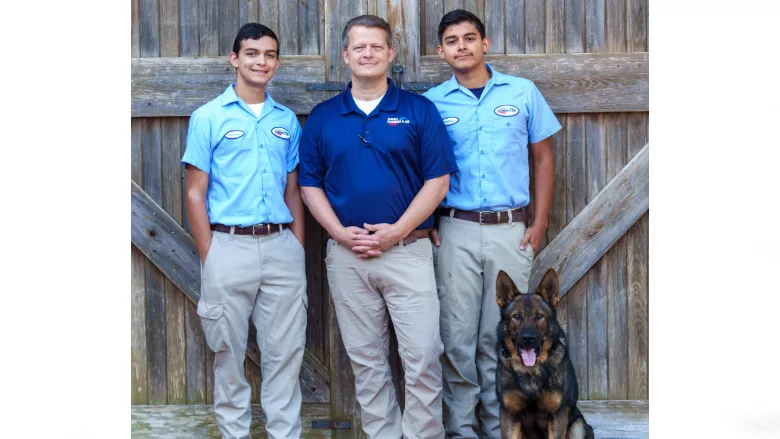
Tony Cooper, owner of Cooper’s Plumbing & Air in Bainbridge, GA, knew that retention wasn’t just about bigger salaries. He wanted to make sure that his employees understood that they were more than cogs in the machine; they were an integral part of his business, and he wanted them to create something lasting together, as a team.
Unsure of how to achieve his goals, Cooper turned to Reins. Together, they created an unique, actionable plan to give Cooper’s employees equity in the business; creating a space where they feel equal responsibility – and pride – in the business.
Co-Founder and CEO of Reins, Chris Buttenham, began thinking beyond paychecks because of his background. “I come from two different worlds,” he told us. “I came from tech myself, where stock options and equity and compensation is very, very commonplace and prolific. And, I came from another world; my dad's a contractor, and I worked for him for a number of years and saw that he lacked those same tools that I became familiar with later on.”
Oftentimes in tech companies, employees are given the opportunity to obtain equity in the company; giving them a sense of ownership in the business.
Combining his expertise in tech and his familial ties to the trades, Chris saw an opportunity: create a system that brought the equity opportunities of the tech world into the trades.
Now, that’s no easy task. According to Chris, the key is starting small. “There's usually one to three individuals where they may have already had some handshake agreement, or a back with a napkin type of agreement. ‘Hey, you know, you're going to get some equity, or you're going to get something a little different.’” He told us. That, he said, was certainly true for Tony with his right-hand man. But, it was time to bring these opportunities to the rest of the company.
“With Cooper's, their office staff/salaried management was kind of a gap in their variable compensation. Oftentimes in the trades, it's very obvious to give a commission-based structure to staff, like particularly selling staff. But, when it comes to the office staff or the management or folks that are on salary, they're often left behind beyond that type of compensation. And so, we often consult in that area and say, hey, here's an opportunity to potentially drive this one or two high-level business goals.”
For Cooper’s, it was important to include the office staff in their new equity plan. Too often, they are forgotten in the conversation. “I think a lot of people in companies feel like they’re just a number,” said Chris. “And, when you treat them a little differently, giving some skin in the game to that individual, they start to feel like a bigger component of that. I think that gives them purpose.”
That consultative perspective from Reins helps business owners like Tony Copper look at the big picture to see who is being forgotten, and how to include them.
So, how did Cooper’s Plumbing & Air use Reins’ system? They began using all of the Reins products: first being a simple bonus structure. “Each individual has some goal that they have to hit, a quantifiable goal that they have to hit. And, that is tracked and updated within the Reins app.” according to Chris. “We also can pull it in from things like QuickBooks or Service Titan and update the employees throughout the month on where they may be towards that goal. And then in the Reins app, they can see what they're tracking towards in terms of that bonus payment. So that's the simplest incentive.”
Then, they began using a quarterly profit-sharing system. “It's basically based on one overarching goal. And in this case, it's a net profit goal… If they hit that net profit goal for the quarter, it unlocks a pool of profits, which then gets shared and distributed amongst those employees in the program.” As with the other programs, these goals are tracked through the app.
Finally, the last incentive is called “alternative equity.” A phantom stock equity where, in Chris’s words, is “Where everyone got some piece of equity in the business.” To put it simply, employees get paid at a later date if the business sells.
“That will also have a directional value. So, Cooper’s will have put in a company valuation into the Reins’ application, and then that's reflected. Every time the employee logs in, they can see year after year how the value is increasing and accruing over time.”
The app also puts things in simple terms for the whole company; they even walk employees through how the system works to ensure that they completely understand. “Usually it's a singular event where we do an employee rollout, everyone's in the room, and we go through a presentation, we answer questions, and we show them what they're getting and what it means to them.”
Now, the important question: has it really helped? According to Tony, he’s felt a cultural shift. Chris told us that, “He was surprised at how many of his employees had thought about what would happen if he sold the business, and he didn't really anticipate that.”
The shift was quick: even during the initial employee rollout, Chris was told how impactful this new system was; many even said that it impacted their family. “They could go to their wife and say, I've got a real stake in this business. And that's a big thing for these folks.”
To other business owners looking to reevaluate how they look at ways to keep their employees happy, Chris believes that the biggest factor is simple: team culture. “I'm not going to pretend that incentives are some silver bullet; I'd like to tell the truth. You can't fix high employee attrition without first looking at team culture.” Incentives, like the ones that Reins uses, are “a very low cost way to be able to give someone something special that not only they're going to intrinsically value, but one of the things I always say with incentives is it's not an entitlement.”
“If you give an incentive, that incentive only gets paid if the business also wins. So it creates this win-win and what I think is a very respectful relationship between company and employee.”
Employee retention in the trades will never depend on pay alone. As the labor market continues to tighten, forward-thinking contractors are realizing that culture, purpose and shared success play just as important a role. Programs like those offered by Reins give contractors a framework to make employees true stakeholders; in both the company’s future and their own.
For Cooper’s Plumbing & Air, that shift meant more than a new compensation structure; it meant a renewed sense of pride and unity. And for the industry at large, it’s a reminder that investing in people is not just about keeping them on the payroll — it’s about giving them a reason to stay for the long run.
Looking for a reprint of this article?
From high-res PDFs to custom plaques, order your copy today!