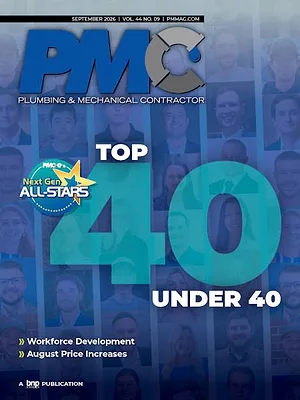
In the March 2026 issue of Plumbing & Mechanical we introduce ten influental women in the industry. New system platforms are redefining maintenance. Discover how code literacy is the contractor’s best advantage. Apply right-sizing strategies for residential plumbing systems. Also, our monthly columns, new products, and more.
Check back throughout the month for additional content.
Sensorization, analytics, and service model transformation is changing the way that contractors react to, and are able to prevent, disruptions of service.
In a data-informed environment, plumbing and mechanical systems become managed infrastructure — visible, measurable and continuously optimized. Contractors who embrace that reality position themselves not simply as technicians, but as long-term asset stewards in an increasingly performance-driven built environment.
Codes are expanding into areas like resilience, electrification, water quality management and long-term accountability. No longer are they static rulebooks; they’re living frameworks shaping how systems perform over decades.
The conversation has clearly moved beyond connectivity for connectivity’s sake, and into something more actionable; and, with new expectations for energy-efficient and low-carbon systems, more necessary.
The next era of the trades won’t be dominated solely by the most prominent brands or the loudest marketers. It will be shaped by operators who understand efficiency, protect their margins, and invest in genuine relationships.
A common plea during the recent bitter cold spell: no heat, frozen pipes, frozen underground water service line and sewer lines, too! But, there’s always at least one issue homeowners never expected - running out of hot water when they haven’t had that problem previously.
Although lower flow rates and higher energy factors remain central, the bills pending in Arizona, Illinois, Massachusetts, Pennsylvania and Virginia reveal a more profound structural shift.
When comparing hydronic systems designs that are common in North America with typical European equivalents, comparisons reveal details that would be beneficial in either market, but are not “traditional” in one market or the other.
Figure 1 shows a hydronic system that’s intended to supply four panel radiators, each with their own thermostatic radiator valve and an indirect water heater from a gas-fired sectional cast-iron boiler. The system is designed using primary/secondary piping. The primary circulator operates whenever the space heating load or the indirect water heater call for heat.