
How inspection technology is transforming drain work
Advances in camera systems are helping contractors reduce uncertainty, limit excavation and win more business.
Even just 30 years ago, there were no video pipe inspection systems. If a contractor wanted to know, with certainty, what was going on in a pipe, they had to dig it up. Things began to change in 1996 as cameras gained widespread acceptance.
Those early versions of pipe inspection systems used huge, bulky black-and-white cameras that lacked self-leveling features, yet they quickly revolutionized the drain-cleaning field. They took away the guesswork, making the diagnosis process much clearer and more professional. They also gave contractors options they never had before. For example, if a contractor found a dip or belly in the pipe that needed to be replaced, they could pinpoint the start and end of the subsidence, allowing them to limit trenching damage to lawns, yards, and parking lots. They could also determine the pipe's depth, giving them a better idea of what tools they needed to complete the job. Camera systems gave plumbers and drain cleaners the ability to see exactly what was happening inside the pipe, enabling them to plan accordingly.
A powerful sales and marketing tool
It wasn't long before contractors realized that, in addition to being a tremendous diagnostic device, camera systems were a very effective marketing tool. This recognition revolutionized the sales process for pipe-replacement and pipe-relining jobs, two of the most lucrative aspects of the drain-cleaning industry. Contractors also discovered that showing before-and-after videos made it much easier to sell preventive maintenance contracts of all kinds. Because of these and other discoveries, contractors realized that video pipe inspection systems were capital investments that could pay for themselves very quickly.
Seeing is believing for customers
Imagine that you were a homeowner who had enlisted a plumber to open a clogged drain. You were expecting a $99 charge, but instead the contractor came back with a pipe replacement estimate totaling thousands of dollars. The fact that the plumber could show you a real-time picture of your collapsed pipe will make it much more likely that you would understand the seriousness of the problem and do the right thing. Or, imagine that you own a fast-food restaurant that had to close down on a Saturday night because of a backed-up sewer line. If the drain-cleaning company could show you a before-and-after video detailing the effects of cleaning the drain with a high-pressure water jetter, showing the pipe transforming from clogged to like-new, you would be much more likely to enlist their services for a preventive maintenance plan.
Turning visuals into revenue
A common expression says that a picture is worth 1000 words. However, in the drain-cleaning industry, you could say that a picture is worth 1,000 dollars! Because of the widespread acceptance of this fact, manufacturers prioritize the inclusion of recording systems in all modern pipe inspection systems. The ability to show a home or business owner still or video recordings of the condition of their pipe has become a standard part of the selling process in pipe replacement, pipe relining, and pipe patching operations throughout North America.
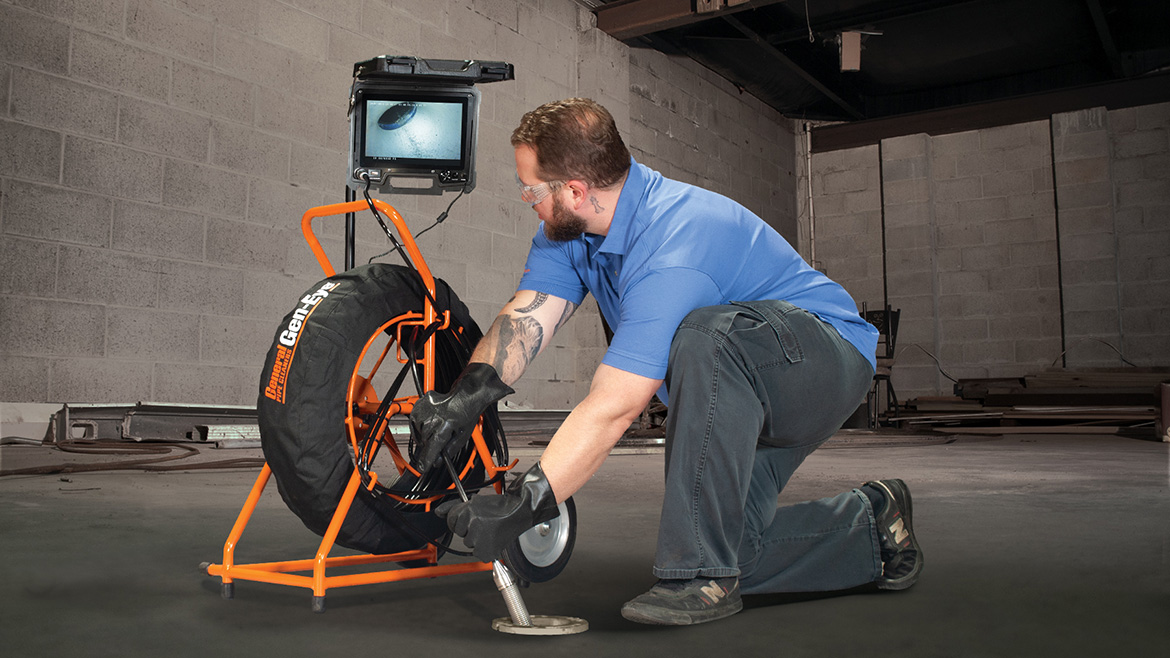
General Pipe Cleaners’ Gen-Eye Fusion™ video pipe inspection system combines a high-quality, high-definition (high-def) camera with three ways to record, a touch screen keyboard for titling, Gen-Pack™ battery adapter for remote operation, and the Hot-Spot® pipe locator. Image courtesy of General Pipe Cleaners.
Technology that enhances communication
Most pipe inspection systems now come with the standard package that allows the contractor to insert voiceover comments or typed labels into the video recording, making it easier to convert the raw data into a marketing tool. In addition, the contractor has several options for how to present the video to the customer. For example, most systems now come with USB ports, so that the user can store recordings on a thumb drive, which then can be handed to the customer. In addition, most modern systems now come standard with Wi-Fi connectivity that connects the pipe inspection system to the contractor’s smartphone or tablet. With this technology, the drain cleaner can simply walk over to the owner and show them what is happening in the drain, in real time. Or they can store the recording on their device, the same way they would any other video, and send it to the owner later, after adding voice-over for titles as necessary.
The role of inflow and infiltration (I&I)
There is one more trend that is driving the increased use of camera systems throughout North America: the growing awareness of ‘Inflow and Infiltration’. Inflow and Infiltration, or I and I, refers to freshwater entering the sewage treatment system. Although it may seem counterintuitive that fresh water entering the sewage system would be a problem, it is drastically increasing the amount of liquid reaching our sewage treatment plants. If you take one gallon of sewage and mix it with one gallon of rainwater, what do you have? Two gallons of sewage must be processed by a treatment plant! It turns out that our lateral sewer pipes are so porous that it is not uncommon for summer rainfalls to double the amount of liquid arriving at a sewage treatment plant. Because of this persistent problem, municipalities across North America have begun enforcing statutes requiring that lateral drainpipes be inspected before a house or building can be sold.
These laws can be a lucrative windfall for contractors who are prepared with camera and jetting systems. After using a high-pressure water jetter to scour the inside of the pipe and remove debris that could obscure their view, a good camera system will allow an experienced professional to pinpoint inflow and infiltration points. The pipe replacement and pipe relining jobs resulting from these discoveries are the seller's financial responsibility and can be quite lucrative for the contractor.
In the past few years, due to the combined effects of the issues mentioned so far, we have found that contractors are moving toward using camera systems on every job. They recognize that without a video inspection, they may miss problems or defects in the drain that could come back to haunt them. This is especially true if the contractor warrants their work. Also, there is a growing recognition that without a video inspection, they may be leaving money on the table. If a contractor has adopted pipe relining or pipe replacement technology, camera systems are their primary lead-generation device, so it makes sense to use them on every drain-cleaning job. As we mentioned, pipe inspection systems start as diagnostic tools but quickly become marketing tools once a problem is identified, allowing drain cleaning professionals to show rather than tell.
In summary, contractors have found that, when used correctly, camera systems simplify their lives, increase their options, and pay for themselves very quickly. What’s not to love?
Looking for a reprint of this article?
From high-res PDFs to custom plaques, order your copy today!