I'm grateful my family showed my brother the value of trades. After my great-grandfather's plumbing business closed, my dad became a welder and shared his skills with my brother during many afternoons in the work shed, like an apprentice learning from a master.
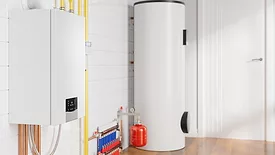
Today, we still get calls about older systems. The potential customers often think their house or building is the oldest we have ever seen. I suppose people think every other building on their block has removed the old steam or hot water system and replaced it with something more modern.
Did you know that plumbing apprenticeships can be dated all the way back to the European medieval period? Back in the 1300s-1500s, Masters of trades would take on young, unskilled workers and teach them their craft in exchange for their indentured servitude, wherein they would work for years without pay while they honed their craft.
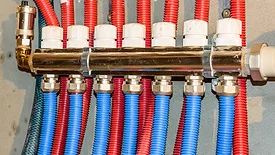
Can you speculate why heat delivery in zone 3 was insufficient before the helper pump? How could the piping system be improved, considering the wasted length of PEX-AL-PEX tubing from the manifolds to the floor panels in figure 2?
Across markets, contractors report that moving labor from unpredictable jobsite conditions into controlled fabrication environments is yielding measurable gains: fewer errors, improved safety metrics, and installation timelines compressed from weeks to days.
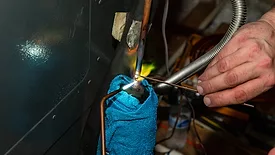
You can teach anyone to sweat a copper joint or wire a circulator pump. What’s much harder to teach is attitude, curiosity, pride in craftsmanship, and the ability to make a customer feel at ease.
U.S. manufacturers face compliance challenges and legal conflicts as the EU’s new Corporate Sustainability Due Diligence Directive extends its reach across global supply chains.
The EU's Corporate Sustainability Due Diligence Directive (CSDDD), approved in 2024, presents a major challenge for U.S. companies, especially in the mechanical and manufacturing sectors. It aims to promote sustainable corporate behavior by requiring companies to identify and address adverse human rights and environmental impacts in their global value chains.
Why clearly defining heated envelopes, coordinating insulation and choosing the right dry technologies are essential to reliable fire protection in cold conditions.
When sprinkler piping freezes, the resulting consequences can be grave: water damage, operational disruption and loss of fire protection when it is needed most. These failures are frequently attributed to extreme weather, but most stem from oversights in controlled conditions, such as unclear heated boundaries, improperly installed insulation that isolates piping from heat and incorrect application of dry sprinkler technology.
In this episode of And So It Flows, host Natalie Forster sits down with Spencer Pope, manager of technical support and training at Bradford White, to explore how education and workforce development are evolving across the plumbing, HVAC and mechanical trades.
Last month, we reviewed the basics injection mixing. It’s a method for controlling water temperatures by regulating the flow of heated water “injected” into a circulating distribution system, while simultaneously removing an equal flow of cooler water from that distribution system. Any method that controls the rate of injection flow also controls the rate of heat transfer into the distribution system.