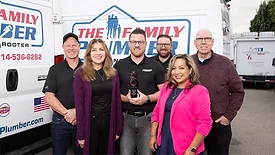
A familiar name can make all the difference when a homeowner needs help fast. That's why building brand recognition before the emergency can give plumbing and mechanical contractors an edge when customers are ready to call.
One often-overlooked factor in technology adoption is how the human brain responds to change. We’re naturally wired to seek familiarity and avoid uncertainty, especially in high-pressure environments like the trades. When new systems are introduced without context or preparation, the brain reads that change as a threat, triggering resistance or disengagement. That reaction isn’t stubbornness; it’s human nature.
The next era of the trades won’t be dominated solely by the most prominent brands or the loudest marketers. It will be shaped by operators who understand efficiency, protect their margins, and invest in genuine relationships.
Expanding on the momentum of Pfister Faucets’ award‑winning American Plumber Stories, Project Stories shifts the lens to the full project ecosystem—plumbers, designers, developers, architects, and builders—while putting a strong emphasis on storytelling.
Explore how refrigerant chemistry, heavier-than-air gases, and real-world brazing hazards highlight critical safety practices for HVAC and mechanical contractor.
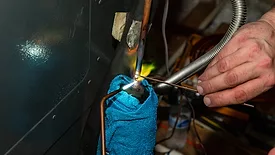
We become comfortable with what we perceive to be best practices and believe they are also safe for all involved. Cupric oxide will always be a concern when brazing copper refrigerant line sets, so purging with nitrogen is the best way to keep your refrigerant lines clean and pristine during brazing.
Technology has reshaped the job. Dispatching, pricing, training, and communication tools have given plumbing businesses more control, clarity, and consistency than ever before. Think about it; in 2010, real-time data was a luxury. In 2025, it’s a baseline. Fortunately for our industry, automation doesn’t replace craftsmanship, it amplifies it, allowing leaders to make decisions with supporting data.
Did you know that plumbing apprenticeships can be dated all the way back to the European medieval period? Back in the 1300s-1500s, Masters of trades would take on young, unskilled workers and teach them their craft in exchange for their indentured servitude, wherein they would work for years without pay while they honed their craft.
Contractors and engineers see a marketplace that is stabilizing, even if margins remain tight. “We remain cautiously optimistic about plumbing industry market conditions in 2026,” says Jason Pritchard, president of the Plumbing-Heating-Contractors—National Association (PHCC). He notes that while uncertainty remains, moderate growth is expected for plumbing and HVAC contractors, though high prices driven by tariffs and inflation will continue to shape consumer behavior.
Well, isn’t this just great: the faucet they purchased from the big box story stinks and now that’s my fault?! On arrival, I could not detect any odor at all, but they insisted there was an odor - except when I was there.