Contractor's Corner | Dave Yates
Brazing safety in the A2L era
Explore how refrigerant chemistry, heavier-than-air gases, and real-world brazing hazards highlight critical safety practices for HVAC and mechanical contractor.
Remember the Monty Python skit where John Cleese attempts to return a parrot he purchased that is “expired”? The shopkeeper, Michael Paline, claims he’s just sleeping!
In real life, a mechanical contracting firm I know was hired to replace two aging HVAC systems in an exotic pet store. Their specialty was breeding, raising, and selling parrots large and small. Birds with beautiful plumage that were housed in large-diameter plexiglas walled arena-like enclosures with an open top.
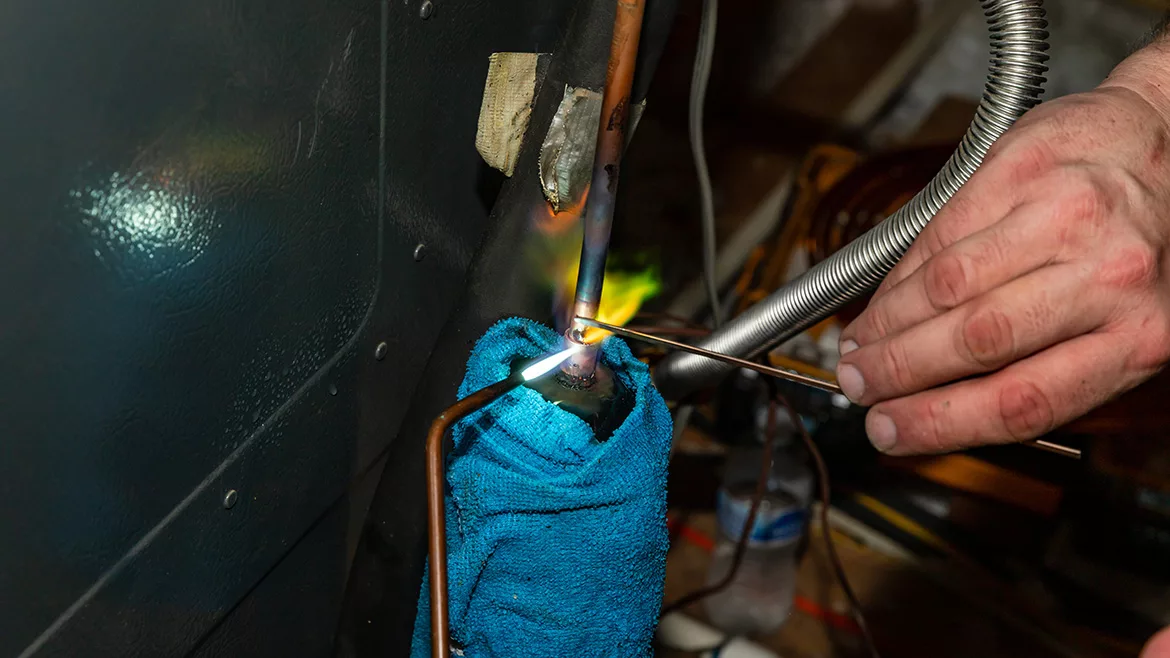
Potential customers had a bird’s eye view while browsing the cages. A painful bite awaited those brave enough to attempt touching or feeding the African Gray, who was the most vocal of the brood. Treated like babies by the shop owners, these were their prized possessions. Imagine the mechanical firm’s shock when they submitted a formal complaint that the HVAC work had killed their on-display parrots! After the birds had dropped dead in their display cases, the pet store owners sent the birds out to be autopsied. According to the avian coroner’s report, gasses, specifically phosgene, created during the refrigerant line brazing process had been the cause of death. The line sets had been reused due to the inability to access them for replacement, and the R22 systems were replacing R22 systems that had not experienced compressor burnout, which had been verified with test kits this firm always used before reusing any line sets.
In addition, process nitrogen had been continuously purged during brazing to prevent formation of cupric oxide (soot), which, as we all know, can break loose and foul/damage components and void the factory warranty. Apparently, the gases created during the overhead brazing in the adjacent mechanical room had settled into the open-top parrot enclosures. Absent any lower openings for ventilation, gases heavier than air could have pooled in the open-top parrot enclosures.
My friend, the HVAC business owner, was a bit skeptical and, at first, thought the pet store owners were grasping at straws, but with that avian autopsy report fingering the HVAC work, he did some research and shared this information: Phosgene gas is generated during brazing if any R22 vapor or liquid is present, is significantly heavier than air, about 3.4 to 3.5 times heavier, causing it to sink and accumulate in low-lying, poorly ventilated, or enclosed areas, increasing the risk of exposure in basements, trenches, and utility corridors. Because it's heavier than air, it can travel along the ground and settle in depressions, making it especially dangerous. Birds, per the avian doc, are highly susceptible to air contaminants. The claim was handled by the contractor’s liability insurance company.
We become comfortable with what we perceive to be best practices and believe they are also safe for all involved. Cupric oxide will always be a concern when brazing copper refrigerant line sets, so purging with nitrogen is the best way to keep your refrigerant lines clean and pristine during brazing. Think we’re safe and out-of-the-woods because R22 is (almost) just a memory? If you do replacement and/or repair work on heat pumps and AC systems, you might just find you’re recovering R22 and purging line sets, although that may void the warranty on new R32 systems.
What about R410a refrigerant and brazing line sets? As always, your work areas need to be adequately ventilated for safety plus use of all appropriate PPE. Polly want a cracker? As we transitioned away from refrigerants with chlorine, we moved on to HCFCs and HFCs, like R410a, which became the standard. Although phosgene was no longer generated during brazing, carbonyl fluorides can be and are also heavier than air and subject to pooling in low lying or confined space areas. Frosted light bulb glass is etched with hydrofluoric acid and when you inhale carbonyl fluorides, it can form hydrofluoric acid when combined with the moisture in your lungs!
There are A2L approved press and push-fit fittings available, which avoid the chemical hazards brazing can create. One added benefit on commercial projects: no hot work = no required fire watch.
A local chemical company installed a 1,500-gallon Teflon tank to house hydrofluoric acid with an atmospheric vent open to the atmosphere, which was under an overhang of the building adjacent to their loading dock. This tank was filled on a Friday. Come Monday morning, one delivery driver arrived, had completed filling his tanker trailer with a custom chemical blend, and climbed up into the tractor. Turning on the windshield wipers to remove the foggy windshield-covered dew, only to find it was not accumulated dew - the atmospherically vented tank of hydrofluoric acid had off-gassed and permanently etched his windshield!
Which brings us to A2L mildly flammable refrigerants. If any R32 or R454B refrigerant gas (liquid prohibited during open-flame work due to potential flammability) is present during the brazing process, then hydrogen fluoride (HF) will be produced. HF is immediately irritating to eyes, nasal passages, and lungs because of its smell and ability to create hydrofluoric acid. Also heavier than air so, as always, adequate ventilation is required.
Why not just skip the open flame and go flame-free? There are A2L-approved press and push-fit fittings available, which avoid the chemical hazards brazing can create. One added benefit on commercial projects: no hot work = no required fire watch. This eliminates the time, materials, and added cost of a process nitrogen purge, the oxygen/acetylene rig, and speeds up the entire process. You may get pushback from techs who see these methods as a dumbing down of trades shills, and they are rightfully proud of: skills they have honed to high standards. Their resistance is completely understandable, but progress and change are relentless, with labor being the one variable that can have the greatest impact on ensuring sufficient workloads in competitive bidding.
Taking the time to convey why these changes can help ensure job security may help to ease their concerns. Never mind the fact that standard flare connections have been the norm for most mini split refrigerant line connections, so we have all been installing flame-free line sets, and no one complained because that was the norm from the get-go. But, one thing to get spot-on is the proper torque to ensure leak-free connections with flared joints and we found it better to cut off and toss the factory flare nuts on preformed line sets and, instead, use heavier-duty refrigerant flare nuts.
Looking for a reprint of this article?
From high-res PDFs to custom plaques, order your copy today!