Plumbing Apprenticeship
The enduring power of plumbing apprenticeships
Centuries-old training traditions still guide young professionals navigating a fast-changing industry.
Did you know that plumbing apprenticeships can be dated all the way back to the European medieval period? Back in the 1300s-1500s, Masters of trades would take on young, unskilled workers and teach them their craft in exchange for their indentured servitude, wherein they would work for years without pay while they honed their craft.
Early cities soon expanded, and plumbers became essential tradespeople responsible for installing and maintaining water and waste systems. Unsurprisingly, apprenticeships became the primary method of ensuring consistent skill and safety standards.
By the late 19th and early 20th centuries, apprenticeship training in North America became more structured. Trade unions around the world began establishing formal apprenticeship programs that standardized curriculum, safety practices and journeyman licensing requirements. These programs helped elevate plumbing into a licensed profession with clearly defined competencies.
Throughout the mid-20th century, as building codes grew more sophisticated and mechanical systems more complex, apprenticeship programs expanded to include classroom education in math, hydraulics, blueprint reading and, eventually, emerging technologies. Federal legislation, such as the National Apprenticeship Act of 1937 or the Fitzgerald Act, further legitimized apprenticeships by setting national guidelines and encouraging state-level registration and oversight.
In recent decades, plumbing apprenticeships have continued to evolve in response to new materials, digital design tools, water-efficiency mandates and a growing emphasis on safety and sustainability. Today’s programs typically blend on-the-job training with hundreds of hours of classroom or online instruction; preparing apprentices for everything from technical proficiency and customer service to project management and increasingly new and complex technology. Despite these modern shifts, the core goal remains the same as it was centuries ago: cultivating skilled professionals through hands-on learning guided by experienced mentors.

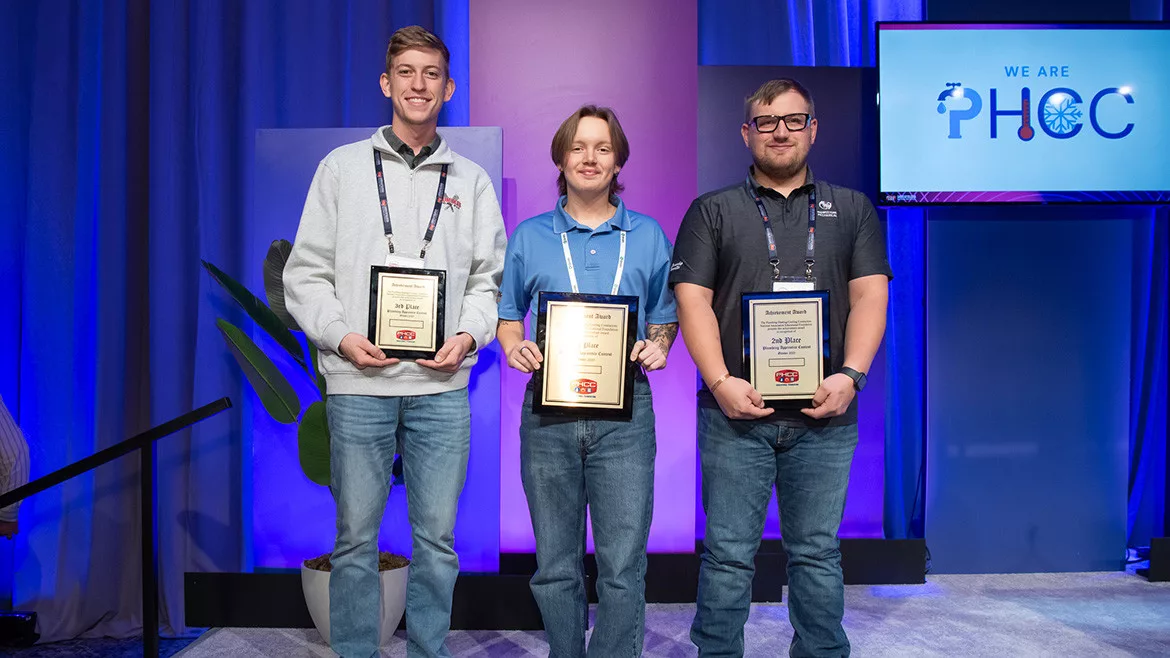
Daniel Pritchett won third place in the contest. Image courtesy of PHCC
In essence, plumbing has been taught the same way for centuries: through the steady rhythm of apprenticeship, where novices learn the craft under the guidance of seasoned pros. That tradition is alive and well today, as shown by the three apprentices who earned top honors in the 2025 National Plumbing Apprentice Contest. Their stories show the evolution of the trade itself—rooted in hands-on learning, shaped by modern technology and driven by a desire to master a craft that keeps communities running.
The winners
When I spoke with the winners of this year’s 2025 National Plumbing Apprentice Contest, they all had somewhat differing reasons for joining the trades. For one, plumbing drew him in due to the security it offered.
First place winner Josh Vogt of Bombard Mechanical in Las Vegas, Nevada, who was sponsored in the event by A.O. Smith, told me, “What first drew me to plumbing as a career was hearing about the amazing opportunities and long-term potential it offered.” he continues, “I was young and didn’t want to go to college for something I wasn’t fully committed to, especially if it meant taking on a tremendous amount of debt. This trade provided a path away from all of that. Plumbing offered me the chance to support a family, be financially stable and independent, and look forward to a secure retirement.”
When Vogt was looking to start his apprenticeship, he spoke to a family friend – a respected member of the local union hall – who told him all about the benefits of the trades as opposed to a college degree. “There’s so much more to it than most people realize, and at its core, plumbing protects the health and welfare of everyone, which I find incredible.”
Conversely, both second-place winner Cody Green from Midwest Mechanical in Sioux Falls, South Dakota, who was sponsored by Moen, and third-place winner Daniel Pritchett of Reichelt Plumbing in Schererville, Indiana, who was sponsored by the Copper Development Association, were drawn in by the hands-on nature of the job. Pritchett told me, “I am very hands-on and always have been. The opportunity to help others and make a career of it solidified the choice for me to try plumbing.”
Green was also intrigued by the evolving nature of the job. “I like how it's always different. It's always changing. It's always like the career as a whole is always changing, too.” He added, “It's always something new, always something's changing, reinvented, and everybody always wants something different on top of that, too.”
For Daniel, finding his apprenticeship was simple. He was already working as a mechanic for Reichelt Plumbing trucks, and he simply asked them how he could apply. The pay and benefits solidified his choice, he said.
Cody interviewed for his position, and the welcoming environment and culture secured his choice. “It's really focused on growing and learning.” He really respected the helpful nature of the company. “They can and are willing to take guys that don't know much, and they'll show them all the ropes, show them how they're always willing to help and then progress through your apprenticeship.”
What goes into an apprenticeship?
For many readers, their days of apprenticeships might be a few years behind them. So, what goes on in an apprenticeship program these days? According to Daniel, it’s different every day. But for Cody and Josh, there’s a bit more structure.
“A typical day starts with me getting up at 4:30 a.m., getting ready, and starting work at 6:00 a.m. After work, I go straight to school. We have classes twice a week from 4:30 p.m. to 7:30 p.m., and most of the training is hands-on with labs and projects that simulate real field situations.” Josh told me.
“On-the-job learning makes up the majority of what you take in during an apprenticeship,” he continued. “I only get six hours of classroom time a week, compared to forty hours in the field. On-the-job training is where you really develop problem-solving skills, which I think is one of the things that defines a good worker. It’s also where you get hands-on experience and learn from mistakes.” According to Josh, a healthy mix of on-the-job training and classroom training are essential to a quality apprenticeship. “In-school training teaches the correct methods and helps refine and perfect your skills. Both types of training are necessary and valuable.”
Cody’s mornings start at around 6am, too. Once the team has arrived at the jobsite – usually around 7am – the foreman leads a morning meeting to discuss the ins-and-outs of the day. The team then starts working on their tasks, which differ day-by-day. “Usually we'll work with a lead or a journeyman to help us, too. So it's not just like we're not thrown to the wolves.” He told me. “We have somebody to bounce questions off of and stuff like that, that, but they'll let you do it by yourself. They're just there for questions.”
Cody agrees with Josh about the importance of both a classroom setting and on-the-job training. According to them, both have their pros and cons. “In the school or technical training center that we have, everything is in perfect condition. In the field, you're learning in not-perfect conditions.” Daniel echoed this sentiment, noting that he’s learned more about codes and standards in the classroom, but on-the-job training has taught him more about the “pace” of the job; the realities of what plumbers go through every day.
One thing is certain for all contestants; they’ve all created lasting memories in the field already. Cody remembers working on a system for an active hospital. That means every second counts. Speed and working together as a team was paramount. “They can't shut it down,” he told me. “It really encompasses everything. Planning, teamwork, because everybody has to be on the same page. In one night, you would need all of your skills all thrown together.”
Josh also highlighted the importance of teamwork. “Teamwork is essential. There have been countless tasks during my apprenticeship that I couldn’t have accomplished without my peers. It takes balance and cooperation to complete work efficiently. Craftsmanship is what separates good from great. It’s about pride and attention to detail.”
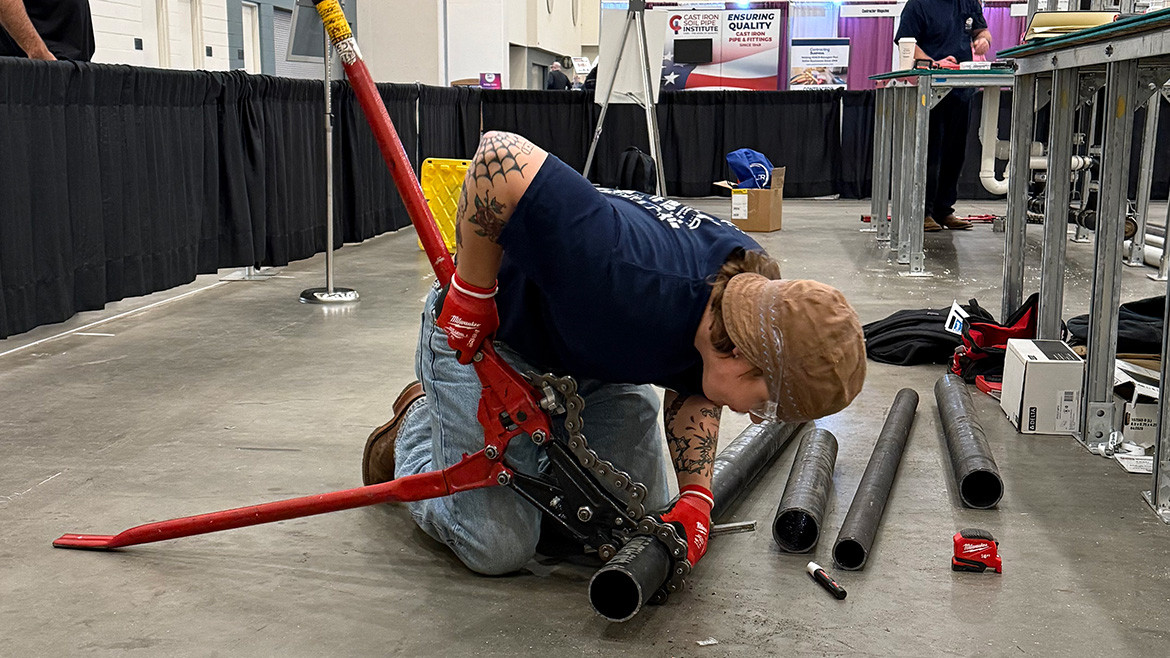
Josh Vogt took home first place in the contest. Image courtesy of PHCC
Cody is also especially proud of a few jobs, including the hospital and an addition to an elementary school. “Like places you go into, like, especially before you start plumbing, you go into them and then you don't realize all the inner workings and stuff to make that place work until you build one.” His work has given him insight into the inner-workings of systems that he might have otherwise never given a second thought to. “So it's kind of a proud moment and be like, oh, I know how much work actually goes into this.” Similarly, Daniel’s proudest moment in his career thus far has been his first job; working on a system at Lowell High School.
For Josh, one of his fondest memories is “A retired journeyman recently gave me a box of his old tools. As I went through them, I found tools he had created himself to make our jobs easier. Innovation and resourcefulness are a big part of the trade, and it’s something that gets passed down through generations.”
The competition
PHCC 2025 National Plumbing Apprentice Contest took place on October 27th-29th in Grand Rapids, Michigan. I was grateful for the opportunity to watch! Seventeen apprentices from all over the U.S. were tasked with building a “rough-in a bathroom system,” according to PHCC’s website. “The set-up includes a toilet, sink and shower, complete with supply, waste and vent lines, plus cleanouts and extra features designed to test the contestants’ knowledge and skills. The test set-up includes a variety of pipe materials – cast iron, copper and PVC and corresponding joining methods.”
With such an exciting competition, I was curious to know how each of the winners had done to prepare. Josh, Cody and Daniel all agreed: they didn’t have to do anything special to prepare. Their apprenticeship programs had prepared them enough.
The combination of real, hands-on experience and classroom learning had taught them all they needed to know to succeed in the competition, and even beyond. All competitors agreed that the competition tested their ability to understand complex graphs and underground systems. “They’re very specific measurements,” according to Cody. Daniel agreed that a big focus was following “isometric drawings and reading submittals and cutsheets.” Josh agreed, stating that, “Being attentive and re-reading the parameters was crucial to doing well.”
What’s next?
After the competition, the future is bright for these young apprentices. Josh’s goals are simple, “After completing my apprenticeship, my goals are to earn as many certifications as possible,
become a foreman, and apply my skills both in my job and in my day-to-day life.” Cody also wants to become a foreman in the future, while Daniel is eager to take on big jobs and get as much experience as he can.
More than just their personal goals, I was curious about how the winners saw the future of the industry as a whole. Just like apprenticeships as a whole have changed, the industry is changing, too. Josh points to new technology as vastly important for new apprentices to learn. “In my experience, technology is becoming more electronically based, and computer skills are
becoming necessary in plumbing.” But, he didn’t underestimate the importance of more traditional methods. “However, I also think it’s important to learn the fundamental
technologies that are becoming outdated. You may still need to work with older existing systems, and knowing how to do that makes you more valuable. At the same time, keeping up with new technology is just as important.”
Daniel notes that the use of “GPS technology in a trimble” is also emerging as an important aspect to teach. “It’s huge in commercial/industrial plumbing.” He also emphasized, “If a new apprentice thinks they aren’t going to need computer skills, they might be mistaken.”
Plumbing has been taught the same way for centuries: through the steady rhythm of apprenticeship, where novices learn the craft under the guidance of seasoned pros. That tradition is alive and well today.
They all had words of advice for anyone considering joining the trades. Josh told me, “Construction sometimes gets a bad reputation, and people can be intimidated by what they see online. But learning a trade is extremely valuable. You learn discipline, pride in what you do, and skills that can allow you to work for yourself one day.” He added, “I think everyone starting out in the plumbing and mechanical trades should go through an apprenticeship program. It gives people the chance to make mistakes, learn from them, and refine their skills before becoming journeymen.”
Daniel also noted that anyone considering a career in the trades should consider the economy, and “take a look at jobs in the industry rather than the jobs being replaced by AI.”
Cody emphasized how many opportunities the trades have for young workers. “With the trades, there's a thousand other things that go into how a trade company works, where you don't always have to be in the trenches, too. You can eventually move into a project manager, and most companies will help you that way, or be an estimator, or a plumbing superintendent, or if you like it like I do, now you can just continue that way, too.
“You don't have to try to look for the next step up. You can follow your progressions up, get your journeyman license, become a foreman, or whatever you'd like to do.” He told me. “There's ways to move up or sideways within the same company, and you're still in the trades. So, it's not like you just wasted all this time. If you get in young, you can do it, and then it opens the door for more opportunities.”
One thing is clear when it comes to the winners: their future, just like the future of the industry itself, is bright and ever-evolving.
Looking for a reprint of this article?
From high-res PDFs to custom plaques, order your copy today!