Single-stage non-modulating heat sources in zoned distribution systems often face short cycling, particularly with low thermal mass. When few zones are active, they struggle to dissipate generated heat quickly, causing temperature build-up and potential shutdown of the heat pump based on internal limits, with varied restart behavior depending on controls.
Can you speculate why heat delivery in zone 3 was insufficient before the helper pump? How could the piping system be improved, considering the wasted length of PEX-AL-PEX tubing from the manifolds to the floor panels in figure 2?
According to the 2025 Q3 Industry Report, Great Lakes = great radiant heating sales.
WarmlyYours reported strong third-quarter momentum, driven by a surge in Great Lakes radiant heating sales and steady gains across key product lines, signaling renewed stability in the broader housing and remodeling markets.
Last month, we reviewed the basics injection mixing. It’s a method for controlling water temperatures by regulating the flow of heated water “injected” into a circulating distribution system, while simultaneously removing an equal flow of cooler water from that distribution system. Any method that controls the rate of injection flow also controls the rate of heat transfer into the distribution system.
For boilers operating on natural gas or propane, flue gas condensation begins at inlet water temperatures below about 130 ºF. Boilers operating on low sulfur #2 fuel oil have lower dewpoint temperatures in the range of 110 ºF.
Designing and installing a system for the unique venue posed challenges that demanded meticulous attention to detail and coordination. It needed to accommodate visitor needs while blending with the building's rustic character. “Introducing modern mechanical systems without disrupting its historic charm was difficult,” said Selestow.
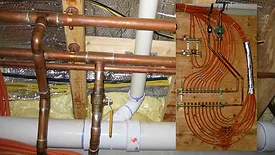
The homerun system is a simple technique for connecting multiple heat emitters using two runs of small flexible tubing (such as PEX) for supply and return. In North America, the standard size is 1/2-inch, but 3/8-inch tubing can be used with proper design and compatible fittings.
An owner, who has never been satisfied with the performance of his heating system, decides that the boiler must be the root cause of all the performance issues. Not wanting to spend any more than necessary, he makes several calls looking for the lowest boiler replacement price.
Many of the ratios used in the HVAC industry are just some “desirable output” quantity divided by the “necessary input” quantity. One example is the coefficient of performance (COP) of a heat pump. The desirable output quantity is Btu/hr of heat output. The necessary input quantity is the electrical input power needed to operate the heat pump. The latter is typically measured in watts or kilowatts.
 RSS
RSS