
search
cart
facebook instagram twitter linkedin youtube
  • Sign In
  • Create Account
  • Sign Out
  • My Account
  • NEWS
  • PRODUCTS
    • FEATURED PRODUCTS
  • CONTRACTORS
    • BATH & KITCHEN PRO
    • BUSINESS MANAGEMENT
    • HIGH EFFICIENCY HOMES
    • TECHNOLOGY
    • WATER TREATMENT
    • PMC COLUMNS
      • Dave Yates: Contractor’s Corner
      • John Siegenthaler: Hydronics Workshop
      • Kenny Chapman: The Blue Collar Coach
      • Matt Michel: Service Plumbing Pros
      • Scott Secor: Heating Perceptions
  • ENGINEERS
    • CONTINUING EDUCATION
    • DECARBONIZATION | ELECTRIFICATION
    • FIRE PROTECTION
    • GEOTHERMAL | SOLAR THERMAL
    • PIPING | PLUMBING | PVF
    • PME COLUMNS
      • Christoph Lohr: Strategic Plumbing Insights
      • David Dexter: Plumbing Talking Points
      • James Dipping: Engineer Viewpoints
      • John Seigenthaler: Renewable Heating Design
      • Lowell Manalo: Plumbing Essentials
      • Misty Guard: Guard on Compliance
  • RADIANT & HYDRONICS
    • RADIANT COMFORT REPORT
    • THE GLITCH & THE FIX
  • INSIGHTS
    • CODES
    • GREEN PLUMBING & MECHANICAL
    • PROJECT PROFILES
    • COLUMNS
      • Codes Corner
      • Natalie Forster: Editorial Opinion
      • Guest Editorial
  • MEDIA
    • EBOOKS
    • PODCASTS
    • VIDEOS
    • WEBINARS
  • RESOURCES
    • INDUSTRY CALENDAR
    • DIRECTORIES
    • PM BOOKSTORE
    • CE CENTER
    • MARKET RESEARCH
    • CLASSIFIEDS
  • EMAGAZINE
    • EMAGAZINE
    • ARCHIVE ISSUES
    • CONTACT
    • ADVERTISE
    • PME EMAGAZINE ARCHIVES
  • SIGN UP!
Plumbing & Mechanical Engineer Radiant & HydronicsRadiant Comfort ReportGeothermal | Solar Thermal

Radiant Comfort Report Winter 2024 Edition

A new generation of Thermal Energy Networks

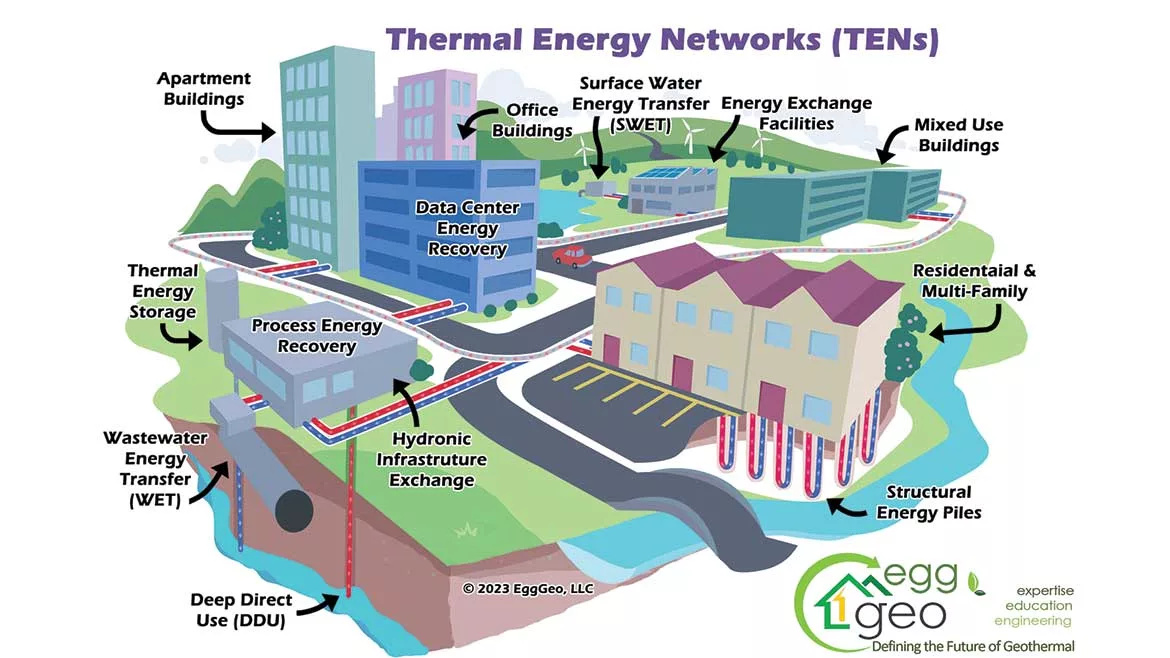
TEN allows for both cooling or warming to be applied to decarbonization efforts.
By Rick Bostian
Illustration of Thermal Energy Networks (TENs)

Image courtesy of Egg Geo

December 18, 2024
✕
Image in modal.

“Systems shall operate to permit independent and bi-directional heating and cooling for comfort and water heating …”

Chapter 17 of the 2024 Uniform Mechanical Code (UMC) focuses on a new generation of district energy systems, where energy flows easily between and among buildings. These systems operate without significant concerns about thermal losses, insulation, pressure or the high costs of central plants that provide only heating or cooling. In this model, each connected building can independently choose its HVAC and water heating systems, as they are linked to water at ground temperature. This approach avoids the need for expensive central plants or the installation of ground heat exchangers, even when such systems are applicable.

Thermal Energy Networks: A community asset

Thermal energy networks (TEN) allow public funds to cover infrastructure costs without the need for consumables, as water circulates and energy moves between buildings. In a recent article, RPA Technical Liaison John Mullen wrote, “Water has a particular talent for going with the flow, and it’s about time we started to use its full power and potential by circulating water and not wasting it. It’s a ripe opportunity for new communities to embrace what the next environmental neighborhood could do for its citizens, making waste heat an asset to a community’s energy use.

Radiant Comfort Report 2024 Winter Edition

RADIANT COMFORT REPORT

Read More of the 2024 Winter Edition

“Buildings, like people, have moods, or in the language of thermodynamics, microstates. Each zone, with its unique temperature needs, represents miniature challenges in energy management.”

By complementing rebates and individual incentives, public ownership of a district ambient temperature loop (ATL) or TEN removes the financial burden from building owners, enabling the application of technologies that further reduce both power and natural gas usage. TEN allows for both cooling or warming to be applied to decarbonization efforts. This is particularly important in addressing environmental issues associated with commercial buildings, where HVAC heat rejection contributes to global warming, and water heating increases on-site carbon consumption.
2024 Uniform Mechanical Code cover

Thermal Energy Networks (TENs) allows for both cooling or warming to be applied to decarbonization efforts. Provisions in the Uniform Mechanical Code provide guidance on these types of systems. Image courtesy of IAPMO

Cooling as a means to decarbonize is an effective environmental action for commercial buildings because modern piping, pumps, and equipment address these issues without requiring “extended or extreme” operation. No pilot projects or case studies are needed, as ATL systems have been in use since the 1970s. The key difference now is public ownership of a third central water system. Since TEN is a closed system, it is simpler to design and manage, as it is not subject to the complexities of individual water usage such as faucets or flushes. The TEN approach, which integrates HVAC and plumbing systems, allows the use of any water or ground heat source or sink for energy exchange. In a collaborative article by Jay Egg and Mimi Egg of Egg Geo, the duo wrote, “Geothermal heat pumps tied into building loops and TEN will eventually become as simple as installing a window air conditioner or clothes washing machine

By applying the bidirectional ATL loop concept within individual buildings, this allows our heating and cooling systems to contribute to decarbonization. Water, as the energy conduit, is a well-understood concept, leveraging existing skillsets while reducing capital expenditures and operating costs for building owners. This revenue-gathering infrastructure allows commercial building energy to be shared with neighboring residences, reducing operating costs even if only for one neighbor, some of the time. The result is energy efficiency without sacrifice — everyone uses less.

While these systems may sound futurist, the provisions in UMC help us get there. IAPMO and the Pace Energy and Climate Center at the Elisabeth Haub School of Law at Pace University (Pace) have agreed to jointly publish Chapter 17 of the UMC as a standalone document (IAPMO/UMC/Chapter 17-2024) to address the needs for enforceable safety provisions for geothermal district ambient temperature loop systems. The document “addresses the general requirements such as permitting, operating, and metering; and design requirements such as thermal resources, performance, and diversity factors.” As mentioned in the release statement, it can be viewed at: https://bit.ly/48pmzpO. Learn more at Radiantpros.org and Iapmo.org  

KEYWORDS: geothermal hydronics Thermal Energy Network (TEN) thermal energy usage

Share This Story

Looking for a reprint of this article?
From high-res PDFs to custom plaques, order your copy today!

Rick bostian

Rick Bostian is chairman of the Hydronic Industry Alliance — Commercial (HIA-C), and business development manager for WaterFurnace International.

Recommended Content

JOIN TODAY
to unlock your recommendations.

Already have an account? Sign In

  • 2025 Next Gen ALL-STARS hero 1440

    2025 Next Gen All Stars: Top 20 Under 40 Plumbing Professionals

    This year’s group of NextGen All-Stars is full of young...
    Plumbing & Mechanical Engineer
    By: Kristen R. Bayles
  • Worker using the Milwaukee Tool SWITCH PACK drain cleaner

    Pipeline profits: Drain cleaning, pipe inspection create opportunities

    Drain cleaning and inspection services offer lucrative...
    Plumbing News
    By: Nicole Krawcke
  • Uponor employee, Arturo Moreno

    The reinvestment in American manufacturing and training

    Plumbing & Mechanical Chief Editor Nicole Krawcke and...
    Plumbing News
    By: Nicole Krawcke and Natalie Forster
Manage My Account
  • eNewsletters
  • Online Registration
  • Subscription Customer Service
  • eMagazine
  • Manage My Preferences

More Videos

Popular Stories

Hot water pipes

Campus shutdown at Oakland University exposes hidden risks of aging hot-water infrastructure

Floor heating manifold cabinet with flowmeter and PEX pipe.

Elegance extended: How to use the homerun system of connecting heat emitters

Industrial pressure gauge on a tank.

From cutting edge to classic: How to modernize outdated pneumatic control systems

Poll

Will business be up or down in 2025?

Do you anticipate business in 2025 to be up or down in comparison to 2024?
View Results Poll Archive

Products

The Water Came To A Stop

The Water Came To A Stop

See More Products
eBook | 2025 Radiant & Hydronics All Stars

Related Articles

  • A trench filled with plastic tubing used for the installation of a geothermal residential heating and cooling system.

    Thermal Energy Networks for HVAC&W

    See More
  • Piping system in the ground.

    Thermal energy networks and the future of radiant

    See More
  • Today’s Technology to Market

    Today’s Technology to Market (T2M) – the bidirectional thermal district

    See More

Related Products

See More Products
  • cengagebook.jpg

    Heating with Renewable Energy

  • Inspector Book.jpg

    Lessons Learned: A Guide to Boilers for Home Inspectors

  • what hydronics taught holohan.jpg

    What Hydronics Taught Holohan: A Memoir of Life in the Heating Industry

See More Products
×

Keep your content unclogged with our newsletters!

Stay in the know on the latest plumbing & piping industry trends.

JOIN TODAY!
  • RESOURCES
    • Advertise
    • Contact Us
    • Directories
    • Store
    • Want More
    • Supply House Times
  • SIGN UP TODAY
    • Create Account
    • eMagazine
    • eNewsletter
    • Customer Service
    • Manage Preferences
  • SERVICES
    • Marketing Services
    • Reprints
    • Market Research
    • List Rental
    • Survey/Respondent Access
  • STAY CONNECTED
    • LinkedIn
    • Facebook
    • Instagram
    • YouTube
    • X (Twitter)
  • PRIVACY
    • PRIVACY POLICY
    • TERMS & CONDITIONS
    • DO NOT SELL MY PERSONAL INFORMATION
    • PRIVACY REQUEST
    • ACCESSIBILITY

Copyright ©2025. All Rights Reserved BNP Media.

Design, CMS, Hosting & Web Development :: ePublishing