search
cart
facebook instagram twitter linkedin youtube
  • Sign In
  • Create Account
  • Sign Out
  • My Account
  • NEWS
  • PRODUCTS
    • FEATURED PRODUCTS
  • CONTRACTORS
    • BATH & KITCHEN PRO
    • BUSINESS MANAGEMENT
    • HIGH EFFICIENCY HOMES
    • TECHNOLOGY
    • WATER TREATMENT
    • PMC COLUMNS
      • Dave Yates: Contractor’s Corner
      • John Siegenthaler: Hydronics Workshop
      • Kenny Chapman: The Blue Collar Coach
      • Matt Michel: Service Plumbing Pros
      • Scott Secor: Heating Perceptions
  • ENGINEERS
    • CONTINUING EDUCATION
    • DECARBONIZATION | ELECTRIFICATION
    • FIRE PROTECTION
    • GEOTHERMAL | SOLAR THERMAL
    • PIPING | PLUMBING | PVF
    • PME COLUMNS
      • Christoph Lohr: Strategic Plumbing Insights
      • David Dexter: Plumbing Talking Points
      • James Dipping: Engineer Viewpoints
      • John Seigenthaler: Renewable Heating Design
      • Lowell Manalo: Plumbing Essentials
      • Misty Guard: Guard on Compliance
  • RADIANT & HYDRONICS
    • RADIANT COMFORT REPORT
    • THE GLITCH & THE FIX
  • INSIGHTS
    • CODES
    • GREEN PLUMBING & MECHANICAL
    • PROJECT PROFILES
    • COLUMNS
      • Codes Corner
      • Natalie Forster: Editorial Opinion
      • Guest Editorial
  • MEDIA
    • EBOOKS
    • PODCASTS
    • VIDEOS
    • WEBINARS
  • RESOURCES
    • INDUSTRY CALENDAR
    • DIRECTORIES
    • PM BOOKSTORE
    • CE CENTER
    • MARKET RESEARCH
    • CLASSIFIEDS
  • EMAGAZINE
    • EMAGAZINE
    • ARCHIVE ISSUES
    • CONTACT
    • ADVERTISE
    • PME EMAGAZINE ARCHIVES
  • SIGN UP!
Radiant & HydronicsThe Glitch & The Fix

The Glitch & The Fix

How would you fix this oil-fired boiler system?
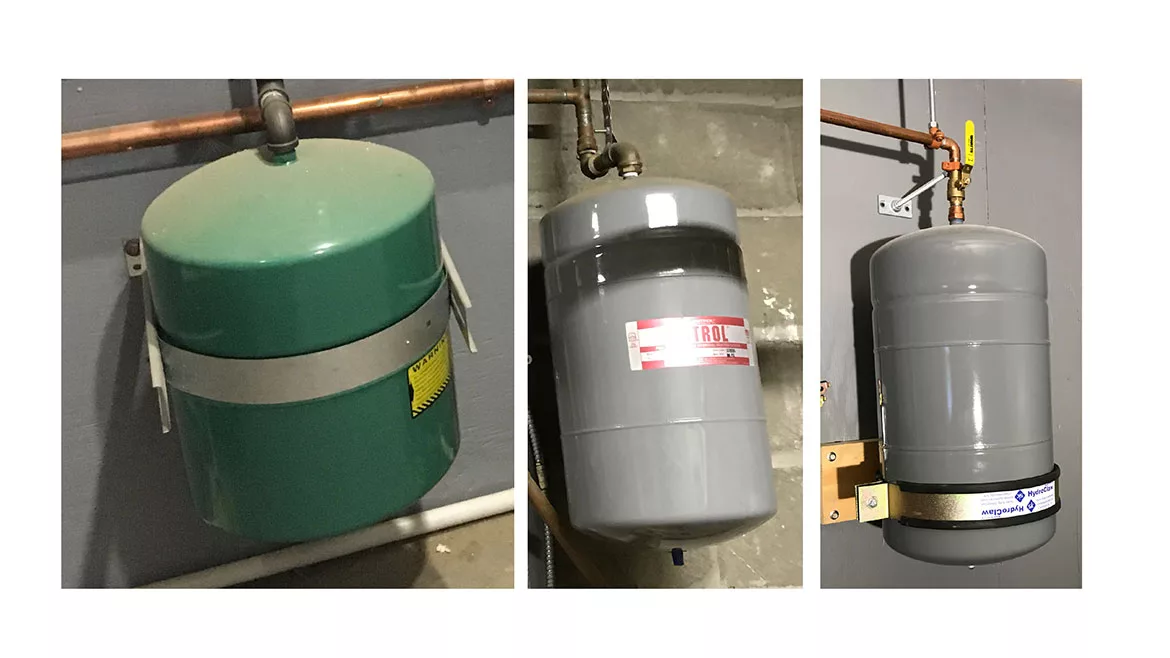
Figure 2
Image courtesy of John Siegenthaler

Image courtesy of John Siegenthaler

December 23, 2024
✕
Image in modal.

The Glitch

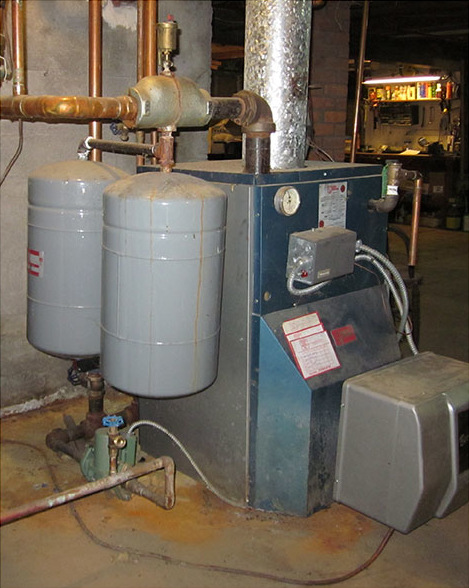
The photo below shows an oil-fired boiler and surrounding details. Take a close look, and make a list of what you would change in this portion of the system.

FIGURE 1

Figure 1

Image courtesy of John Siegenthaler

The Fix

  1. I suspect most of you quickly focused on the two expansion tanks. There’s nothing wrong with using two tanks of a given size, and piped in parallel, compared to a single larger tank of equivalent acceptance volume. In Figure 1, both tanks are piped in parallel with their air valves on the bottom. No problem so far. However, look at how the tank on the left is supported — or, should I say, not supported. If the diaphragm in the left side tank were to fail, and the tank fill with water, there would be tremendous torque on the tee beneath the air separator, maybe even enough to crack the fitting or the connection to the cast iron air scoop. The fix: Any expansion tank that’s not hanging directly below a fitting or other component should be supported. This can be done in several ways, as shown in Figure 2.

    FIGURE 2

    Figure 2

    Image courtesy of John Siegenthaler

  2. On the left of the boiler is a circulator with its motor shaft in the vertical position. That circulator also lacks isolation valves or isolation flanges. When it fails due to worn bushings, or by functioning as a sediment collection device at the lowest point in the piping system, replacing it is going to be “fun” and wet. Don’t put circulators at the low point in systems. Don’t mount them with vertical motor shaft orientation. And always provide isolation valves or isolation flanges.
  3. How about that drain valve with an outlet at least a foot above the base of the boiler, as well as the previously mentioned circulator? Maybe it’s there as an afterthought, for some purpose that I’m not understanding. Still, as a drain valve, it would likely serve that unknown purpose better if mounted lower in the system.
  4. So much for the action on the left side of the boiler. See any issue over the right side? Look at the discharge pipe on the pressure relief valve. It’s pointing down, but it’s supposed to end within 6 inches of the floor or drain based on most mechanical codes.
  5. The stains on the air purger and left expansion tank infer that the float-type air vent on the top of the air purger is leaking. It’s probably going to fail at some point, and when it does, there doesn’t appear to be any simple way to isolate it from the remainder of the system so that a replacement can be screwed in

One suggestion is to put a small ball valve and a short pipe nipple between the vent and the air purger. Take the handle off the ball valve and store it close to the boiler. This prevents curious little hands that like to turn valves from “accidentally” leaving the valve in the closed position.

Another suggestion is to replace the air purger and vent with either a microbubble air separator or a combined air/dirt/magnetic particle separator. Then move both expansion tanks to the wall behind the boiler and support them with either clamps that wrap around the tank shells, or a cantilevered support bracket. Put a tee under the new air separator with a drain valve on the bottom, and the side port leading to the relocated expansion tanks.

6. It would also be a good idea to wrap the copper oil supply pipe with some plastic looming to get it up off the floor and provide some protection.

Reasonable speculation

In the background, you see a work area with spray cans and what appears to be cans of other liquids paints, etc., on the floor. If some of those liquids or vapors from the spray cans contain chlorine, cleaning chemicals or flammable solvents, it would be better to isolate them from the air going into the oil burner. Chlorine vapors, in particular, can form hydrochloric acid within the boiler’s combustion chamber. That acid can quickly corrode the galvanized steel venting on the boiler. Most homeowners have no idea that this can happen. Give them a heads up. It may lead to a “remember that discussion we had a couple of years ago,” when they call you back to replace the vent pipe.

Are you an ace troubleshooter?

PM’s Hydronics Editor John Siegenthaler, P.E., will pose a question to you, our readers, to review a system’s schematic layout and discover its faults, flaws and defects. Good luck!
Read More The Glitch & The Fix⮞

KEYWORDS: boilers hydronics oil hot water boilers plumbers and pipefitters troubleshooting

Share This Story

Looking for a reprint of this article?
From high-res PDFs to custom plaques, order your copy today!

Recommended Content

JOIN TODAY
to unlock your recommendations.

Already have an account? Sign In

  • 2025 Next Gen ALL-STARS hero 1440

    2025 Next Gen All Stars: Top 20 Under 40 Plumbing Professionals

    This year’s group of NextGen All-Stars is full of young...
    Plumbing & Mechanical Contractor
    By: Kristen R. Bayles
  • Worker using the Milwaukee Tool SWITCH PACK drain cleaner

    Pipeline profits: Drain cleaning, pipe inspection create opportunities

    Drain cleaning and inspection services offer lucrative...
    Plumbing News
    By: Nicole Krawcke
  • Uponor employee, Arturo Moreno

    The reinvestment in American manufacturing and training

    Plumbing & Mechanical Chief Editor Nicole Krawcke and...
    Plumbing News
    By: Nicole Krawcke and Natalie Forster
Manage My Account
  • eNewsletters
  • Online Registration
  • Subscription Customer Service
  • eMagazine
  • Manage My Preferences

More Videos

Popular Stories

Hot water pipes

Campus shutdown at Oakland University exposes hidden risks of aging hot-water infrastructure

Floor heating manifold cabinet with flowmeter and PEX pipe.

Elegance extended: How to use the homerun system of connecting heat emitters

Industrial pressure gauge on a tank.

From cutting edge to classic: How to modernize outdated pneumatic control systems

Poll

Will business be up or down in 2025?

Do you anticipate business in 2025 to be up or down in comparison to 2024?
View Results Poll Archive

Products

The Water Came To A Stop

The Water Came To A Stop

See More Products
eBook | 2025 Radiant & Hydronics All Stars

Related Articles

  • You Can't Make This Stuff Up

    See More
  • Figure 1. The inside portion of a heating system supplied by a non-pressurized outdoor wood-fired furnace.

    Installation nightmare — how many problems can you spot?

    See More
  • glitch-fix-feature

    The Glitch + The Fix: This almost got built

    See More

Related Products

See More Products
  • Classic Hydronics - How To Get The Most From Those Older Hot-Water Heating Systems

  • Lessons Learned in a Boiler Room: A common sense approach to servicing and installing commercial boilers

  • howcome.gif

    How Come? Hydronic heating questions we've been asking for 100 years (with straight answers!)

See More Products

Events

View AllSubmit An Event
  • April 10, 2014

    Workshop: Hydronics for High Efficiency Wood-fired and Pellet-fired Boilers

    Session added to April 9-11 Northeast Biomass Heating Expo.
View AllSubmit An Event
×

Keep your content unclogged with our newsletters!

Stay in the know on the latest plumbing & piping industry trends.

JOIN TODAY!
  • RESOURCES
    • Advertise
    • Contact Us
    • Directories
    • Store
    • Want More
    • Supply House Times
  • SIGN UP TODAY
    • Create Account
    • eMagazine
    • eNewsletter
    • Customer Service
    • Manage Preferences
  • SERVICES
    • Marketing Services
    • Reprints
    • Market Research
    • List Rental
    • Survey/Respondent Access
  • STAY CONNECTED
    • LinkedIn
    • Facebook
    • Instagram
    • YouTube
    • X (Twitter)
  • PRIVACY
    • PRIVACY POLICY
    • TERMS & CONDITIONS
    • DO NOT SELL MY PERSONAL INFORMATION
    • PRIVACY REQUEST
    • ACCESSIBILITY

Copyright ©2025. All Rights Reserved BNP Media.

Design, CMS, Hosting & Web Development :: ePublishing