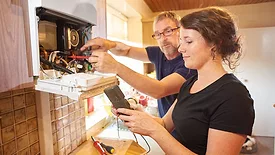
The next-level leader does not do everything. They build the people and the systems that make everything work, long after they step away from the day-to-day.
Problems do not go away in business. They are part of the process. But in a culture of ownership, problems become opportunities for leadership. Instead of frustration, you get solutions. Instead of finger pointing, you get growth.
Here is the truth I have seen time and time again: most businesses do not struggle with ideas, they struggle with execution. The gap between what we know and what we consistently do is where businesses either grow or stall.
One often-overlooked factor in technology adoption is how the human brain responds to change. We’re naturally wired to seek familiarity and avoid uncertainty, especially in high-pressure environments like the trades. When new systems are introduced without context or preparation, the brain reads that change as a threat, triggering resistance or disengagement. That reaction isn’t stubbornness; it’s human nature.
For years, leadership in the trades was defined by grit, hustle, and sheer willpower. If you worked harder, stayed longer, and pushed through, you were considered a strong leader. And while work ethic will always matter in plumbing, the demands of today’s workforce are calling for something more.
Technology has reshaped the job. Dispatching, pricing, training, and communication tools have given plumbing businesses more control, clarity, and consistency than ever before. Think about it; in 2010, real-time data was a luxury. In 2025, it’s a baseline. Fortunately for our industry, automation doesn’t replace craftsmanship, it amplifies it, allowing leaders to make decisions with supporting data.
All year, leadership is a fast-moving, day-by-day experience. But December's slower pace lets you take a step back, and that's when strategic thinking happens. An intentional leadership reset is a chance to reflect on what truly matters, refocus on the strategies that drive results, and reignite the performance, purpose, and passion that will carry you into 2026 with clarity and momentum.
Culture is a vital driver of results. A 2025 Deloitte study found that strong cultures lead to 30% more innovation and 40% higher employee retention, saving companies 90–200% of an employee’s annual salary for each retained worker. In contrast, Gallup estimates disengaged employees cost the global economy $8.8 trillion, or 9% of GDP.
Your energy drives the tone, the pace, and the performance of your team. If your goal is to create a culture where people show up strong, stay accountable, and do work they’re proud of—guess what? That starts with you showing up that way first.
If you’re leading a plumbing team today, you’re probably dealing with a whole mix of generations, attitudes, and learning styles. The top-down, “Because I said so,” approach may have worked in the past (barely), but it’s not cutting it now. The truth is, people don’t want to be managed—they want to be developed.

 RSS
RSS