The Glitch & The Fix: May 2026
The Glitch and the Fix: Grounded Errors
Can you find the issue with this multi-zone floor heating system?

The Glitch:
An installer is planning a multi-zone floor heating system supplied from a single stage non-modulating geothermal heat pump. The radiant floor panels will be low thermal mass. The system also includes domestic water heating. The system is shown in figure 1. Assume that the amount of buried tubing in the earth loop tubing is sufficient for the heat pump. Can you identify at least four design flaws or operational issues that are likely to develop if the system is installed as shown?
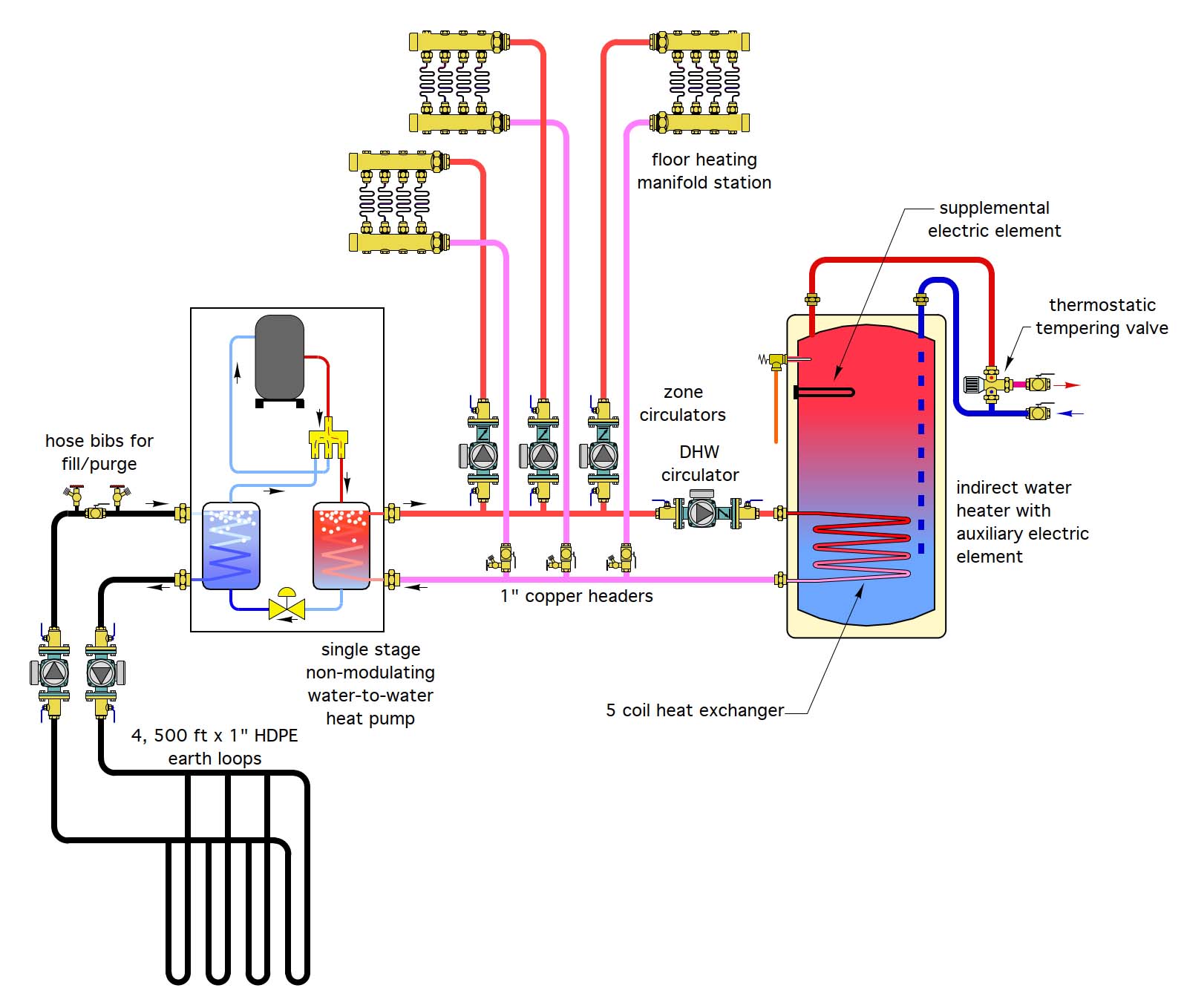
Click diagram to enlarge
Figure 1. Courtesy of John Siegenthaler
The Fixes:
Any single stage non-modulating heat source coupled to a zoned distribution system is likely to experience short cycling when only one or possibly two zones are operating. This is especially true if the heat emitters have low thermal mass. When only one or two zones are operating, heat cannot be delivered to the building as fast as it is generated by the heat pump. The water temperature between the heat pump and operating zones will quickly increase, and the heat pump will turn off on internal safety. It may or may not automatically restart, depending on how its internal controls are configured. Even if it does restart automatically, the short cycling will be chronic.
The solution is to install a buffer tank between the heat pump and space heating loads as shown in figure 2. This allows the rate of heat generation by the heat pump to be very different from the rate of heat dissipation by the load. This tank, in combination with the generously sized headers, also provides good hydraulic separation between the zone circulators and the heat pump-to-buffer tank circulator.
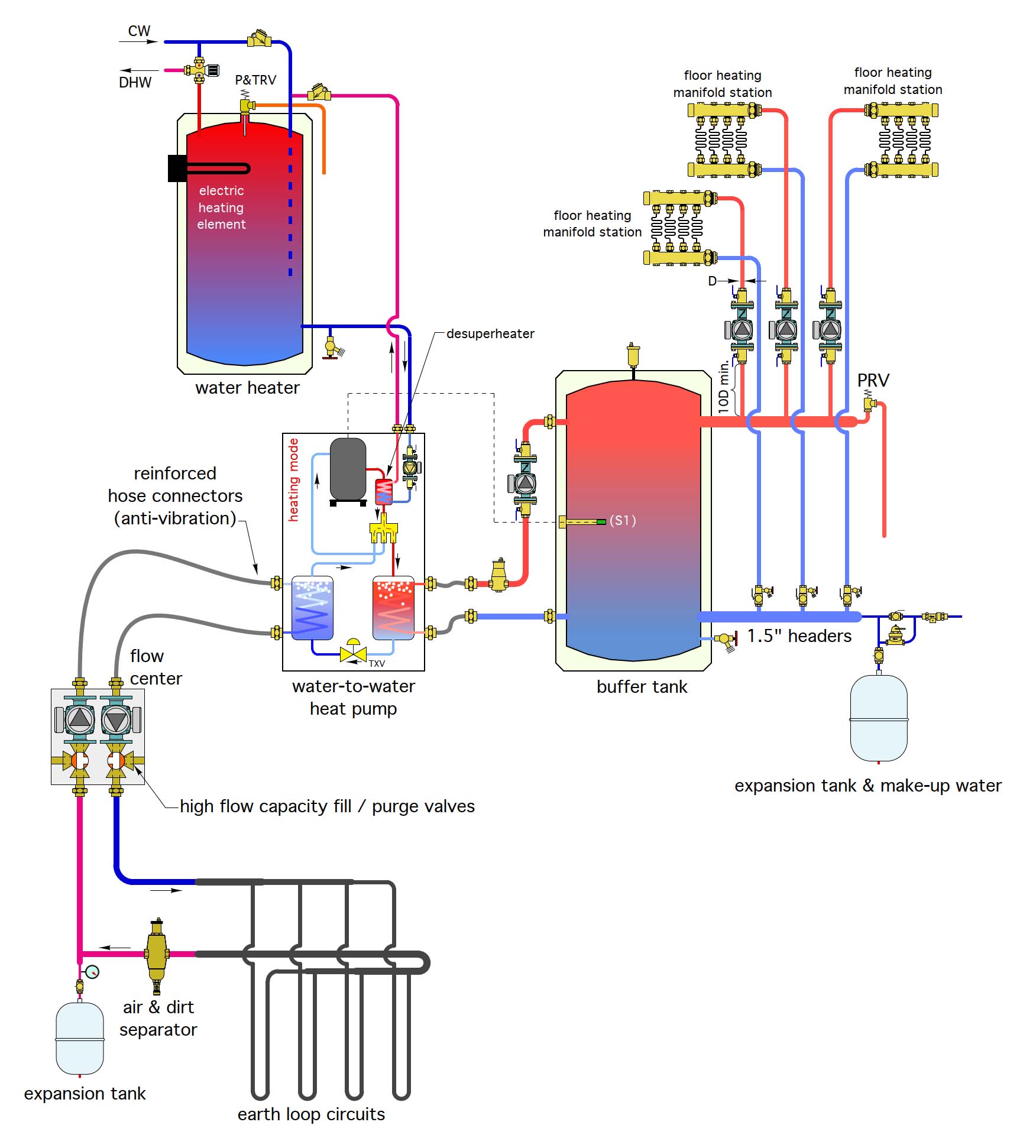
Click diagram to enlarge
Figure 2. Courtesy of John Siegenthaler
The coil heat exchangers in many North American indirect domestic water heaters simply don’t have enough surface area to dissipate the output of a 4- or 5-ton rated heat pump, while operating within the upper water temperature limits of a heat pump (typically 120 to 140 ºF depending on refrigerant). The coil heat exchanger won’t be able to dissipate heat into the tank as fast as heat is generated by the heat pump, and short cycling will occur. This condition can be further worsened if the coil is scaled from dissolved solids in the domestic water.
The simplest alternative to an insufficient indirect water heater is to select a heat pump equipped with a desuperheater heat exchanger. Heat from the hot refrigerant leaving the compressor is transferred to domestic water, and moved to a standard electric water heater tank whenever the heat pump is operating. The upper electric heating element in an electric DHW tank provides any supplemental heating. This option is shown in figure 2.
Getting the earth loop filled and purged through a set of hose bibs is going to be virtually impossible. It takes a substantial flow and differential pressure to simultaneously purge 4 parallel 1-9nch HDPE branches, each of which is 500 feet long. A small submersible transfer pump is way too small. The flow and head needed to purge such a piping network is likely going to require a 2 HP swimming pool pump or equivalent. The flow that such a pump will produce requires purging connection much larger than a typical hose bib. The inlet and outlet connections should be 1-inch pipe size at a minimum. A common solution is to use a geothermal “flow center” specifically matched to the earth loop. Several types of flow centers are available with high-capacity fill / purge valves, and circulator options to match the flow and head requirements of earth loop for residential and light commercial systems.
I also recommend that the earth loop be equipped with a properly sized expansion tank as shown in figure 2. It minimizes pressure variations in the loop as it changes temperature between heating and cooling season operation. The combined air/dirt separator scours out microbubbles and fine dirt particles that may remain in the piping after it is purged.
Other issues with the system in figure 1 are corrected in figure 2.
- Some of the purging valves are upside down.
- There should be a purging valve on the return side of every branch circuit. It’s missing on the return side of the branch through the indirect water heater.
- The inlet of the zone circulators is very close to the header. There should be at least 10 pipe diameters (10D) of straight pipe on the inlet to any circulator to minimize turbulence at the circulator inlet.
- There is no expansion tank or mmake-uphardware shown on the load side of the system.
- The 1-inch copper headers are too small for the combined flow of three zones operating simultaneously.
- There is no air separator in the load side of the system.
- There’s no pressure relief valve on the load side of the system.
Looking for a reprint of this article?
From high-res PDFs to custom plaques, order your copy today!