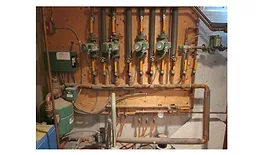
Can you speculate why heat delivery in zone 3 was insufficient before the helper pump? How could the piping system be improved, considering the wasted length of PEX-AL-PEX tubing from the manifolds to the floor panels in figure 2?
The homerun system is a simple technique for connecting multiple heat emitters using two runs of small flexible tubing (such as PEX) for supply and return. In North America, the standard size is 1/2-inch, but 3/8-inch tubing can be used with proper design and compatible fittings.
Driven by advancements in refrigerants, controls and system design, modern heat pumps are taking on applications once thought beyond their reach — from food service and healthcare to district energy and industrial processes. This evolution is creating new opportunities for engineers, facility owners and contractors to rethink how buildings are heated, cooled and powered.
Weather emergencies have steadily increased in frequency and severity over the past six decades. In addition to a gasoline-powered high-volume dewatering pump, we maintained an inventory of submersible sump pumps and if it looked like severe weather was potentially headed our way, I increased our inventory.
Many of the ratios used in the HVAC industry are just some “desirable output” quantity divided by the “necessary input” quantity. One example is the coefficient of performance (COP) of a heat pump. The desirable output quantity is Btu/hr of heat output. The necessary input quantity is the electrical input power needed to operate the heat pump. The latter is typically measured in watts or kilowatts.
A dual-fuel hydronic installation near Lake Michigan demonstrates how hybrid heating systems can improve comfort and efficiency in cold climates.
By pairing an air-to-water heat pump with a high-efficiency propane boiler, contractor James Downs helped a Chicagoland homeowner cut fuel costs and reduce environmental impact — without sacrificing performance.
Explore the power of hands-on learning in the heating industry as seasoned experts share their insights on effective teaching. This editorial reflects on the impact of memorable seminars, the importance of understanding theory, and the art of listening in nurturing the next generation of skilled technicians.
Millinocket is near utility-scale wind turbine farms where strong winter winds can lead to over-generation of electricity, surpassing local grid demand. While it might seem intuitive to shut down some generation equipment during such times, the process is not as simple as flipping a switch.