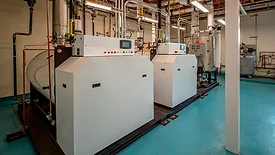
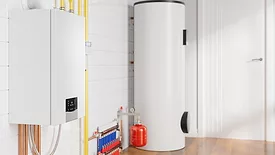
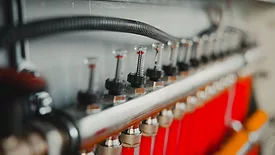
Non-pressurized storage systems have advantages and limitations. In applications where cost per gallon of storage is critical, or where it’s otherwise impractical to bring in one or more pressure-rated tanks, a non-pressurized tank combined with the piping and control concepts discussed represents a viable solution to leverage the combination of time-of-use electrical rates, heat pumps, and the unsurpassed comfort made possible by modern hydronics technology.
As utilities and building owners look for new energy storage solutions, hydronic thermal storage presents an efficient alternative to batteries in many applications.
What if your boiler system could automatically switch between heat sources based on energy cost? A closer look at staging logic, relays and smarter system control.
When comparing hydronic systems designs that are common in North America with typical European equivalents, comparisons reveal details that would be beneficial in either market, but are not “traditional” in one market or the other.
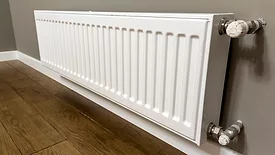
Panel radiators operated at low water temperatures, and with minimal fins attached to the rear of the water plate, can emit upwards of 50% of their total output as radiant heat.
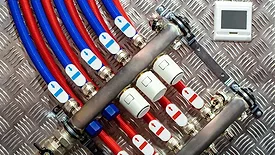
The homerun system is a simple technique for connecting multiple heat emitters using two runs of small flexible tubing (such as PEX) for supply and return. In North America, the standard size is 1/2-inch, but 3/8-inch tubing can be used with proper design and compatible fittings.
Many of the ratios used in the HVAC industry are just some “desirable output” quantity divided by the “necessary input” quantity. One example is the coefficient of performance (COP) of a heat pump. The desirable output quantity is Btu/hr of heat output. The necessary input quantity is the electrical input power needed to operate the heat pump. The latter is typically measured in watts or kilowatts.
Some hydronic heating systems use slab-on-grade floor heating combined with an air handler or fan-coils in other areas of a building. This approach is also used for heated basement floors combined with a “hydro-air” delivery system for the main living areas.
Zoning has always been a premier benefit of hydronic heating and cooling systems. There are many zoning configurations capable of delivering heat (or cooling effect) when and where it’s needed in a building, with minimal effect on the temperature in other parts of the building. Some methods use circulators to create flow in each zone; others use either motorized or thermostatic valves to regulate flow.

 RSS
RSS
.webp?height=168&t=1783240106&width=275 "An Open & Shut Case (part 1)")