The Glitch & The Fix: September 2026
The Glitch & The Fix: Checking Details
Can you find the issues with this heat pump system?

The Glitch:
A contractor installs two identical monobloc air-to-water heat pumps in parallel as shown in figure 1. Each heat pump has its own internal circulator. Each heat pump is connected to a header system that leads back to a buffer tank inside the house. The system operates with a 30% solution of propylene glycol and water.
The installer notices that when both heat pumps are operating, their combined output is very close to double the output of a single heat pump based on its ratings and the current outdoor temperature and leaving water temperature. However, when only one heat pump is operating under the same conditions the measured output in the mechanical room is significantly lower than the rated output. This abnormality holds true regardless of which heat pump is operating while the other is off.
Can you figure out why this is happening and proposed a way to correct it?
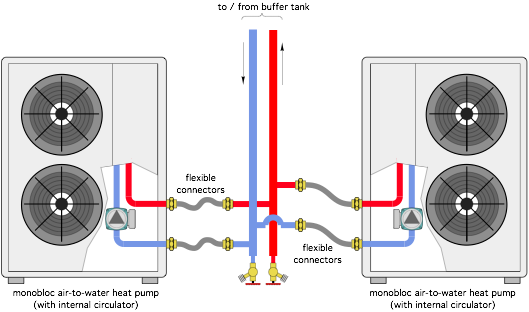
Image courtesy of John Siegenthaler.
The Problem:
Whenever multiple circulators are connected to the same header systems, it’s necessary to install check valves to prevent flow reversal in the inactive circulator. In this case, the antifreeze solution leaving the operating heat pump splits up between one pathway along the headers and through the buffer tank, and another pathway through the inactive heat pump. The latter flow does double harm:
- It reduces the desirable rate of heat transport to the buffer tank.
- The reverse flow through the inactive heat pump increases the fluid temperature entering the active heat pump, which reduces both its heating output and its coefficient of performance (COP).
The Fix:
Fortunately, there’s an easy fix. Just do what you would “instinctively” do when setting up a system using zone circulators - be sure there’s a check valve in each parallel branch. For the heat pump shown, the easiest solution would be to disconnect the flexible hose at the outlet of each heat pump and insert a spring-loaded check valve between the male end of the hose and the male threaded outlet on the heat pump. If the heat pump has FPT connections, just use a brass or stainless close nipple.
Figure 2 shows the check valves installed.
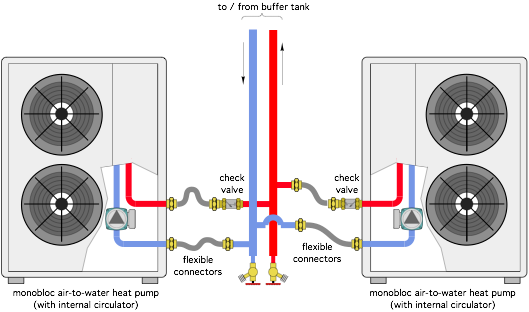
Image courtesy of John Sigenthaler
Adding the check valve will likely add 2.5 to 3.5 inches to the piping connection length. There may be sufficient flexibility in the flexible connector to absorb this added length. If not, get a short flexible connector.
Another option is to install the check valve at the header rather than at the heat pump. Make sure the arrow on the check valve is pointing in the correct direction when the valve is mounted. You might think that getting the check valve inadvertently pointed in the wrong direct never happens - I beg to differ…
Many of the air-to-water heat pumps coming from Europe or Asia have internal circulators. However, I’ve yet to see one that also includes a check valve to prevent flow reversal.
This column is based on a real installation that frustrated just about everyone involved. If those two check valves had been included in the original installation, it would have saved a lot of time and expense.
Looking for a reprint of this article?
From high-res PDFs to custom plaques, order your copy today!