Rethinking How We Work Together at the GF Flow Symposium
What stood out most to me at the GF Flow Symposium was the growing recognition that no one company is going to solve all the problems of the industry alone.
The industry talks a lot about change. It seems like every day we hear, “Faster timelines, bigger projects, more complexity, fewer people.”
But, what stood out most to me at the recent GF Flow Symposium was not the scale of those challenges. Rather, it was the growing recognition that no one company is going to solve them alone.
That was the real theme of the event; togetherness.
Over the course of two days, contractors, manufacturers, distributors and industry leaders came together to talk through some of the most pressing issues facing the built environment today: Labor shortages, compressed schedules, rising material costs and increasing system complexity. None of these topics are new, but the way they were being approached felt distinctly different to me. The event was focused less on individual solutions, and more about collective responsibility.
I had the pleasure of speaking with John Reutter, President of GF Building Flow Solutions Americas (who co-hosted the event with their sister division, GF Industry & Infrastructure Flow Solutions) at the conference, and he told me, “The goal of the symposium is to bring industry experts across multiple facets together to help solve the dynamic and complex problems we have today.”
And – unfortunately – those problems are only intensifying as time goes on. “The pace of change is only getting faster,” he said. “Buildings are getting more complex, projects are getting bigger, and timelines are getting longer.” Layer on external pressures, from supply chain disruption to global instability, and one challenge continues to rise above the rest.
“Labor shortage is the one constant,” Reutter said.
That theme echoed throughout the event, not only in conversations on the show floor, but in sessions specifically focused on workforce development and retention. As demand continues to grow across sectors like data centers, infrastructure and advanced manufacturing, the question is no longer whether the industry needs more people, it’s how to build a workforce that can keep up.
Other sessions highlighted how quickly the job itself is evolving. Discussions around AI infrastructure, semiconductor growth, and the data center boom made it clear that the systems being designed and installed today look very different from those of even a decade ago!
One thing is clear: the way the industry works has to evolve alongside the work itself.
It’s a reality that continues to shape how projects are planned, staffed and executed across the industry. And, paired with compressed timelines, it creates a difficult equation: how do you do more, with fewer people, in less time? The instinct in moments like this is often to work harder; move faster, push through the pain to keep the momentum going.
But, what came through clearly at the symposium is that the real opportunity may lie in working differently. Reutter put it perfectly: “What’s gotten us here is not going to get us there.”
In my opinion, that idea applies across almost every corner of the industry.
For years, success has been built on experience, relationships and the ability to execute under pressure, and those fundamentals still matter! But, today’s environment demands something more: more alignment, more visibility and more collaboration across the value chain.
And that is not something any one company can figure out in isolation. “It’s not any one company that’s going to solve this,” Reutter said. “We’re going to need partners.”
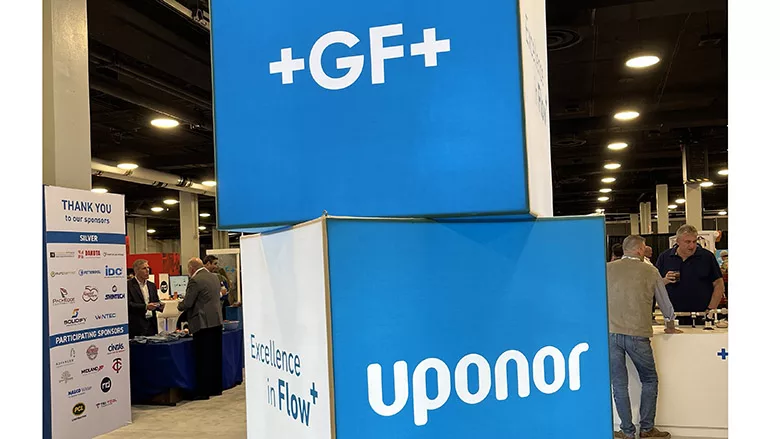
That mindset showed up not just in the content, but in the structure of the event itself. With nearly 40 breakout sessions, a hands-on product showcase and multiple networking events, including a welcome reception and an exciting “Hoedown-Flow-Down” Nashville-style closing celebration, the focus extended far beyond information sharing, and into relationship building.
Conversations focused not just on solving individual problems, but on building the relationships needed to address them over time. “We may not solve everything in the next couple of days,” Reutter added, “but we’re going to know who to contact when we need to.”
In my opinion, that might be one of the most important takeaways. Because in an industry that still runs on relationships and knowing who to call can be just as valuable as having the answer.
I asked Reutter what he wanted people to leave the conference with – other than the fun swag bags, of course! “I want people to come away from this thinking, “How do I have to work differently going forward?” Reutter said.
His question is not a simple one. It might involve rethinking some long-held-onto processes, adopting new tools or communicating earlier and more often. But, it reflects a broader shift, one that moves the industry away from reactive problem-solving and toward more intentional execution, and one where you may have to reach across the table to one that you might even consider a rival.
While much of the industry continues to move toward digital tools and virtual collaboration, the value of being in the same room was hard to ignore.
Hundreds of attendees made the time to be there, at the end of a long stretch of trade shows and industry events, not for a product launch, but for a very important conversation.
“That’s a big ask,” Reutter acknowledged. “But it shows there’s a real need and desire for this.”
The GF Flow Symposium didn’t solve the industry’s biggest challenges; that wasn’t the goal. It did something just as important; it created a space for the right conversations to happen, and for the right people to be in the room when they do.
In a moment where the industry is being asked to do more than ever before, that may be exactly where real progress begins!
Looking for a reprint of this article?
From high-res PDFs to custom plaques, order your copy today!