search
cart
facebook instagram twitter linkedin youtube
  • Sign In
  • Create Account
  • Sign Out
  • My Account
  • NEWS
  • PRODUCTS
    • FEATURED PRODUCTS
  • CONTRACTORS
    • BATH & KITCHEN PRO
    • BUSINESS MANAGEMENT
    • HIGH EFFICIENCY HOMES
    • TECHNOLOGY
    • WATER TREATMENT
    • PMC COLUMNS
      • Dave Yates: Contractor’s Corner
      • John Siegenthaler: Hydronics Workshop
      • Kenny Chapman: The Blue Collar Coach
      • Matt Michel: Service Plumbing Pros
      • Scott Secor: Heating Perceptions
  • ENGINEERS
    • CONTINUING EDUCATION
    • DECARBONIZATION | ELECTRIFICATION
    • FIRE PROTECTION
    • GEOTHERMAL | SOLAR THERMAL
    • PIPING | PLUMBING | PVF
    • PME COLUMNS
      • Christoph Lohr: Strategic Plumbing Insights
      • David Dexter: Plumbing Talking Points
      • James Dipping: Engineer Viewpoints
      • John Seigenthaler: Renewable Heating Design
      • Lowell Manalo: Plumbing Essentials
      • Misty Guard: Guard on Compliance
  • RADIANT & HYDRONICS
    • RADIANT COMFORT REPORT
    • THE GLITCH & THE FIX
  • INSIGHTS
    • CODES
    • GREEN PLUMBING & MECHANICAL
    • PROJECT PROFILES
    • COLUMNS
      • Codes Corner
      • Natalie Forster: Editorial Opinion
      • Guest Editorial
  • MEDIA
    • EBOOKS
    • PODCASTS
    • VIDEOS
    • WEBINARS
  • RESOURCES
    • INDUSTRY CALENDAR
    • DIRECTORIES
    • PM BOOKSTORE
    • CE CENTER
    • MARKET RESEARCH
    • CLASSIFIEDS
  • EMAGAZINE
    • EMAGAZINE
    • ARCHIVE ISSUES
    • CONTACT
    • ADVERTISE
    • PME EMAGAZINE ARCHIVES
  • SIGN UP!
Radiant & HydronicsThe Glitch & The Fix

The Glitch & The Fix: October 2025

Hindsight - From complex loops to clean headers: simplifying for reliability

By John Siegenthaler, P.E.
Figure 3 and Figure 5 feature image
Images courtesy of John Siegenthaler
October 13, 2025
✕
Image in modal.

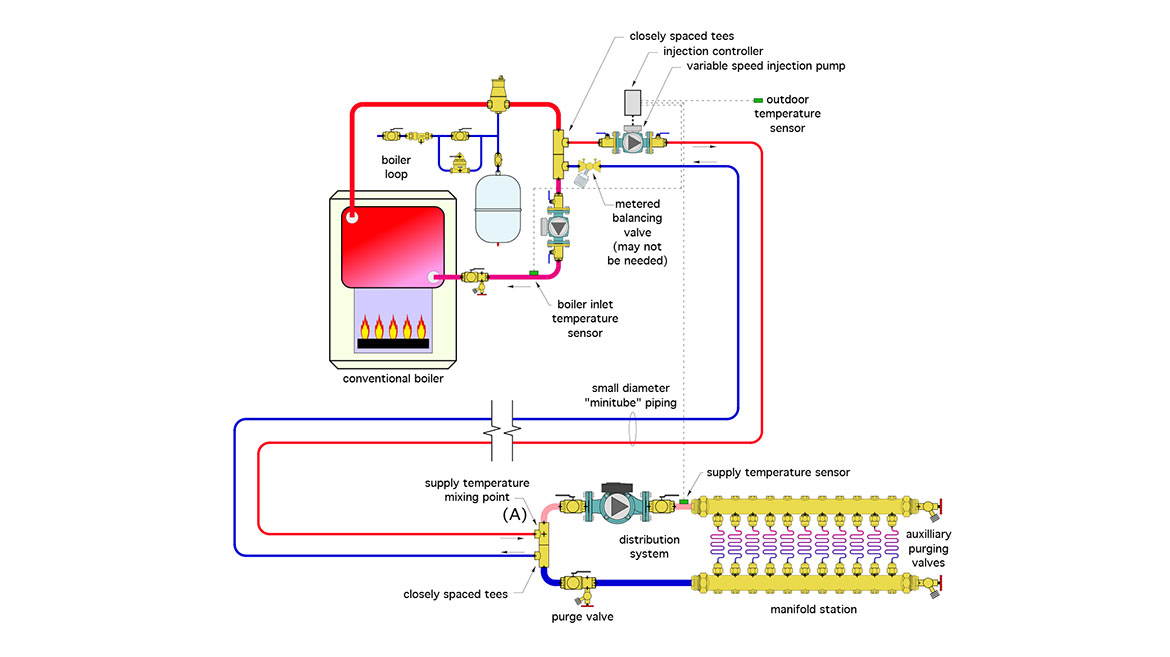
About 25 years ago, I began using a design technique that sends high temperature water to a remote manifold station serving low temperature floor heating circuits. Upon arrival at the manifold, that high temperature water gets mixed with water returning from the floor heating circuits to create a suitable supply water temperature for the embedded circuits. The rate of hot water flow to the manifold station was regulated by a variable speed "injection" pump. The concept is shown in figure 1.

FIGURE 1

Figure 1

Drawing courtesy of John Siegenthaler

The advantage of this approach was a significant reduction in the pipe size needed to transport heat to the manifold station. This is possible because of the high temperature difference between the hot water going to the manifold station (say 180 ºF), and the water returning from the manifold station (say 90ºF). Since that ∆T is about 4 times greater than the typical ∆T of floor heating circuits ( 15 ºF), the flow rate needed for a given rate of heat transport is only about 1/4 of what would be required with the 15 ºF ∆T. That lower flow rate allows 3/4" PEX-AL-PEX tubing to replace 1.5" copper. In large buildings where manifold stations can be located 100+ feet from the mechanical room the savings in distribution piping cost can be thousands of dollars.

I called this approach a "minitube" system.

Multi-zone minitube

The minitube technique can be used on systems with multiple manifold stations. Doing so requires the same hot water temperature to be available to each manifold. It also requires hydraulic separation of the multiple variable-speed injection circulators.  

My original approach to these requirements was heavily influenced by the popularity of primary / secondary piping at the time. I used a parallel primary loop, as shown in figure 2.

FIGURE 2
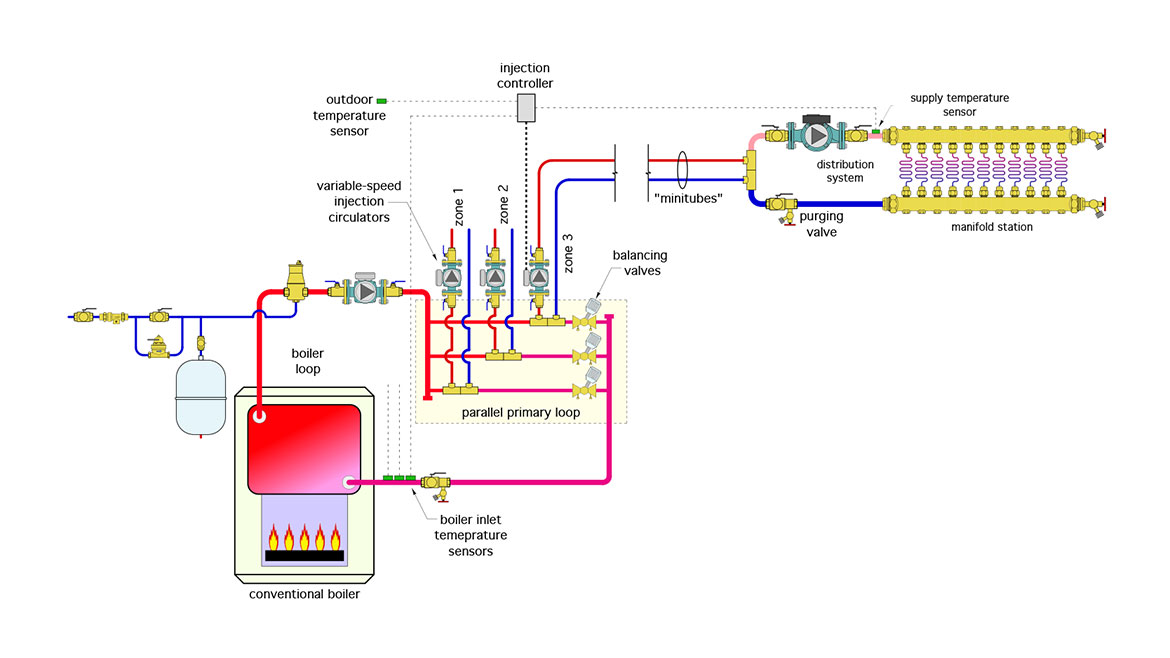
Figure 2

Drawing courtesy of John Siegenthaler

The parallel primary loop provides the same water temperature to each set of closely-spaced tees. However, it involves quite a bit of piping and fittings, as well as a balancing valve on each crossover.

The concept shown in figure 2 was used for a floor heating system in a highway garage.  The installation work was awarded to the lowest bidder. The system worked, but the "craftsmanship" applied during the installation was, well, let’s just say marginal. This became more evident over time. Multiple joints eventually revealed that they were not properly sealed. The slowly oozing antifreeze solution created an ugly patina on several portions of the copper tubing (see figure 3).

FIGURE 3
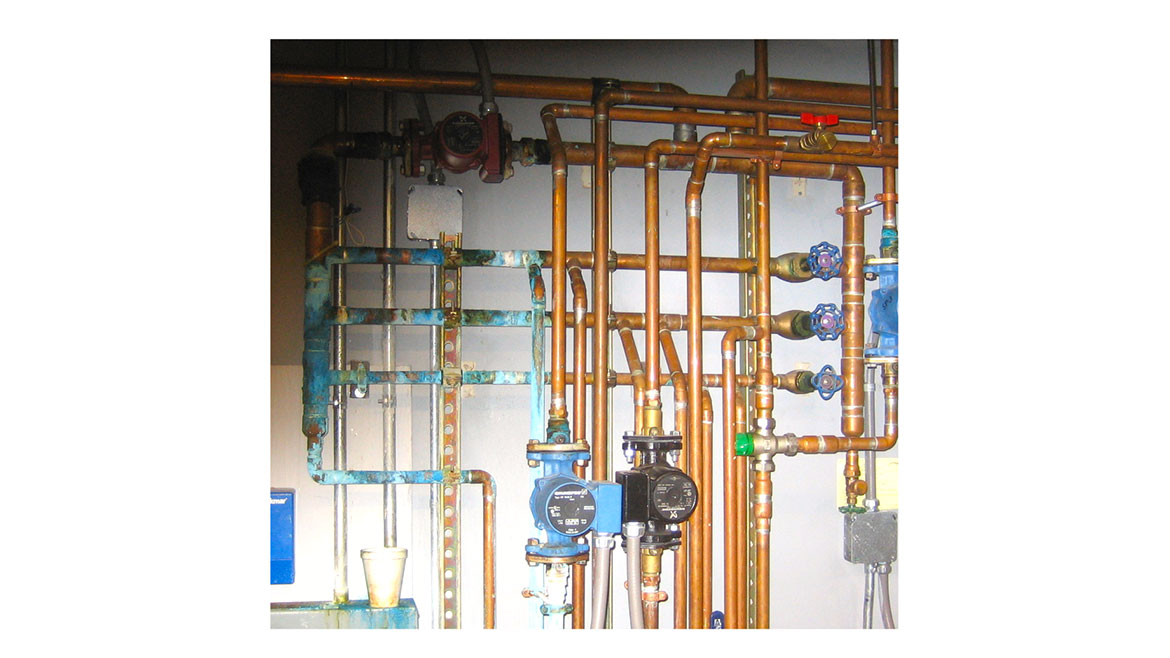
Figure 3

Image courtesy of John Siegenthaler

Although the system continued to work, and the building was properly heated, the client eventually decided to replace portions of the heavily corroded piping. That’s where hydraulic separation - a concept that I was just beginning to appreciate - was used to simplify the replacement piping.

The parallel primary loop seen in figures 2 and 3 was replaced by a simple "short/fat" header as shown in figure 4.

FIGURE 4
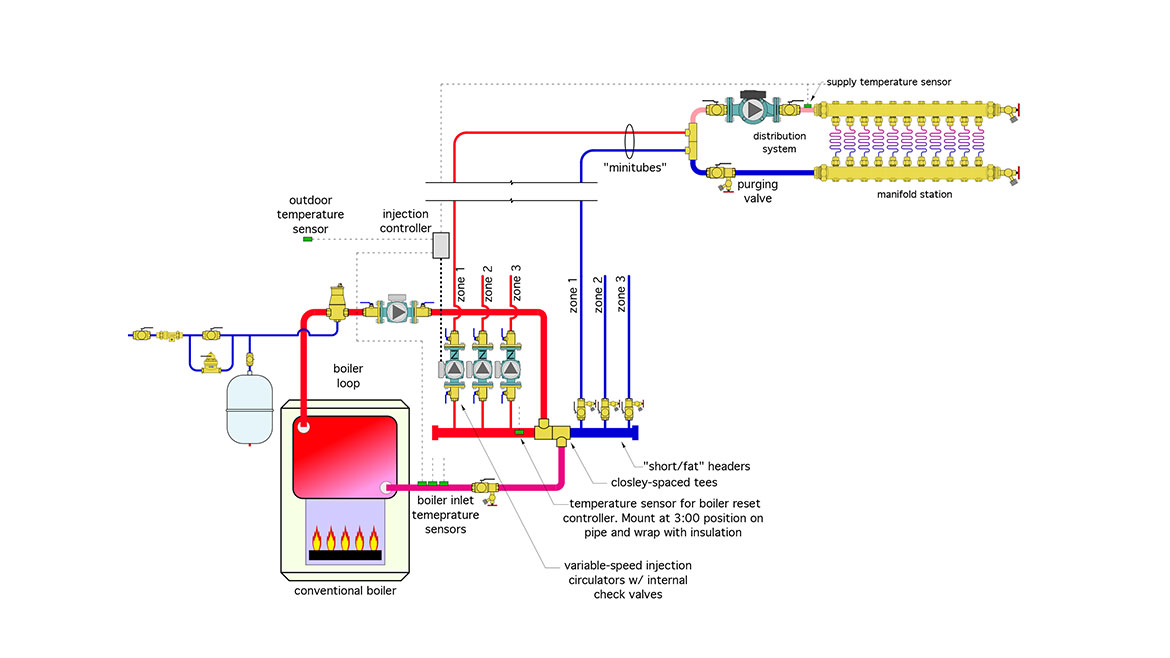
Figure 4

Drawing courtesy of John Siegenthaler

To achieve hydraulic separation the piping that’s "in common" with all the circuits needs to have minimal head loss.For the three variable speed injection circulators in figure 4, that common piping is a minimal length of larger piping (e.g., the "short/fat" headers). In this system, which has a capacity of 400,000 Btu/hr, those "short/fat" headers are 2" copper, and the minitube circuits are 3/4" copper transitioning to 3/4" PEX-AL-PEX for most of the run out to the manifold stations. The boiler circulator is separated from the injection circulators by the closely spaced tees between the supply and return headers serving the minitube circuits.

The system worked, but the "craftsmanship" applied during the installation was, well, let’s just say marginal. This became more evident over time.

Each injection circulator is independently controlled based on the demand of their associated zone. Each injection controller needs a boiler inlet temperature sensor to ensure that the boiler is not operated at conditions that would cause sustained flue gas condensation.

Figure 5 shows the partially completed reworked piping. It’s definitely "cleaned up" and simplified compared to the piping in figure 3. The revision removed the parallel primary loop but left as much of the original piping as possible in place.

FIGURE 5
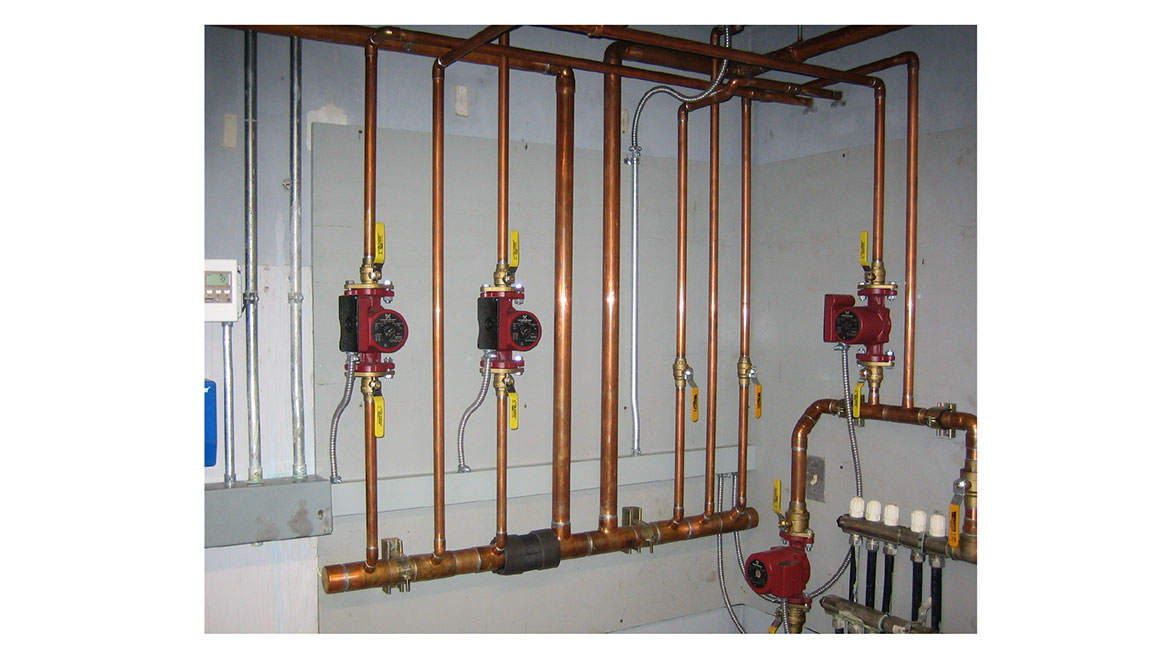
Figure 5

Drawing courtesy of John Siegenthaler

Hindsight is always 20/20. Although the parallel primary loop approach worked, the opportunity to improve a marginal installation, combined with a better understanding of the requirements for hydraulic separation, led to much simpler piping that provided the same performance. It was a lesson applied to many subsequent designs.

Are you an ace troubleshooter?

PM’s Hydronics Editor John Siegenthaler, P.E., will pose a question to you, our readers, to review a system’s schematic layout and discover its faults, flaws and defects. Good luck!
Read More The Glitch & The Fix⮞

KEYWORDS: heating systems hydronics radiant radiant design

Share This Story

Looking for a reprint of this article?
From high-res PDFs to custom plaques, order your copy today!

John siegenthaler 200x200

John Siegenthaler, P.E., is a consulting engineer and principal of Appropriate Designs in Holland Patent, New York. In partnership with HeatSpring, he has developed several online courses that provide in-depth, design-level training in modern hydronics systems, air-to-water heat pumps and biomass boiler systems. Additional information and resources for hydronic system design are available on Siegenthaler’s website,  www.hydronicpros.com.

Recommended Content

JOIN TODAY
to unlock your recommendations.

Already have an account? Sign In

  • 2025 Next Gen ALL-STARS hero 1440

    2025 Next Gen All Stars: Top 20 Under 40 Plumbing Professionals

    This year’s group of NextGen All-Stars is full of young...
    Plumbing & Mechanical Contractor
    By: Kristen R. Bayles
  • Worker using the Milwaukee Tool SWITCH PACK drain cleaner

    Pipeline profits: Drain cleaning, pipe inspection create opportunities

    Drain cleaning and inspection services offer lucrative...
    Green Plumbing and Mechanical
    By: Nicole Krawcke
  • Uponor employee, Arturo Moreno

    The reinvestment in American manufacturing and training

    Plumbing & Mechanical Chief Editor Nicole Krawcke and...
    Plumbing News
    By: Nicole Krawcke and Natalie Forster
Manage My Account
  • eNewsletters
  • Online Registration
  • Subscription Customer Service
  • eMagazine
  • Manage My Preferences

More Videos

Popular Stories

Hot water pipes

Campus shutdown at Oakland University exposes hidden risks of aging hot-water infrastructure

Floor heating manifold cabinet with flowmeter and PEX pipe.

Elegance extended: How to use the homerun system of connecting heat emitters

Industrial pressure gauge on a tank.

From cutting edge to classic: How to modernize outdated pneumatic control systems

Poll

Will business be up or down in 2025?

Do you anticipate business in 2025 to be up or down in comparison to 2024?
View Results Poll Archive

Products

The Water Came To A Stop

The Water Came To A Stop

See More Products
eBook | 2025 Radiant & Hydronics All Stars

Related Articles

  • 01 PME 1123 CLMN John Siegenthaler

    Concepts for varying flow rate in geothermal earth loops

    See More
  • 01 PME John Siegenthaler column opening photo

    Concepts for varying flow rate in geothermal earth loops — Part 2

    See More
  • PM0919_TheGlitch.jpg

    The Glitch and Fix: Overly complex

    See More

Related Products

See More Products
  • Classic Hydronics - How To Get The Most From Those Older Hot-Water Heating Systems

  • Inspector Book.jpg

    Lessons Learned: A Guide to Boilers for Home Inspectors

  • Optimizing Social Media from a B2B Perspective

See More Products

Events

View AllSubmit An Event
  • May 15, 2025

    From Legacy to Leadership: Preparing Your Home Services Business for the Next Generation

    On Demand Whether you're passing the torch to a family member or grooming current employees for leadership, preparing the next generation of leaders is key.
View AllSubmit An Event
×

Keep your content unclogged with our newsletters!

Stay in the know on the latest plumbing & piping industry trends.

JOIN TODAY!
  • RESOURCES
    • Advertise
    • Contact Us
    • Directories
    • Store
    • Want More
    • Supply House Times
  • SIGN UP TODAY
    • Create Account
    • eMagazine
    • eNewsletter
    • Customer Service
    • Manage Preferences
  • SERVICES
    • Marketing Services
    • Reprints
    • Market Research
    • List Rental
    • Survey/Respondent Access
  • STAY CONNECTED
    • LinkedIn
    • Facebook
    • Instagram
    • YouTube
    • X (Twitter)
  • PRIVACY
    • PRIVACY POLICY
    • TERMS & CONDITIONS
    • DO NOT SELL MY PERSONAL INFORMATION
    • PRIVACY REQUEST
    • ACCESSIBILITY

Copyright ©2025. All Rights Reserved BNP Media.

Design, CMS, Hosting & Web Development :: ePublishing