Radiant Comfort Report Spring 2025 Edition
Radiant Professionals Alliance educating the industry
Resources and new technologies to stay up-to-date on radiant & hydronics.
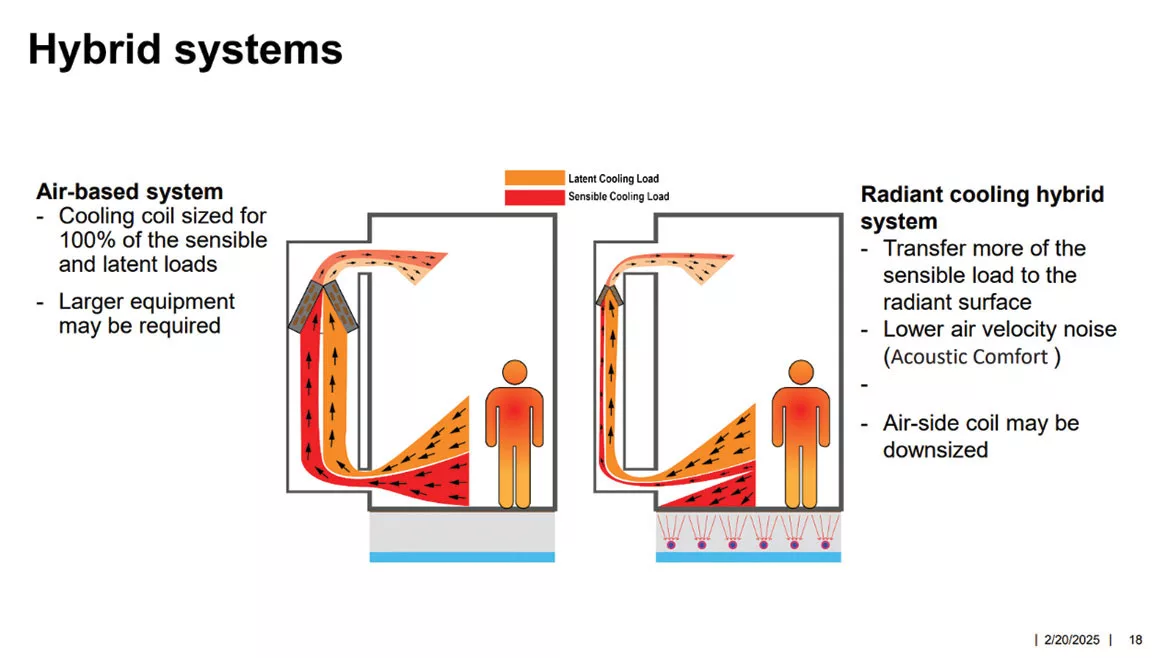
Image courtesy of IAPMO
The Radiant Professionals Alliance (RPA) provides superior comprehensive educational activities and innovative product awareness. This was evident at the 2025 AHR conference held in Orlando Florida. The RPA hosted eight sessions providing education to professionals and students. From the eight sessions, I would like to highlight five that deal with industry patterns, installation practices and innovative design. These sessions dealt with current industry patterns, installations practices and the latest technologies. Thank you to all of our presenters for lending your expertise to better the industry.
How cities can use thermal energy networks (TENs) to cut pollution and create jobs
Presented by Jay Egg
Jay Egg from Egg Geothermal gave an excellent presentation on thermal energy networks, better known as TENs. Underground TENs are becoming important for the future of U.S energy. Many jurisdictions have implemented TENS as a means to reduce carbon emission. A TENs system can provide an efficient way to reuse energy loss from a commercial and residential building. The system uses a network of pipes that act as a thermal source and sink for space heating and cooling, and water heating purposes as displayed in the image below. As Mr. Egg stated, this technology can add thousands of jobs for tradesmen, electricians, HVAC, and excavators.
Since the 2018 edition, the Uniform Mechanical Code has provided the minimum requirements for geothermal energy systems, including district systems. Experts like Jay Egg have volunteered their time to improve the codes to provide guidance to the industry. To learn more about TENs, please visit the RPA website to listen to Mr. Egg’s presentation.
Radiant cooling: High performance trends and system research
Presented by Carlos Duarte & Saeed Danesh
A presentation that we would also like to highlight is the presentation by Carlos Duarte from the Center of Built Environment at UC Berkely and Saeed Danes from REHAU. Mr. Duarte and Mr. Danes presentation included high performance trends and research on radiant cooling systems. This co-presented presentation discussed the benefits of radiant systems; benefits like superior comfort, energy efficiency, and the reduce of maintenance and operating cost when compared to other systems.
How to use new model specs for ground source geothermal piping systems
Presented by Lance MacNevin, P.Eng.
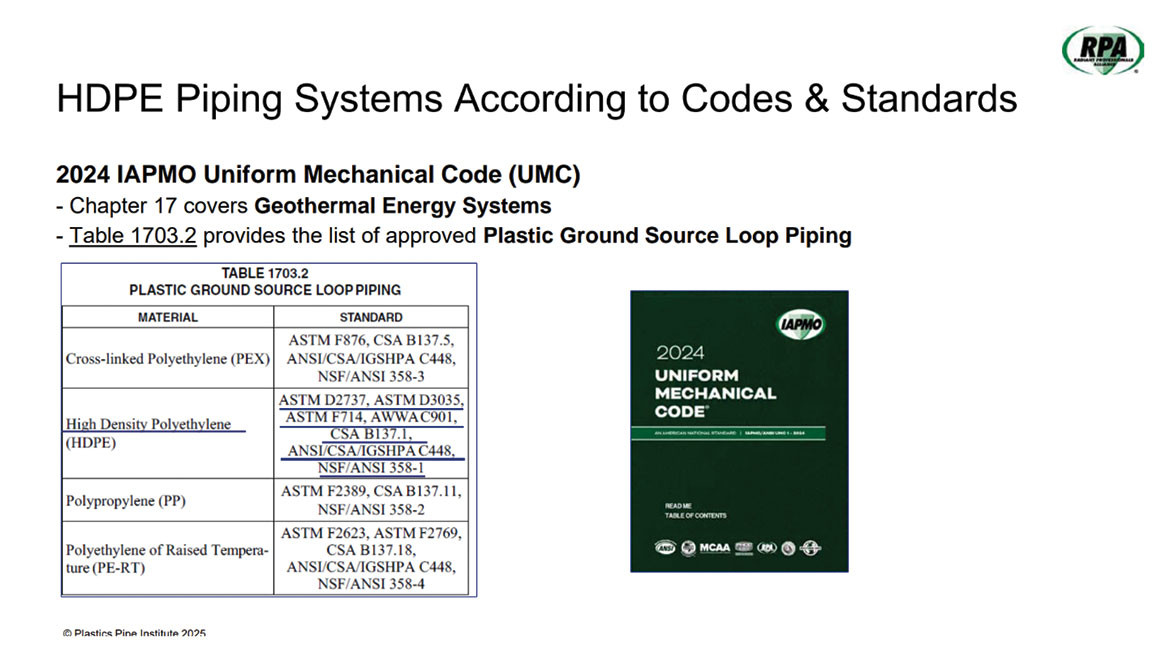
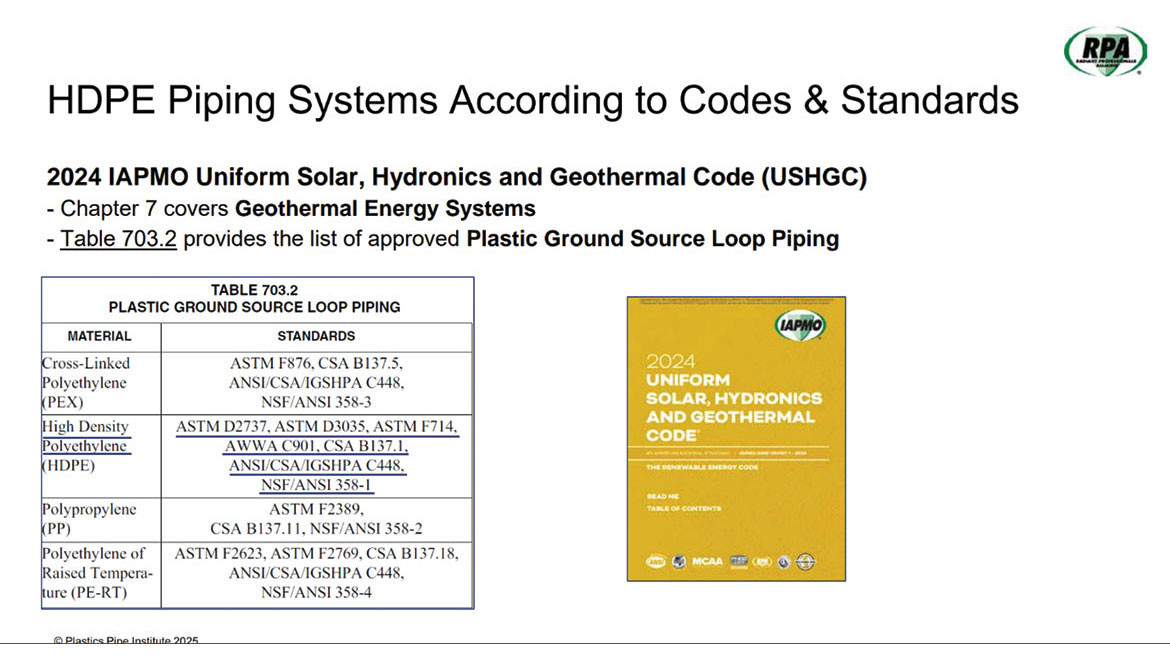
The AHR also included a presentation from long-time RPA member Lance MacNevin from the Plastics Pipe Institute. Lance presented on the model specifications for ground source geothermal piping systems (PPI MS-7 and MS-8). It focused on a technical specification on codes and standards and how to utilize PPI model specifications. The table below talked about the acceptable standards in the Uniform Mechanical Code (UMC) and the Uniform Solar, Hydronics and Geothermal Code (USHGC) for HDPE piping systems used in geothermal energy systems.
© Plastics Pine Institute 2025
© Plastics Pine Institute 2025
Radiant heating: Best practices for design and installation
Presented by William J. Werthman
Willima Werthman form Legend Valve presented on installation practices and guidelines. Mr. Werthman discussed applications such as wet systems (high mass), dry systems (low mass), and pipe layout guidelines. When it came to providing guidelines for the installation of tile and stone, the recommendation is to always install the substrate in accordance with the TCNA (Tile Council of North America), it is not recommended to operate a radiant system at less 7 days after installation but 28 days is ideal and recommends the installation of crack suppressant to slow any crack propagation. When using hardwood floors, the manufacturer’s recommendation should be followed. Different types of hardwood were discussed, and resistance value must be known for the different hardwoods.
When carpet and pads are used on top of radiant, you must use a pad designed for radiant systems with a dense pad that transfers heat and has low resistance or use no pad at all.
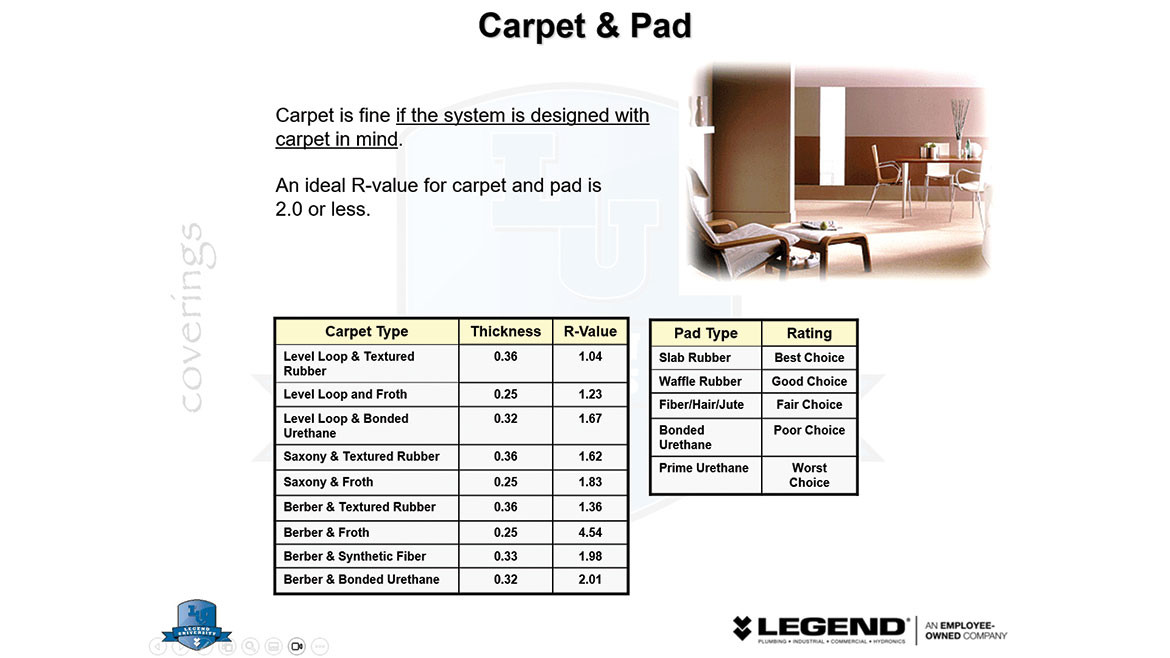
Image courtesy of IAPMO
Other guidelines for wet systems include: a minimum of R-10 is recommended for radiant floors, proper use of insulation, placement and anchoring of tubing, and guidelines for over pour systems. For dry systems, a pipe layout was recommended with a typical spacing of 6 to 12 inches for residential systems and 18 inches spacing for commercial. Other dry systems recommendations include transfer plates for the proper heat transfer, and some explanations on what not to do were provided. Overall, an excellent presentation by Mr. Werthman and I would encourage industry professionals and students to listen to his presentation.
Latest Technologies
Energy modeling: The future of BEST software
Presented by Greg Cunniff
When it comes to the latest technology, the Building Efficiency System Tool (BEST) Software certainly deserves some recognition due to its capabilities and for receiving the 2025 Innovation Award from AHR. The software allows an accurate comparison of up to four different HVAC systems before there is a system in place. It allows the comparison to be made with a fraction of the time when compared to other sizing tools. A comparison that will allow the right decision to be made for the energy and operating cost and life cycle cost for your city and building (see below image).
With the move to carbonization and electrification, the BEST software is being updated to include thermal energy networks (TEN) and it is slated to be completed in 2025. With the upgrade, one can model district energy systems including thermal energy networks. An example of a thermal energy network with shared energy between buildings includes a single pipe loop around a community with a supply and a return to add energy or obtain energy from the loop.
Other future potential options for BEST include waste energy transfer which is another type of thermal energy network. These systems use wastewater to obtain heat via a heat exchanger and auxiliary heat pump to compensate for the additional heat required to its final temperature of 110oF or 120oF.
If you are interested BEST, I would encourage you to join the Hydronics Industry Alliance so that you are involved in the conversations. The Hydronics Industry Alliance is a committee of the RPA.
Please visit the RPA website to download the BEST software for free at https://hydronicsindustryalliance.org/best-software
Submit your abstract: As an RPA member, RPA can provide a venue for you or your organization to present at the next AHR Expo to share your concept or design idea. The RPA is now collecting abstracts for speaker opportunities at the 2026 AHR Expo in Las Vegas, Nevada. The RPA will host business meetings and educational sessions at one of North America's largest Expos for our trade. The team is preparing panel sessions and educational talks to benefit our members and the AHR audience. Please contact us at RPA@radiantprofessionalsalliance.org if you or someone you know is interested in speaking on behalf of The Alliance.
The RPA membership look forward to providing quality education that everyone can benefit from. We look forward to providing further quality education in 2026.
Join RPA. If you would like to know more about becoming part of the alliance please feel free to contact us at RPA@radiantprofessionalsalliance.org. If you are not a member of RPA, then you should join.
Looking for a reprint of this article?
From high-res PDFs to custom plaques, order your copy today!