
Ray Wohlfarth: Troubleshooting hydronics
Always assume it’s wrong!
A water meter is installed to let the owner know if there is a leak in the system. Photo credit: Ray Wohlfarth

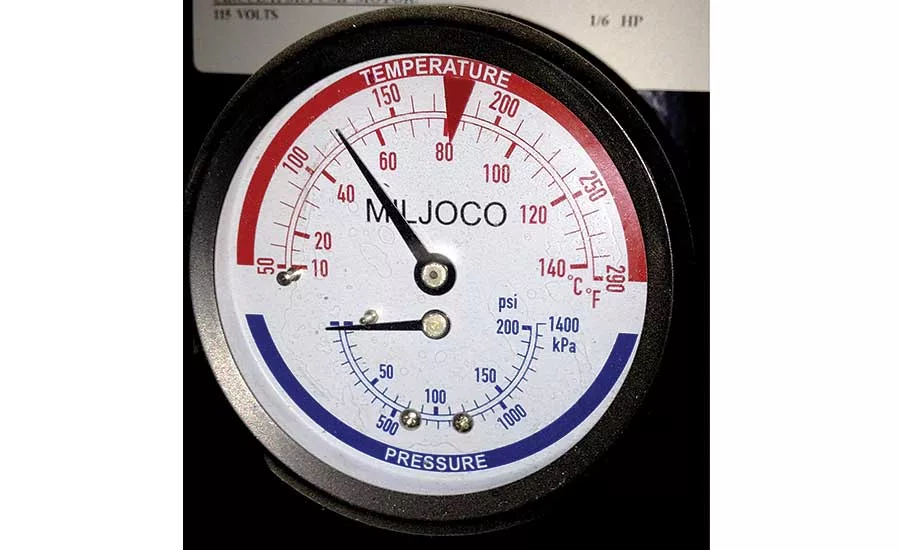
A pressure temperature altitude (PTA) gauge tells the owner the system pressure, elevation of the water and the temperature of the water. Photo credit: Ray Wohlfarth
When I look at any replacement hydronic boiler project, my tenet is always to assume the existing system is installed improperly. I like to pretend I am a famous detective, such as Sherlock Holmes, and my job is to uncover the hidden mistakes.
What I learned early on was you inherit any problem in the building once you touch the boiler. My boilers have been blamed for everything from a malfunctioning garage door opener to the lights in the second-floor classroom stopped working. You may have heard the customer say this on one of your jobs, “This thing worked fine before you installed that new boiler.”
The problem is it may or may not be true, and now you have to prove your new boilers did not cause the problem — all of this at your own cost.
Questions
I like to speak with the person responsible for the boilers; the one who deals with them daily. This individual may be a custodian or maintenance person. I want to ask questions and following my tenet, I assume there is a problem and will direct my questions in that vein.
For instance, I ask, “What areas are the hardest to heat?” or “Which areas do you get the most complaints?” This assumes there is a problem. Another question I ask is: “Why are you looking to replace the boiler(s)?”
The customer will most likely tell you the most significant problems they are having with the system. Another question is, “How long has this been a problem?” This tells me if something changed or if this was a problem all the time.
System pressure
I was the third contractor to look at a boiler replacement project in a six-story apartment building. The onsite contact told me they were looking to replace the 10-year-old boiler because the top apartments would not heat.
When I looked at the boiler, I noticed the system pressure was 12 psi or enough static pressure to reach 28 feet or about three stories high. One pound of pressure will raise water 2.3 feet. I initially thought I was being pranked or the subject of a hidden camera exposé. How could they not increase the system pressure and get heat to the top floors?
I met with the owner and told him what I found. I explained how I could give him a price for a new boiler but believed that increasing the system pressure would solve the problem. He eagerly agreed, and I talked myself out of the boiler sale. What did happen though was we were given the maintenance responsibility for every building with boilers the owner managed. While we did not get that project, we did get two others, plus all the service.
System pressure 2.0
We were asked to look at the circulator pumps for the hydronic heating system because they were noisy. When the owner flipped the electrical breaker on for the pumps, the pumps banged and the pipes shook wildly. I had never seen such a thing, and the owner shut off the power.
While walking around the boiler to access the pumps, I noticed the system static pressure was less than 5 psi. After opening the bypass valve and filling the system with water to the proper static pressure, the noisy pumps quieted and the pipes stopped shaking.
The boiler had a low water cutoff, but the pumps ran out of water and cavitated before tripping the low water control. The added water stopped the pumps from cavitating. Cavitation is a formation of bubbles inside a liquid, and they collapse due to a rapid pressure change. The collapsing bubbles can cause an intense shock wave and damage the pump.
There is a water leak
According to the water meter on the makeup water pipe, the system was losing water, and we had no idea where. The leak started a few weeks before, and the amount of water lost was significant. There was no evidence of a leak in the boiler room or the piping.
As a sort of Hail Mary pass, the maintenance person and I opened the access door on the air handling unit and discovered our leak. The hydronic coil froze and split, and the tube was leaking water onto the drain pan of the air handling system.
During the preventive maintenance check at another building, the water meter showed a leak in the system. We traced the piping and could not find the leak. The new custodian told me he had not seen a water leak anywhere in the building. The leak was discovered when we returned to the boiler room. The custodian had a large rubber hose attached to the boiler drain and was using the boiler water to clean the boiler room floor.
I explained how he was wasting the chemically treated water. If the owner had not installed the water meters, the leaks might not have been discovered until irreparable damage was done to the boiler or piping. Water meters are a good idea for any hydronic system.
Telephone chain
During a prolonged cold snap, one of our school district customers called with a cold office. The technician discovered a wide temperature drop between the supply and return loops. He diagnosed the problem as inadequate flow. He blamed the flow problem on the design engineer and stated the pump was too small.
When the technician left, the customer called the school superintendent, who called the school district architect, who called the design engineer, who called me. It was not pretty. In between curse words and threats of a lawsuit, I calmed the engineer and offered to meet him on the job site that day. The school maintenance person met us on site as well.
When I arrived, we found the flow was indeed inadequate and went back to the boiler room to check the circulating pumps. Inside the boiler room, we saw someone had replaced the original pump with a much smaller one. The maintenance person swallowed hard and suggested that it was he who did it. The smaller pump was supposed to be a temporary repair while the original was repaired. We reinstalled the rebuilt pump, and the office heated.
The problem was resolved, but the school district decided to switch to another vendor shortly afterward, and the engineer’s office never again used our products. If my technician had gone inside the boiler room, he would have seen the problem and resolved it without the angry telephone calls.
Looking for a reprint of this article?
From high-res PDFs to custom plaques, order your copy today!


