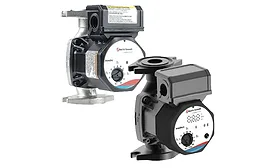
The compliance date may be in 2028, but the transition is already creating an opportunity to think differently about circulator selection. Contractors and distributors who use the time now to strengthen their system-level knowledge will be better prepared not only to meet the new requirements, but also to help customers make more informed decisions about how their hydronic systems perform.
Two identical air-to-water heat pumps deliver nearly twice the expected output when operating together, but when either unit runs alone, its measured output falls well below its rating. What’s causing the performance drop, and how can the system be corrected?
Advancements in the plumbing industry are driven by U.S. Department of Energy regulations, with new efficiency standards for fractional horsepower pumps set for 2028. Plumbing & Mechanical's Nicole Krawcke discussed these changes and performance improvements with Becky Henderson from Grundfos Pumps.
The photo in Figure 1 shows a non-pressurized outdoor wood-fired furnace connected to a floor heating subsystem via two PEX tubes. It includes a cast iron circulator, a thermostatic 3-way valve for mixing, a bypass linking supply and return tubes, and an "expansion zone" for another floor heating circuit. This setup is in a multi-million dollar home. Are there any potential issues with the installation?
A project needs medium- and low-temperature radiant floor panels. The installer proposes using a mod/con boiler with a 1-inch tempering valve for lower temperatures and plans to pipe the entire system with 1-inch tubing. What potential issues could arise from this design?
The two photos below were from the same project. Flow is upward through the vertical pipe in Figure 1. Without any more details being described, can you spot at least two problems in each photo?
The new EC Motor-Driven, high-efficiency, wet-rotor circulator pump for the residential and commercial HVAC market is designed to improve performance and save energy consumption.