
What Your Truck Says Before Your Techs Say a Word
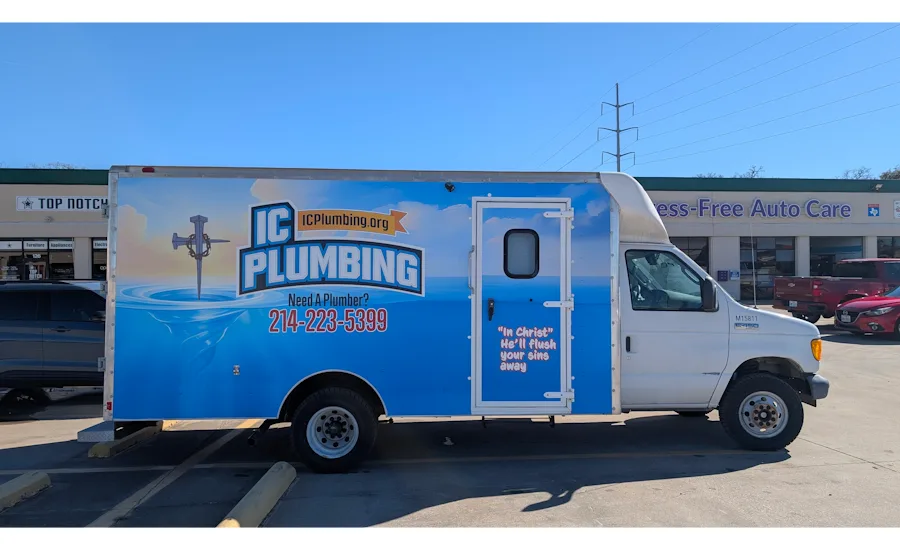
Two plumbing vans stopped at the same red light in front of me last spring. The first was beautiful. Flames of blue water curled down the side, a mascot grinned from the back door, and somewhere in the artwork sat a phone number I could not find before the light turned green. The second van was plainer: a name, the word plumbing in big letters, a promise about same-day service, and a phone number I could have read from twice the distance. I remember the second company. I could not tell you the name of the first.
That intersection is where most fleet graphics succeed or fail, and it has almost nothing to do with how good the design looks parked outside your shop. A service vehicle is the only advertisement a contractor owns that shows up unannounced in the customer's own neighborhood, parks in a driveway like an endorsement, and drives past thousands of people between jobs. It is also the only advertisement most contractors buy by asking what it costs per square foot instead of asking what it needs to say.
After years of watching which trucks generate calls and which just generate compliments, I use a simple standard I call the 45 MPH Test. At traffic speed, a viewer gives your vehicle about three seconds. In those three seconds, five things need to land:
- The company name. Readable at distance, not buried in a logo that only works on a business card.
- The service category. The word plumbing, visible from across an intersection. Homeowners do not remember clever. They remember plumber.
- One brand promise. Same-day service. Upfront pricing. Licensed and insured since 1988. One claim, chosen deliberately. Trucks that try to say four things say nothing.
- The contact path. One phone number or one web address, large, high on the vehicle where traffic can see it. Not both, not five social icons, not a QR code on a moving truck.
- The service area. A city name tells the viewer you are local, and local is half the buying decision in residential service.
Five elements, three seconds. Everything else on the vehicle is decoration, and decoration is fine only after communication is handled.
Here is the part that stings: the failures are almost never the installer's fault, and they are rarely the designer's fault either. They happen because the design conversation started with what will fit on the truck instead of what the company stands for. When a contractor cannot say in one sentence who they serve and why those customers should choose them, the truck ends up saying everything, which reads as nothing at 45 miles per hour. The vehicle is not the brand. It is the loudest place the brand shows up, and it can only repeat what the business has already decided.
The problem compounds across a fleet. I regularly see companies whose vans, pickups, and trailers were done in different years, by different shops, in different eras of the logo. Individually, some of those vehicles pass the test. Together they read as three different companies, which quietly splits the credibility a fleet is supposed to compound. A homeowner who sees the same company three times in a week has a reason to trust it. A homeowner who sees three different-looking trucks from the same company has seen it once, three times.
You can grade your own fleet this afternoon, and it costs nothing. Photograph each vehicle from the side and from behind, at least fifty feet away, because that is how traffic sees it. Look at each photo for three seconds, then look away and write down what you remember. Better, show it to someone who does not work for you and ask them three questions: What is the company called? What do they do? How would you reach them? Then put the photos of all your vehicles side by side and ask one more: do these look like the same company? If the answers come back wrong, you have not found a vinyl problem. You have found a decision the business has not made yet, wearing a wrap.
The lesson from that red light has held up in every fleet I have looked at since. The trucks that ring the phone are almost never the prettiest ones in town. They are the ones where somebody decided, before any design work started, exactly what three seconds of a stranger's attention should accomplish. Make that decision first. The vinyl is just where it becomes visible.
Looking for a reprint of this article?
From high-res PDFs to custom plaques, order your copy today!


