
What Mechanical Square Footage Costs Plumbing Contractors on the Back End
The contractors who stay profitable through the next two years are the ones who know their real cost per job, not their theoretical cost per square foot.
Last spring, a plumber I work with in Charlotte sent me a bid packet where the GC had already penciled in mechanical at a flat rate per square foot, based on a cost book that was, best I could tell, at least five years old. The house was 5,200 square feet, three-and-a-half baths, a recirculation loop, and a slab that had already been poured over a rough-in the previous plumber walked away from. The GC's number worked out to roughly $6 per square foot for plumbing. Contractors in that same market were quoting $14-$22 per square foot for comparable custom work.
That is not a rounding error. That is the difference between a profitable job and a lien filing.
The Benchmark Everyone Quotes Is Already Behind
There is a widely repeated planning range of $4 to $8 per square foot for new-construction plumbing, and a 2026 buyer-facing guide still lists $4.50 per square foot as a working benchmark for new houses. Those numbers are not wrong in the aggregate. They are wrong for almost every specific job you will bid this quarter.
Here is why. On new-construction plumbing, labor is roughly 50 to 65 percent of total cost, and the BLS put the median annual wage for plumbers, pipefitters, and steamfitters at $62,970 in May 2024. Wages have kept moving. Meanwhile, the "mechanical per SF" allowance in a design set does not.
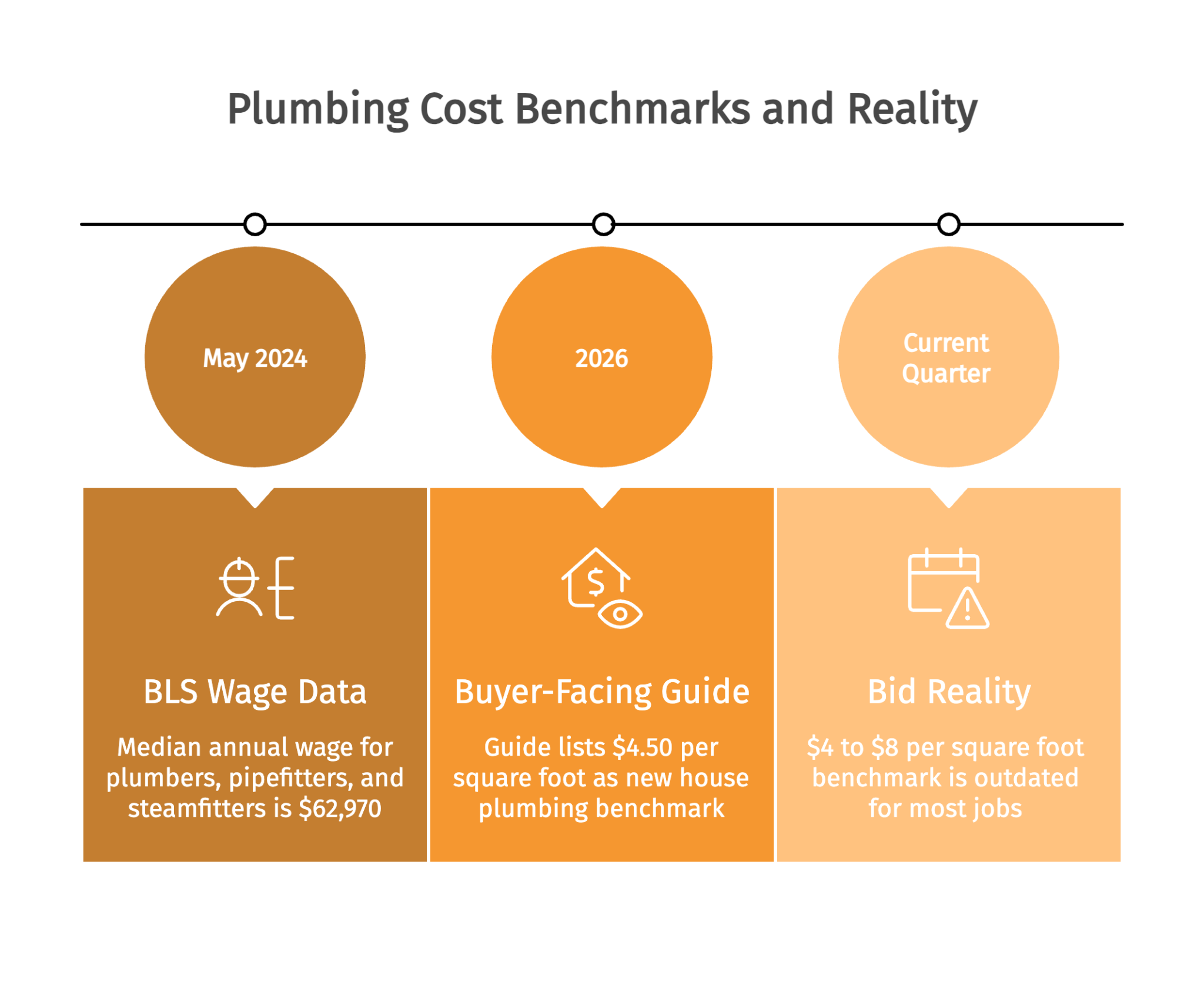
Image courtesy of Field Promax.
Where Square-Foot Pricing Actively Hides Risk
Square-foot pricing works for shells. It fails for plumbing because plumbing cost is driven by fixture count, linear feet of pipe, code requirements, and fixture grade, not by the floor plan's outline.
Consider what the same "per square foot" logic buries:
A 40-square-foot bathroom in Phoenix can run $450 to $875 per square foot once fixtures and finishes are in, while the rest of the house sits at a fraction of that.
CPVC supply and install runs $1.50 to $3.25 per linear foot. That is a linear-foot cost. It does not scale with square footage.
Outpatient surgery centers can see plumbing materials alone hit 23 percent of total material cost. A generic mechanical allowance on a medical TI will not survive first submittal.
On commercial work, plumbing represents up to 4.3 percent of total construction cost, and a small percentage mistake on a $560-per-square-foot mid-rise is a large absolute number.
A construction finance write-up put it plainly: stop using square-foot estimating in residential construction, because dividing house cost by area hides plan geometry, fixture level, and MEP intensity.
What Back-End Damage Actually Looks Like
I have seen the back-end damage show up three ways.
First, margin compression on service and drain work. Profitability analysis for plumbing shops assumes a typical job around $1,200 in revenue, with direct cost at 45 to 50 percent, and drain cleaning running 65 to 75 percent direct cost. There is not much room to absorb a mis-scoped rough-in.
Second, emergency work eating the schedule. The typical contractor on our platform runs somewhere in the 15 to 30 percent range of jobs as emergency calls, and those shops lean on real-time dispatch reassignment rather than fixed-route planning to keep technicians billable. If you priced a new-construction job flat at $5 per square foot and then lose two techs to a Saturday callout at $150 to $300 per hour of premium labor, the math on the flat-priced job gets uglier.
Third, invisible bleed on multi-phase work. Rough-in, top-out, trim, and punch each carry their own labor mix. When they are collapsed into one SF number, overruns in one phase do not surface until the whole job closes.
What Contractors I Trust Are Doing Instead
The shops I see holding margin in 2025 and 2026 have done three unglamorous things.
They estimate by fixture count and linear foot, then reconcile against a per-SF sanity check, not the other way around. Bathroom rough-in alone ranges $2,000 to $5,000 in labor and materials, independent of the room's footprint.
They actually job cost. Job costing tracks all labor, materials, and overhead for a specific job, so overruns get caught while the job is live, not at year-end.
They watch dashboards weekly. Most operators report that the single most-overlooked feature in their first year is the dashboard view, and shops that build a habit of checking weekly job count, revenue per tech, and aging receivables tend to catch problems before they become quarterly surprises.
The 2025 Plumbing & Mechanical outlook noted contractors have already raised prices in response to rising costs. Raising prices without tightening estimating just moves the overrun down the P&L. The two have to happen together.
The Takeaway
If a GC or homeowner hands you a mechanical square-foot number, treat it as a conversation starter, not a bid. Price the fixtures, price the linear feet, price the labor phases, then compare your total to their SF assumption and be ready to defend the delta. The contractors who stay profitable through the next two years are the ones who know their real cost per job, not their theoretical cost per square foot.
Looking for a reprint of this article?
From high-res PDFs to custom plaques, order your copy today!


