
Top ten of 2025: The most-read articles on Plumbing & Mechanical
Our top stories of 2025, based on the number of unique pageviews.
In 2025, readers came to Plumbing & Mechanical magazine for insights that went beyond the basics. From cutting-edge hydronic heating systems and high-efficiency water heaters to emerging trends in sustainability, electrification, and smart building technology, in 2025, you wanted practical solutions, expert guidance, and a peek at the innovations shaping the future of plumbing and mechanical systems.
10. OK - At a glance: three zone radiant floor heating system
Imagine: a three zone radiant floor heating system using a single speed 5-ton (60,000 Btu/hr) geothermal water-to-water heat pump as the primary heat source., with a mod/con boiler as the auxiliary heat source.
This technical deep dive challenged readers to diagnose why a geothermal heat pump and boiler system was short-cycling, then walked through a corrected design that simplified the layout, stabilized performance with a buffer tank and demonstrated best practices in modern hydronic system design.

Image courtesy of John Siegenthaler.
9. President Trump signs executive order promoting skilled trades and apprenticeships
In April of 2025, President Trump signed the “Preparing Americans for High-Paying Skilled Trade Jobs of the Future” Executive Order. The executive order prioritizes expanding apprenticeships and workforce training to address critical skilled labor shortages, reduce reliance on four-year degrees, and better align federal education and workforce programs with the needs of emerging industries, including construction and the skilled trades.

8. 2025 Next Gen All Stars: Top 20 Under 40 Plumbing Professionals
The next generation of plumbing professionals is stepping into the spotlight, and the talent pool is deep. Known for their problem-solving skills, technical know-how and passion for the systems that keep buildings and communities running, these young professionals are helping move the industry forward.
The Next Gen All Stars and Top 20 Under 40 programs recognize individuals whose work is often behind the scenes, but essential to everyday life. By highlighting their achievements, the industry is shining a light on the value of the trades and the people building their futures within them.
This year’s honorees represent a strong mix of innovators and emerging leaders who are already making an impact through their skills, dedication and commitment to the profession. Together, they reflect a bright future for the plumbing industry — one shaped by a new generation ready to learn.

7. Wet vents: Take full advantage of the minimum standards set forth in plumbing code books
Wet venting might spark some strong opinions among plumbers, but when applied correctly and in line with code, it can be both efficient and effective. Despite resistance from some corners of the trade, wet venting often uses fewer materials and less labor than traditional venting methods — a reality that can make the difference when competing for bids.
Ultimately, the piece reinforces that proper venting is about protecting trap seals by managing pressure and airflow — not about sticking rigidly to outdated practices. By understanding fixture loads, sizing requirements and code allowances, plumbers can design smarter systems, stay competitive and deliver installations that meet both performance and code standards.
Dave Yates' walks through real-world examples of how showing a solid understanding of plumbing codes can help contractors design compliant systems while avoiding unnecessary work. It also highlights the importance of inspectors being well-versed in modern code provisions, particularly when newer or less familiar venting methods are used.

Image courtesy of Dave Yates.
6. Heat pumps open possibilities for DWH and hydronic-based cooling
An air-to-water heat pump system evolves from simple space heating system into a fully integrated solution that also handles cooling, domestic hot water and ventilation. A reverse indirect water heater serves double duty as a domestic hot water source and a buffer tank, stabilizing operation while supporting highly zoned hydronic distribution.
Smart control strategies are key. Simple piping and temperature-based controls prevent uncomfortable “bursts” of hot or cold air when the system switches between modes, keeping transitions smooth and mostly unnoticed by occupants.
The design also folds in fresh air delivery using a heat recovery ventilator tied into the air handler. The result is a modern hydronic system that covers heating, cooling, hot water and ventilation—showing how today’s air-to-water heat pumps can serve as the backbone of an efficient, all-in-one comfort system.

Image courtesy of John Siegenthaler.
5. Charlotte Pipe and Foundry testifies on trade fraud before U.S. House Judiciary subcommittee
Vice President of Corporate Communications for Charlotte Pipe, Bradford Muller, brought the issue of trade fraud directly to Capitol Hill, testifying before a House Judiciary subcommittee about how foreign manufacturers are skirting U.S. trade laws. The focus was on cast iron soil pipe and fittings, where duties have been in place since 2018 after investigators found foreign products were being sold in the U.S. at prices far below fair market value.
Since those duties took effect, foreign producers have increasingly relied on transshipping—routing products through third countries like Malaysia and Cambodia to hide their true origin and avoid tariffs. Investigations by U.S. Customs uncovered shell operations with no real manufacturing behind them, but enforcement has struggled to keep up as companies dissolve and reappear under new names.

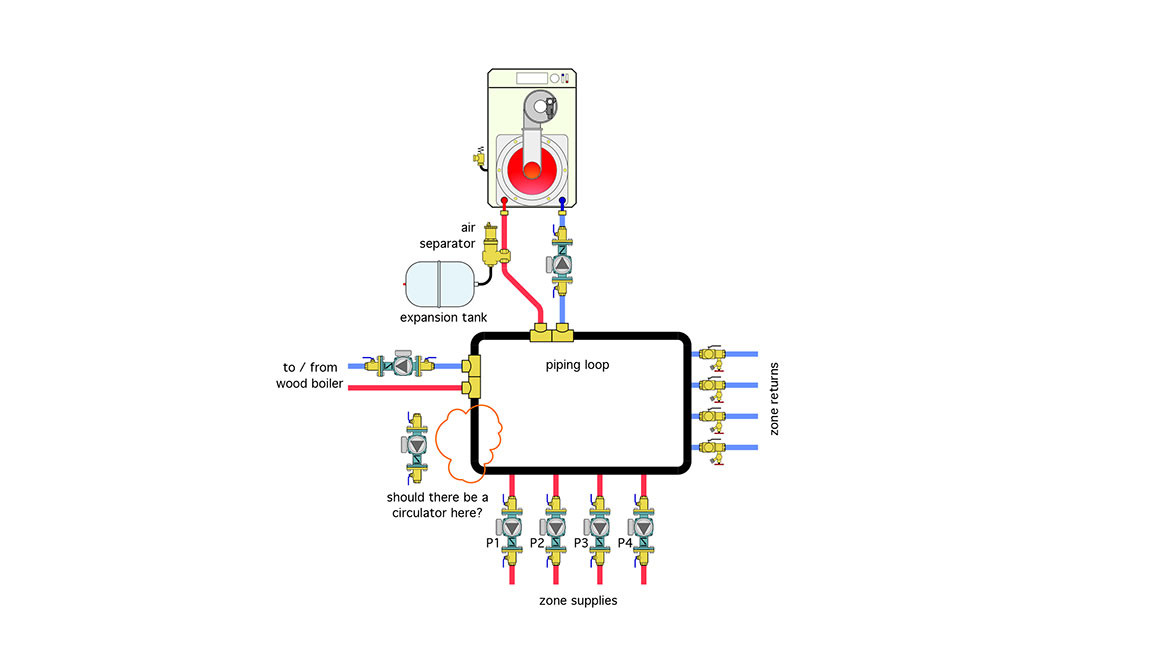
4. Hydronic heating glitch solved: Why adding a circulator won't fix primary loop flow issue
A hydronic system’s poor heat delivery was traced back to a misconfigured piping loop that short-circuited flow back to the zone circulators instead of through the boilers. Converting the loop into a proper supply-and-return header fixed the issue.
The review also flagged several secondary issues, including a poorly supported expansion tank, an air separator that wasn’t effective when the wood boiler was running alone, and limited serviceability at the boiler connections. Together, this case underscored how small layout decisions can have outsized impacts on system performance, and why correcting the piping logic often matters more than adding hardware.
3. Methods from Millinocket: One town in Maine is leading the way in hydronics technology and transactive energy management
In Millinocket, Maine, researchers are exploring how hydronic heating can leverage surplus renewable electricity from local wind and hydro power. High-temperature air-to-water heat pumps feed multiple thermal storage tanks, storing heat when electricity prices are low and supplying it to homes as needed.
Advanced controls—including a Raspberry Pi microcomputer—coordinate valves, circulators, and storage to maintain comfort while optimizing energy costs. These pilot systems have successfully maintained home heating during extreme cold using off-peak electricity, demonstrating the potential of transactive energy management to integrate hydronics with the evolving electric grid.

2. A hydro-split air-to-water heat pump system that ‘sorta’ works
A hydro-split air-to-water heat pump serving multiple heating zones and an indirect water heater can work, but performance issues often arise from overcomplicated piping and undersized components. Replacing a separate hydraulic separator with a properly piped buffer tank improves flow to zones, maintains temperature stratification, and provides hydraulic separation between the heat pump and distribution circulator.
Controlling the heat pump based on buffer tank temperature rather than zone calls boosts efficiency. Larger indirect water heater coils prevent DHW shortages, while pressure relief valves, isolation/purging valves, vibration-absorbing hoses, and automatic fluid feeders improve safety, serviceability, and system reliability.

Image courtesy of John Siegenthaler.
1. Why heat pump water heaters are the smart choice for businesses
Commercial heat pump water heaters (HPWHs) help businesses cut energy use and carbon emissions by efficiently capturing and reusing heat from warm spaces or conditioned air. They operate up to four times more efficiently than traditional systems and can store heat for off-peak use, reducing costs and easing grid demand.
HPWHs offer long-term savings, environmental benefits, and can be integrated with building systems for optimal performance. Advanced controls, monitoring, and new refrigerants improve efficiency but require trained technicians. Incentives and rebates can offset initial costs, making HPWHs a smart, sustainable investment for commercial buildings.

Looking for a reprint of this article?
From high-res PDFs to custom plaques, order your copy today!


