
Plumbing Essentials — Design Approaches, Codes and Everything in Between | Lowell Manalo
Defending your hospital system design from VE and cost-cutting
Codes and standards can be the first line of defense.

The recent Covid-19 pandemic once again highlighted the hospital’s vital role in the community. It also normalized working from home. Our industry now has engineers and designers working remotely from other states. Though this is nothing new, it is now the norm. Does this have any adverse effect on the plumbing design community? From my point of view, the answer is no. We must stay true to ourselves, practice self-discipline and not cut corners when reading and applying the codes and standards to our design. We must move away from the mentality of, "This is how we do things here, and it has been working for so many years, so I will design it that way."
With people in our industry moving around, it is not uncommon to run into plumbing contractors and installers that are not well-versed with the code for the state in which they just moved to. With the pressure of building a more efficient hospital, but at a lower cost, coupled with contractors and designers who are not aware of the local building code, we are now seeing more VE and cost-cutting items that we typically do not usually see in hospitals.

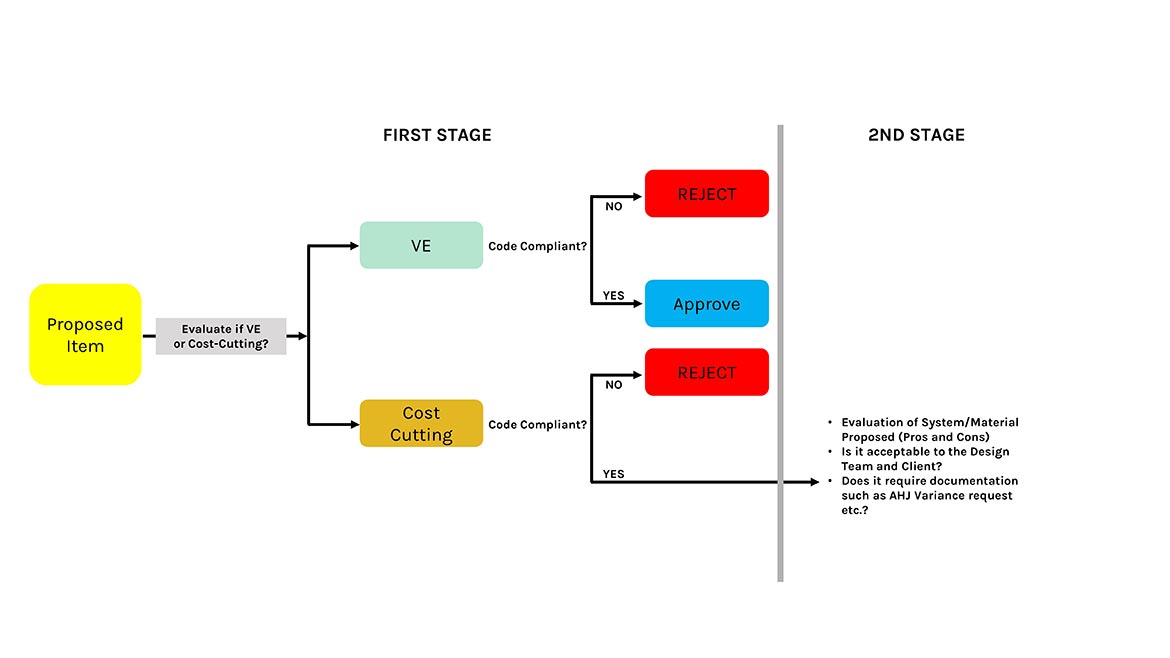
FIGURE 1: Sample of Basic Evaluation Stage Diagram of Value Engineer (VE) vs. Cost-Cutting. Image courtesy of SmithGroup
First, one item that needs clarity, especially for young engineers and designers, is the two-letter word "VE." We often hear the word Value Engineering (VE) in our industry. Unfortunately, VE has been used unintentionally also to include cost-cutting measures. Cost-cutting is different from Value Engineering. Value Engineering (VE) is looking at alternative means, products and materials for a lower cost but while providing equal or better performance. When you seek a less superior product, system or approach that lowers the quality and deviates from the original purpose of the design, then it is simply a cost-cutting approach.
Before spending the time to defend your system from a proposed VE and cost-cutting item, you need to ask yourself, "Is the proposed acceptable per code"? If the answer is no, this eliminates the burden of defending your design. Codes and Standards can be your first line of defense for cost-cutting attempts, so learn the code applicable to your building and use it!
Using a new Hospital in California under the Department of Health Care Access and Information (HCAI)formerly known as Office of Statewide Health Planning (OSHPD) as an example. I will cover the typical cost-cutting measures that engineers and designers may encounter but are against the California Plumbing Code (CPC).
Pipe materials: The pipe materials are the first item usually subjected to VE and cost-cutting. With plastic pipe getting more traction, I have seen CPVC being proposed for domestic cold and hot water systems. Also, the question has been asked whether ABS or PVC can be used. The answer to both is No, as it is not allowed, as stated in the Code.
Sanitary waste and vent slope: Though the minimum waste piping slope is not unique to OSHPD 1 Hospitals, it will be a disservice to the readers if this is something that I do not mention. California Plumbing Code requires a minimum of 2% slope. If you are an engineer or contractor familiar with the International Plumbing Code (IPC), this is an important and costly item if missed. Sloping at 2% vs. IPC’s 1% for pipe size 3 inches and larger means the contractor will have to dig deeper, move more dirt, and is more costly. You can apply for a code variance from the Authority Having Jurisdiction (AHJ) if you must use the piping slope of 1%. However, this is typically a hard sell on new constructions. Vent routing is also different from IPC. While IPC allows combination waste and vent system, CPC only allows this if first approved by AHJ for the portion of such system is installed.
Removal of the isolation valves on the branch lines serving the fixtures: The argument is that there are already supply stops at each fixture. In lieu of spending time defending and explaining the operations, program, and functions of the Hospital, the easiest way is to point to the code. The California Plumbing Code cleary states that risers and branches shall be provided with accessible sectionalizing valves in addition to the supply stops.
Before spending the time to defend your system from a proposed VE and cost-cutting item, you need to ask yourself, "Is the proposed acceptable per code"? If the answer is no, this eliminates the burden of defending your design. Codes and Standards can be your first line of defense for cost-cutting attempts, so learn the code applicable to your building and use it!
Vent termination distance from air intake: Sometimes, there are indeed structural, piping, or duct conflicts above the ceiling when we offset the vent piping. The question you may encounter is, why do we have to do that? Why can't we just run the vent straight up, where the code allows the vent to terminate ten feet from the air intake? CPC does indeed allow a minimum of ten feet distance, but not for OSHPD 1 building type. CPC clearly states the twenty-five feet minimum requirement away from air intakes for OSHPD buildings.
Hot water piping: We have heard this statement so many times "This is ridiculous! This does not make any sense. Why is the hot water supply limited to twenty-five feet max when it is serving just a mop sink or a non-public fixture?" The answer is simple: the CPC code clearly states that non-recirculated fixture branch piping shall not exceed twenty-five feet in length.
Hot water temperature: Can we boost the temperature, so the water stays hot inside the pipe, allowing a longer un-circulated pipe length while mitigating Legionella simultaneously? No - if the reason is for longer uncirculated piping runs, as I stated above, this is against the code. For the reason of Legionella prevention, the proposed is possible. The temperature of hot water distribution can be elevated. However, this needs to be appropriately designed while keep scalding in mind. One requirement unique to Hospitals under OSHPD is a high-temperature alarm set at 125 degrees. It also requires an audible and visual device for the high-water temperature alarm that annunciates and is located at a continuously occupied location.
Medical gas: Unlike IPC, CPC has its section for medical gas based on NFPA 99. I highly recommend that the designer and engineers read this section.
The above are just a few examples of code requirements unique to OSHPD 1 Hospitals. Knowing the code helps you professionally design and defend the system from any potential VE or cost-cutting items.
Another line of defense is picking up what I discussed in my previous column, "Designimus Defendimus." Using individual experience, expertise, and code knowledge as a collective resource, we put in place a powerful tool to defend our designs. It does not matter if you have one or twenty-plus years of experience in the industry if you do not know the latest code. You may design what you can consider the best systems. If it cannot be constructed because of Code violations, then it is just an excellent conceptual design on paper and does not do any good for the client, the design, the construction team, and the community.
Looking for a reprint of this article?
From high-res PDFs to custom plaques, order your copy today!


