search
cart
facebook instagram twitter linkedin youtube
  • Sign In
  • Create Account
  • Sign Out
  • My Account
  • NEWS
  • PRODUCTS
    • FEATURED PRODUCTS
  • CONTRACTORS
    • BATH & KITCHEN PRO
    • BUSINESS MANAGEMENT
    • HIGH EFFICIENCY HOMES
    • TECHNOLOGY
    • WATER TREATMENT
    • PMC COLUMNS
      • Dave Yates: Contractor’s Corner
      • John Siegenthaler: Hydronics Workshop
      • Kenny Chapman: The Blue Collar Coach
      • Matt Michel: Service Plumbing Pros
      • Scott Secor: Heating Perceptions
  • ENGINEERS
    • CONTINUING EDUCATION
    • DECARBONIZATION | ELECTRIFICATION
    • FIRE PROTECTION
    • GEOTHERMAL | SOLAR THERMAL
    • PIPING | PLUMBING | PVF
    • PME COLUMNS
      • Christoph Lohr: Strategic Plumbing Insights
      • David Dexter: Plumbing Talking Points
      • James Dipping: Engineer Viewpoints
      • John Seigenthaler: Renewable Heating Design
      • Lowell Manalo: Plumbing Essentials
      • Misty Guard: Guard on Compliance
  • RADIANT & HYDRONICS
    • RADIANT COMFORT REPORT
    • THE GLITCH & THE FIX
  • INSIGHTS
    • CODES
    • GREEN PLUMBING & MECHANICAL
    • PROJECT PROFILES
    • COLUMNS
      • Codes Corner
      • Natalie Forster: Editorial Opinion
      • Guest Editorial
  • MEDIA
    • EBOOKS
    • PODCASTS
    • VIDEOS
    • WEBINARS
  • RESOURCES
    • INDUSTRY CALENDAR
    • DIRECTORIES
    • PM BOOKSTORE
    • CE CENTER
    • MARKET RESEARCH
    • CLASSIFIEDS
  • EMAGAZINE
    • EMAGAZINE
    • ARCHIVE ISSUES
    • CONTACT
    • ADVERTISE
    • PME EMAGAZINE ARCHIVES
  • SIGN UP!
Plumbing & Mechanical ContractorRadiant & HydronicsThe Glitch & The Fix

The Glitch & Fix: March 2018
By John Siegenthaler, P.E.
The Glitch
March 30, 2018

The Glitch:

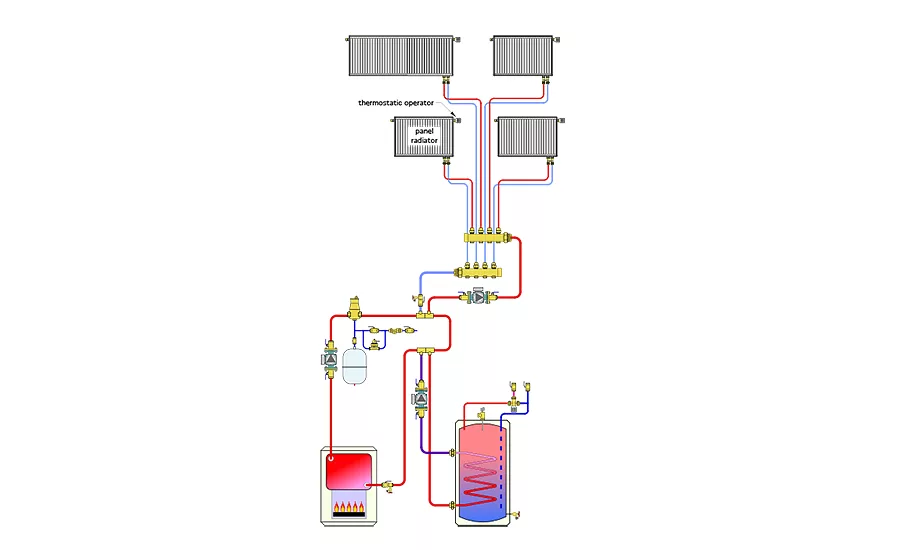
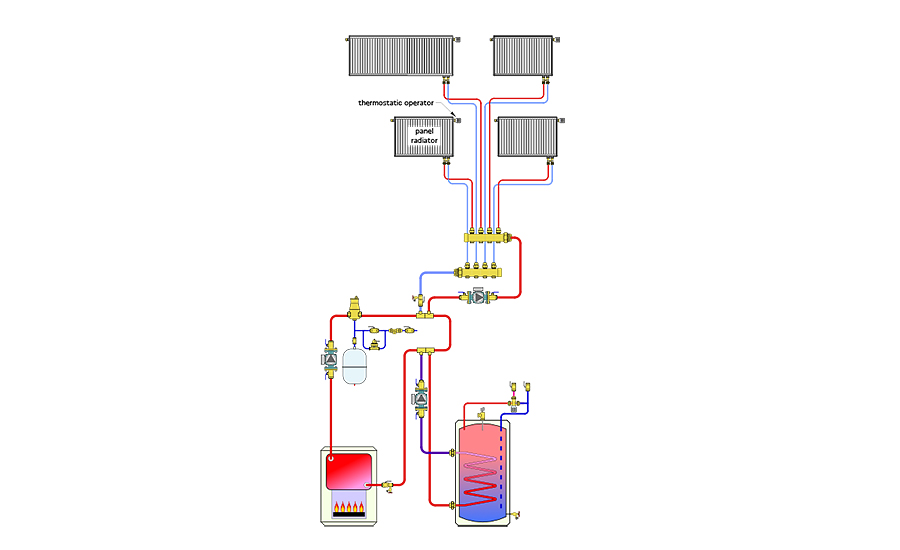
A hydronic system is to supply four panel radiators, each with their own thermostatic radiator valve, and an indirect water heater from a gas-fired sectional cast-iron boiler.  The system is designed using primary / secondary piping as shown below.  The primary circulator operates whenever the space heating load or the indirect water heater call for heat.  All circulators are standard, fixed speed, wet rotor units.

a. Can you spot at least 6 details that are incorrect?

b. Beyond the incorrect details, are there ways to improve the design to provide the same functionality with fewer components?
 

The Fix:

Before looking at improvement, here’s a tally of the errors on the primary/secondary approach:

  1. The primary circulator is pumping toward, rather than away from the point of no pressure change (e.g. where the expansion tank connects to the system).
  2. The secondary circulators are both pumping toward, rather than away from the primary loop.  This is incorrect because each secondary circuit “sees” the primary loop connection as its point of no pressure change (because the expansion tank is in the primary loop).  Thus all secondary circulators should pump into their respective secondary circuits.
  3. The piping for the panel radiator sub-system is reversed at the closely spaced tees.  This will cause a reduced supply water temperature to the panels.
  4. The heat exchanger coil within the indirect water heater is not piped for counterflow. The hot water should always enter the top connection of the coil.
  5. Assuming primary / secondary piping was used, the indirect tank should be the first load connected to the primary loop, and thus able to operate with the highest available water temperature.
  6. The purging valve is missing on the return side of the secondary circuit serving the indirect water heater.
  7. There is no thermal trap installed on the thermostatic tempering valve of the indirect tank.  This will lead to thermosiphoning and wasted energy.
  8. There is no means of differential pressure control within the zoned secondary circuit serving the panel radiators.
  9. The lack of check valves in the secondary circulators will allow for heat migration.  As shown, the indirect water heater will use its secondary circuit piping to continually dump heat to its surroundings.

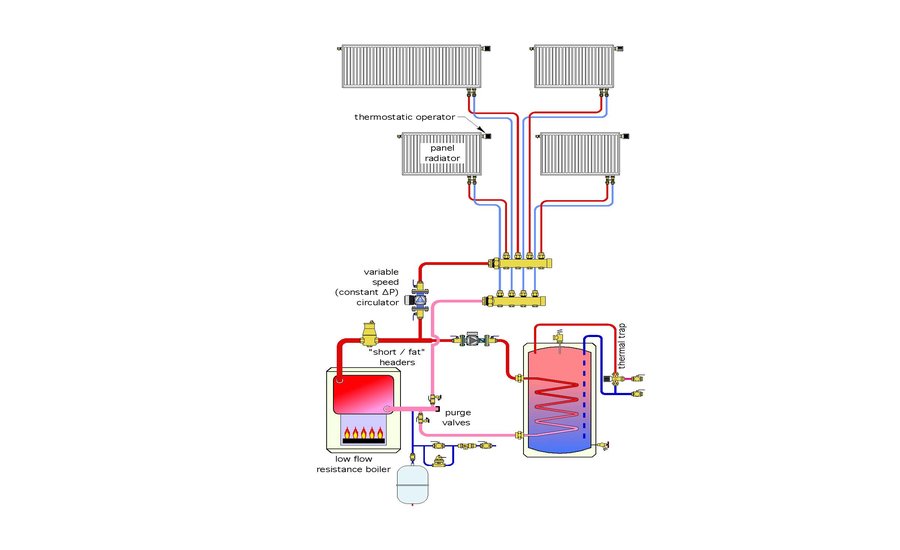
The fix drawing shows what I consider to be an improved design that provides the same functionality.  It eliminates one of the circulators and both sets of closely spaced tees required in the previous approach.
The Fix

The loads do not require this to be a primary / secondary system.  The low head loss boiler and generously sized header piping provide sufficient hydraulic separation between the two circulators, even when one of the loads operates with a variable speed circulator. Just keep the headers relatively short, and sized for a maximum flow velocity of 2 feet per second. This approach eliminates both the installation and operating cost of a primary circulator.

Another change is use of a pressured regulated constant ∆P circulator within the subsystem serving the panel radiators. This eliminates the need of a differential pressure bypass valve and significantly reduces operating cost compared to a fixed speed circulator.  Today, it’s likely to be less expensive to install a pressure regulated circulator compared to a fixed speed circulator paired up with a differential pressure bypass valve.  The operating cost will also be less than half that of an equivalent fixed speed circulator.

A thermal trap is shown on the piping leading to the thermostatic mixing valve on the indirect water heater.

Because of the very low hydraulic resistance of the boiler and headers it is possible to locate the system’s expansion tank on the inlet of the boiler where its temperature will remain a bit cooler, and thus its internal air pressure will be less effected by the elevated water temperature in the system.


Please click here to view The Glitch & Fix: March 2018 in pdf form.

KEYWORDS: boilers hydronic heat pumps radiant panels

Share This Story

Looking for a reprint of this article?
From high-res PDFs to custom plaques, order your copy today!

John siegenthaler 200x200

John Siegenthaler, P.E., is a consulting engineer and principal of Appropriate Designs in Holland Patent, New York. In partnership with HeatSpring, he has developed several online courses that provide in-depth, design-level training in modern hydronics systems, air-to-water heat pumps and biomass boiler systems. Additional information and resources for hydronic system design are available on Siegenthaler’s website,  www.hydronicpros.com.

Recommended Content

JOIN TODAY
to unlock your recommendations.

Already have an account? Sign In

  • 2025 Next Gen ALL-STARS hero 1440

    2025 Next Gen All Stars: Top 20 Under 40 Plumbing Professionals

    This year’s group of NextGen All-Stars is full of young...
    Plumbing & Mechanical Contractor
    By: Kristen R. Bayles
  • Worker using the Milwaukee Tool SWITCH PACK drain cleaner

    Pipeline profits: Drain cleaning, pipe inspection create opportunities

    Drain cleaning and inspection services offer lucrative...
    Green Plumbing and Mechanical
    By: Nicole Krawcke
  • Uponor employee, Arturo Moreno

    The reinvestment in American manufacturing and training

    Plumbing & Mechanical Chief Editor Nicole Krawcke and...
    Plumbing News
    By: Nicole Krawcke and Natalie Forster
Manage My Account
  • eNewsletters
  • Online Registration
  • Subscription Customer Service
  • eMagazine
  • Manage My Preferences

More Videos

Popular Stories

Hot water pipes

Campus shutdown at Oakland University exposes hidden risks of aging hot-water infrastructure

Floor heating manifold cabinet with flowmeter and PEX pipe.

Elegance extended: How to use the homerun system of connecting heat emitters

Industrial pressure gauge on a tank.

From cutting edge to classic: How to modernize outdated pneumatic control systems

Poll

Will business be up or down in 2025?

Do you anticipate business in 2025 to be up or down in comparison to 2024?
View Results Poll Archive

Products

The Water Came To A Stop

The Water Came To A Stop

See More Products
eBook | 2025 Radiant & Hydronics All Stars

Related Articles

  • The Glitch

    The Glitch & Fix: April 2018

    See More
  • The Glitch figure 1

    The Glitch & Fix: January 2018

    See More
  • One change to get it right

    The Glitch & Fix: February 2018

    See More
×

Keep your content unclogged with our newsletters!

Stay in the know on the latest plumbing & piping industry trends.

JOIN TODAY!
  • RESOURCES
    • Advertise
    • Contact Us
    • Directories
    • Store
    • Want More
    • Supply House Times
  • SIGN UP TODAY
    • Create Account
    • eMagazine
    • eNewsletter
    • Customer Service
    • Manage Preferences
  • SERVICES
    • Marketing Services
    • Reprints
    • Market Research
    • List Rental
    • Survey/Respondent Access
  • STAY CONNECTED
    • LinkedIn
    • Facebook
    • Instagram
    • YouTube
    • X (Twitter)
  • PRIVACY
    • PRIVACY POLICY
    • TERMS & CONDITIONS
    • DO NOT SELL MY PERSONAL INFORMATION
    • PRIVACY REQUEST
    • ACCESSIBILITY

Copyright ©2025. All Rights Reserved BNP Media.

Design, CMS, Hosting & Web Development :: ePublishing