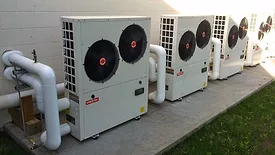
Heated floor slabs, without floor coverings, have one of the lowest supply water temperature requirements of any radiant panel system. This makes them well-suited for use with renewable energy heat sources such as air-to-water heat pumps, water-to-water geothermal heat pumps, biomass boilers and solar thermal collectors.
Recently, I wrote about plumbing pipe thermal expansion and expansion fittings. Based upon feedback from some in the design community, there seems to be a feeling that more design professionals within the consulting industry need to have a better foundation to enhance their understanding of the topic.
This month I want to deviate a bit from a purely renewable energy topic to one that’s important across the entire spectrum of hydronics technology. It’s a topic that likely gets exercised on a daily basis in any engineering office where water-based HVAC systems are conceived.
Hybrid systems that run on propane and solar can be tailored to a project’s unique needs, providing lower first costs and reduced ongoing energy costs and emissions.
Fresh water is an undeniably valuable and essential natural resource. But are plumbing engineers unintentionally putting building occupants are risk by implementing water conservation guidelines and equipment? What are the unseen consequences of water conservation?
A lot of things are out of your control when working on a job involving multiple trades. Whenever I design any type of system, I always go down a list of “what ifs.” The “what ifs” are scenarios that can affect the performance of a system due to an unknown. This includes actions by other trades.
Over the past 60 years, plastic piping materials have evolved from a new alternative to the material of choice for building and construction applications such as hot- and cold-water plumbing distribution, fire protection and mechanical systems like hydronics and chilled water.
Recently, there was a discussion on the ASPE Open Forum regarding, “Plumbing Pipe Thermal Expansion and Expansion Fitting.” Generally, this topic would be found within your specifications under Section 22 05 16, “Expansion Fittings and Loops for Plumbing Piping;” this topic is under-discussed, and in many cases, poorly understood by many designers and engineers.
When I first entered the trades in 1972, residential tank-style water heaters shipped with the aquastat set to approximately 140° F. Dishwashers had no need to incorporate a sanitizing cycle. Around 1977, water heater manufacturers were required to lower the aquastat temperature setting to approximately 120°, and now, dishwashers needed to incorporate a sanitizing cycle where rinse water in their reservoir was raised to 140° or higher.
The commercial building community is giving its full attention to improving indoor air quality as we attempt to make our way out of the COVID-19 pandemic. While it’s true that germs and pathogens can be carried through the air, we’re forgetting how easy it is to pick them up through the water we drink, wash our hands with and cook our food in.