
search
cart
facebook instagram twitter linkedin youtube
  • Sign In
  • Create Account
  • Sign Out
  • My Account
  • NEWS
  • PRODUCTS
    • FEATURED PRODUCTS
  • CONTRACTORS
    • BATH & KITCHEN PRO
    • BUSINESS MANAGEMENT
    • HIGH EFFICIENCY HOMES
    • TECHNOLOGY
    • WATER TREATMENT
    • PMC COLUMNS
      • Dave Yates: Contractor’s Corner
      • John Siegenthaler: Hydronics Workshop
      • Kenny Chapman: The Blue Collar Coach
      • Matt Michel: Service Plumbing Pros
      • Scott Secor: Heating Perceptions
  • ENGINEERS
    • CONTINUING EDUCATION
    • DECARBONIZATION | ELECTRIFICATION
    • FIRE PROTECTION
    • GEOTHERMAL | SOLAR THERMAL
    • PIPING | PLUMBING | PVF
    • PME COLUMNS
      • Christoph Lohr: Strategic Plumbing Insights
      • David Dexter: Plumbing Talking Points
      • James Dipping: Engineer Viewpoints
      • John Seigenthaler: Renewable Heating Design
      • Lowell Manalo: Plumbing Essentials
      • Misty Guard: Guard on Compliance
  • RADIANT & HYDRONICS
    • RADIANT COMFORT REPORT
    • THE GLITCH & THE FIX
  • INSIGHTS
    • CODES
    • GREEN PLUMBING & MECHANICAL
    • PROJECT PROFILES
    • COLUMNS
      • Codes Corner
      • Natalie Forster: Editorial Opinion
      • Guest Editorial
  • MEDIA
    • EBOOKS
    • PODCASTS
    • VIDEOS
    • WEBINARS
  • RESOURCES
    • INDUSTRY CALENDAR
    • DIRECTORIES
    • PM BOOKSTORE
    • CE CENTER
    • MARKET RESEARCH
    • CLASSIFIEDS
  • EMAGAZINE
    • EMAGAZINE
    • ARCHIVE ISSUES
    • CONTACT
    • ADVERTISE
    • PME EMAGAZINE ARCHIVES
  • SIGN UP!
Radiant & HydronicsThe Glitch & The Fix

Proper Replacement

By John Siegenthaler, P.E.
November 17, 2008
The Glitch


The Glitch

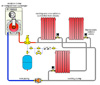
Overview: An installer decides to replace a 30-year-old cast-iron boiler with a modern mod/con unit that has a 5:1 turndown ratio and integral outdoor reset control. He pipes in the new boiler to the existing black iron piping system as shown below. He also installs thermostatic radiator valves (TRV) on the return side of each radiator to provide room-by-room zone control.

Exercise: Can you spot some potential problems in the making?

The Fix

The Fix

Anytime new hardware is added to an older system, especially a former steam heating system, it’s good practice to install a dirt separator to minimize sludge migration to the new hardware. The old piping should also be flushed out with an appropriate surfactant to remove as much sludge as possible.

The mod/con boiler with compact heat exchanger will not like the low flow rates that will occur in the original design when only one thermostatic radiator valve is open (or partially open). This is corrected by hydraulically separating the boiler circuit from the distribution system with a pair of closely spaced tees. It could also be accomplished using a hydraulic separator. The latter would provide air and dirt separation for the system and thus eliminate need to install separate air and dirt separators.

An ECM-based variable speed, pressure-regulated circulator is shown in the distribution system. This circulator will vary its speed as needed to maintain proportional differential pressure across the distribution system as the thermostatic radiator valves open and close. An alternative would be use of a fixed speed circulator with differential pressure bypass valve. However, the pressure-regulated circulator will ultimately have the lowest lifecycle cost through reduced electrical consumption.

The thermostatic radiator valves should be installed on the supply side of the radiators. This helps prevent heat migration from the supply piping into the radiators. The valves shown have angle pattern bodies. This keeps the thermostatic head far enough from the radiator to minimize convective interference that could cause erratic operation of the valve.

Manually operated air vents are shown at the top of each radiator to aid in purging the system.

Finally, a supply temperature sensor that regulates boiler modulation is shown on the supply side of the distribution system (downstream of the closely spaced tees). This allows the boiler to modulate based on the true water supply temperature to the radiators.

Links

  • Hydronic Symbol Legend
  • The Glitch & The Fix "

Share This Story

Looking for a reprint of this article?
From high-res PDFs to custom plaques, order your copy today!

John siegenthaler 200x200

John Siegenthaler, P.E., is a consulting engineer and principal of Appropriate Designs in Holland Patent, New York. In partnership with HeatSpring, he has developed several online courses that provide in-depth, design-level training in modern hydronics systems, air-to-water heat pumps and biomass boiler systems. Additional information and resources for hydronic system design are available on Siegenthaler’s website,  www.hydronicpros.com.

Recommended Content

JOIN TODAY
to unlock your recommendations.

Already have an account? Sign In

  • 2025 Next Gen ALL-STARS hero 1440

    2025 Next Gen All Stars: Top 20 Under 40 Plumbing Professionals

    This year’s group of NextGen All-Stars is full of young...
    Plumbing & Mechanical Engineer
    By: Kristen R. Bayles
  • Worker using the Milwaukee Tool SWITCH PACK drain cleaner

    Pipeline profits: Drain cleaning, pipe inspection create opportunities

    Drain cleaning and inspection services offer lucrative...
    Green Plumbing and Mechanical
    By: Nicole Krawcke
  • Uponor employee, Arturo Moreno

    The reinvestment in American manufacturing and training

    Plumbing & Mechanical Chief Editor Nicole Krawcke and...
    Plumbing News
    By: Nicole Krawcke and Natalie Forster
Manage My Account
  • eNewsletters
  • Online Registration
  • Subscription Customer Service
  • eMagazine
  • Manage My Preferences

More Videos

Popular Stories

Hot water pipes

Campus shutdown at Oakland University exposes hidden risks of aging hot-water infrastructure

Floor heating manifold cabinet with flowmeter and PEX pipe.

Elegance extended: How to use the homerun system of connecting heat emitters

Industrial pressure gauge on a tank.

From cutting edge to classic: How to modernize outdated pneumatic control systems

Poll

Will business be up or down in 2025?

Do you anticipate business in 2025 to be up or down in comparison to 2024?
View Results Poll Archive

Products

The Water Came To A Stop

The Water Came To A Stop

See More Products
eBook | 2025 Radiant & Hydronics All Stars

Related Articles

  • Primary/secondary systems need proper detailing to work correctly

    See More
  • The Glitch & The Fix

    Overlooped: Boiler swap gone wrong

    See More
  • Hydrant Fuel Pump Station

    An expensive lesson in hydronic fundamentals

    See More

Related Products

See More Products
  • Lessons Learned: Connecting New Boilers to Old Pipes

  • what hydronics taught holohan.jpg

    What Hydronics Taught Holohan: A Memoir of Life in the Heating Industry

  • howcome.gif

    How Come? Hydronic heating questions we've been asking for 100 years (with straight answers!)

See More Products

Events

View AllSubmit An Event
  • August 26, 2014

    Free Webinar: Low Temperature Heat Emitter Options in Hydronic Systems

    With proper design, you can create systems that require supply water temperatures no higher than 120° F under design load conditions.
View AllSubmit An Event
×

Keep your content unclogged with our newsletters!

Stay in the know on the latest plumbing & piping industry trends.

JOIN TODAY!
  • RESOURCES
    • Advertise
    • Contact Us
    • Directories
    • Store
    • Want More
    • Supply House Times
  • SIGN UP TODAY
    • Create Account
    • eMagazine
    • eNewsletter
    • Customer Service
    • Manage Preferences
  • SERVICES
    • Marketing Services
    • Reprints
    • Market Research
    • List Rental
    • Survey/Respondent Access
  • STAY CONNECTED
    • LinkedIn
    • Facebook
    • Instagram
    • YouTube
    • X (Twitter)
  • PRIVACY
    • PRIVACY POLICY
    • TERMS & CONDITIONS
    • DO NOT SELL MY PERSONAL INFORMATION
    • PRIVACY REQUEST
    • ACCESSIBILITY

Copyright ©2025. All Rights Reserved BNP Media.

Design, CMS, Hosting & Web Development :: ePublishing