The Ceiling Became a Plenum After I Piped It
What one master plumber learned the hard way about plastic pipe in return-air plenums — and why the answer isn’t always to tear it out.
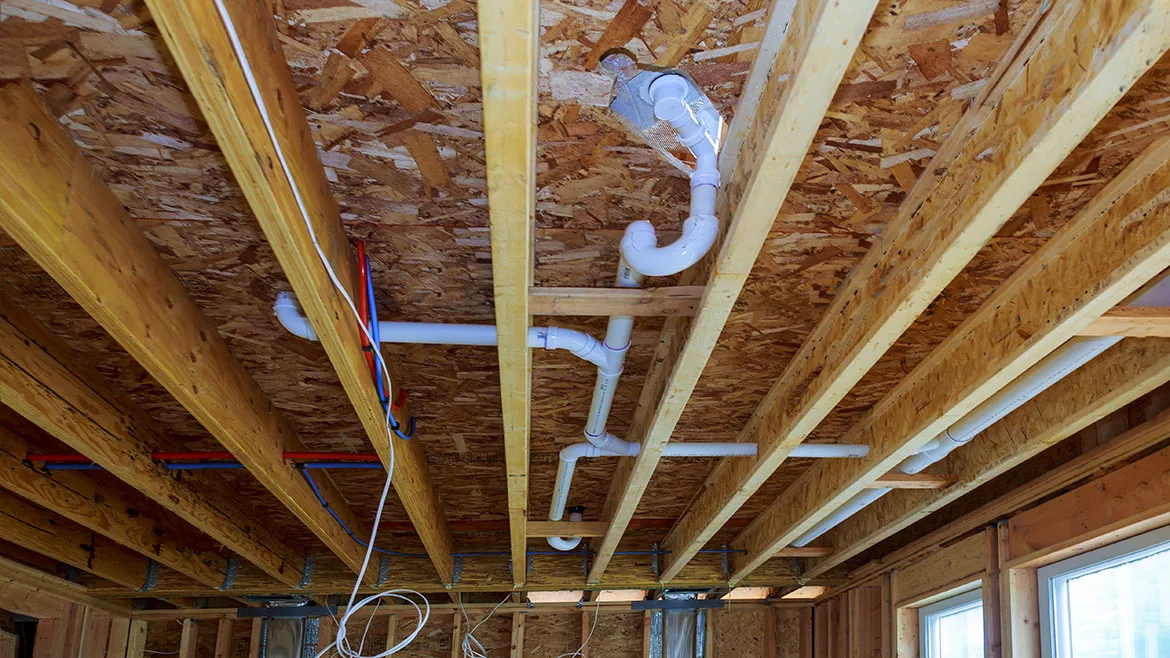
A number of years ago, I ran the plumbing on a tenant space on the first floor of a mall. The prints called for PVC. So, we ran PVC — waste, vent, everything overhead, hung tight, tested, inspected, done. Good clean work.
Then the ceiling went in, and somewhere in the coordination it came out that the cavity above that lay-in tile was a return-air plenum.
I want to be honest about the next few minutes, because every contractor reading this has had them. I did the math in my head on tearing out every foot of overhead PVC in that space and putting it back in cast iron, on my own dime, on somebody else’s schedule. I thought I was going to lose my tail on that job.
I didn’t. And the reason I didn’t is the reason I’m writing this.
What Actually Happened Above That Ceiling
A return-air plenum is a ceiling cavity used to move return air back to the equipment instead of ducting it. The supply side is often fully ducted, which is exactly what fools people — you flip through the mechanical sheets, you see duct everywhere, and you decide it isn’t a plenum. Meanwhile, the return is dumping straight into the cavity through booted registers, and every material exposed up there is now sitting in the airstream.
The mechanical code is not vague about what that means. In the 2021 International Mechanical Code — the edition Colorado adopted effective 2024 — Section 602.2.2 requires materials exposed within a plenum to be noncombustible, or to have a flame spread index of 25 or less and a smoke-developed index of 50 or less when tested to ASTM E84 or UL 723. Older editions carried the same requirement at 602.2.1. The trade calls it 25/50.
Bare PVC does not meet 25/50. Neither does standard PEX. That is not an inspector having a bad day; it is the reason the note exists.
The Part Nobody Told Me: You Have Options
Here is what I found out, and what I wish somebody had told me before I started doing tear-out math. The code does not say the pipe has to come out. It says the material exposed in the plenum has to comply. There is more than one way to get there, and only one of them involves a demo crew.
- Listed insulation assembly. Certain jacketed pipe insulations are UL certified specifically as insulated plastic pipe assemblies. Where a listing exists for your pipe type and size, this is usually the cheapest and fastest route, and it installs like ordinary insulation.
- Plenum wrap. A mineral-wool blanket with a foil facing, listed for plastic pipe in environmental air spaces, tested to standards including ASTM E84, UL 1887 and NFPA 262. This is the one I used. It comes in a roll, it wraps the pipe, and the system includes its own foil tape. It works where no listed insulation assembly exists for your material.
- Listed plastic pipe. Plastic water distribution piping and tubing listed and labeled to UL 2846 — peak optical density not over 0.50, average not over 0.15, flame spread distance not over five feet — is permitted in a plenum installed per its listing, with no covering at all. If you are still in the buying stage, this can solve the problem before it starts.
- Noncombustible substitution. Cast iron waste and vent, copper or steel water. Always compliant, always the most expensive answer, and the only one most people know about.
On that mall job the wrap saved me. It was not free and it was not fun, but it was a fraction of a tear-out, and it passed.
Four Ways to Get the Wrap Wrong
If you go the covering route, understand that this is a listed system, not a roll of insulation. I have seen every one of these mistakes:
- Component thinking instead of assembly thinking. The covering and the pipe are tested and listed together, as a composite. A foil facing that meets 25/50 on its own proves nothing about the assembly. Match the listing to your actual pipe material — PVC, CPVC, ABS, PP-R and PE do not all have the same certifications available.
- Losing thickness. The listing specifies a minimum thickness. Crush it flat at an inline hanger and you have compromised the very spot you were protecting. Support has to be detailed so the insulation keeps its dimension through the hanger.
- Substituting the tape. The tape is part of the listed system. Generic foil tape out of the truck is not the tested product, and an inspector who knows the system will look at the seams.
- • Wrapping the wrong things. Piping concealed inside walls is not in the airstream and does not need any of this. Contractors who miss that distinction overspend in the other direction and hand the job to somebody who read it right.
Catching it Before You Commit a Number
All of the above is recovery. Prevention is cheaper. Before your bid goes out, look in four places:
- The mechanical plan notes. Any language about return air being open to plenum, or return-air sound boots at registers. This is the single most reliable tell, and it lives on a sheet most plumbing estimators skip.
- The general notes on your own plumbing sheets. If a general note says exposed material shall be plenum rated while the plumbing notes call for PVC and PEX, you have a live conflict and you do not get to quietly pick the cheap side.
- The reflected ceiling plan and architectural sections. A hard lid with ducted return is a different animal from an open cavity with lay-in tile and boots.
- The order-of-precedence clause. Many sets state that where documents conflict, the more stringent and more expensive requirement governs. That clause settles the argument before you have it — and it settles it against you if you priced the light side.
How to Bid It Once You Find It
Do not quietly price the expensive version and hope you are still competitive, and do not quietly price the light version and hope nobody notices. One loses the job, the other loses the money.
Write the RFI so the answer is usable. Ask the engineer to confirm one of two conditions in plain language: either the ceiling cavity is not a return-air plenum and the specified materials are acceptable as drawn, or it is a plenum and the exposed piping must comply with 25/50. If it is a plenum, ask which compliance path they will accept — a listed insulation assembly, a listed plenum wrap, or listed pipe. That last question is worth real money and almost nobody asks it.
Then structure the number so you are covered either way. Price the base compliant, and carry the difference as a stated deduct if the engineer confirms the lighter condition. The general contractor gets a number that will pass inspection and gets the savings if the condition does not apply. Nobody has to trust anybody.
One more thing that costs you nothing: ask the general contractor to make sure every plumbing bidder is working from the same answer. If half the field carries cast iron and half carries bare PVC, the numbers coming back are not comparable, and the low bid is simply the contractor who missed the note. That is bad for the GC too, and most of them will thank you for saying it.
Why This Ends Up in Front of Lawyers
Everything above is a bidding problem until the day it becomes a claim. When combustible pipe sits unprotected in a plenum and something happens, the questions asked afterward are the same ones the estimator should have asked at bid time: what did the documents require, where was that requirement stated, and was it reasonable for a competent contractor to have found it.
A note printed on the mechanical sheet is still part of the contract documents. “It wasn’t on my sheet” has never been a defense, and an order-of-precedence clause makes it worse rather than better. The same goes for a covering installed outside its listing — an assembly that was never tested as installed is not compliance, it is the appearance of compliance, and that distinction shows up fast under examination.
Read Every Page
There is a habit behind all of this and it is not complicated. Read the whole set. Every page, every discipline — architectural, structural, mechanical, electrical, kitchen, specifications. Not because you are estimating somebody else’s trade, but because the requirement that kills your job is rarely printed on your own sheet. It is one line, in a list of thirty, on a drawing you did not think you needed.
I learned that standing in a mall looking up at a ceiling full of PVC that had just become a code violation while I was standing there. Read the mechanical sheet. And if it happens to you anyway, before you call the demo crew, go find out whether there is a listed covering for what you already installed. There usually is.
Looking for a reprint of this article?
From high-res PDFs to custom plaques, order your copy today!