Water Heater Shipments Stay Under Pressure Through May
AHRI's latest shipment report shows water heater residential numbers slowing, while commercial levels are up slightly.

The U.S. water heater market continued its pace in May, with the latest shipment data from the Air-Conditioning, Heating, and Refrigeration Institute (AHRI) showing that most product categories remained below last year’s levels. While the declines were generally modest on a monthly basis, the year-to-date figures suggest that the industry is still navigating a slightly slower market than it experienced in 2025.
The latest numbers indicate that residential demand remains under pressure, particularly for electric storage water heaters, while commercial shipments present a more mixed picture. Commercial gas storage water heaters were one of the few categories to post year-over-year gains, highlighting that demand is varying by application and market segment rather than declining uniformly across the board.
According to AHRI's May 2026 U.S. Water Heater Statistical Release, residential gas storage shipments totaled 347,865 units, down 1.8% from May 2025, while residential electric storage shipments declined 7.5% to 411,726 units. Commercial gas storage water heaters bucked the trend with a slight 0.2% increase, while commercial electric storage shipments fell 16.3% year over year.
Residential Market Continues to Cool
Residential water heater shipments continued to trail last year's pace in May, although the declines were less pronounced than the broader downturn might suggest.
According to AHRI, manufacturers shipped 347,865 residential gas storage water heaters during May, a 1.8% decrease compared to the same month in 2025. Through the first five months of the year, shipments totaled 1,790,543 units, representing a 5.4% decline year over year.
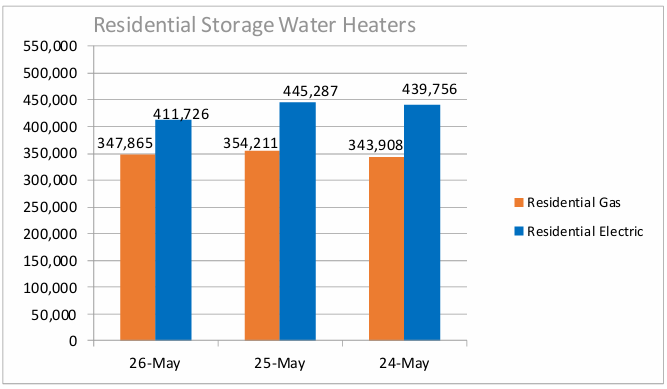 Image courtesy of AHRI.
 Residential electric storage water heaters experienced a steeper monthly decline. Manufacturers shipped 411,726 units in May, down 7.5% from May 2025. Year-to-date shipments reached 2,068,785 units, a 6.6% decrease compared with the same period last year.
Viewed together, the residential numbers continue to reflect a market that has softened compared with 2025, but not one experiencing dramatic month-to-month swings. Instead, the year-to-date totals suggest a sustained moderation in shipment activity that has carried through 2026 thus far.
Despite the fact that overall shipment volumes remain below last year's pace, the residential market continues to benefit from the replacement cycle that drives much of the industry's business. Water heaters remain an essential household appliance, and failures often require immediate replacement regardless of broader economic conditions. That replacement demand continues to provide a measure of stability, even as larger remodeling projects appear more measured than in recent years.
Commercial Market Shows a Split Picture
Commercial shipments presented a more mixed picture in May, highlighting how demand can differ depending on product category.
Commercial gas storage water heaters posted one of the report's strongest performances. Manufacturers shipped 7,624 units during May, a slight 0.2% increase over the same month last year. On a year-to-date basis, shipments climbed to 40,210 units, up 3.8% compared with the first five months of 2025.
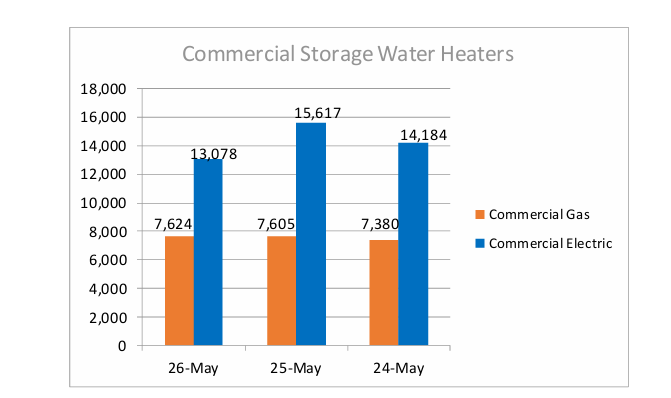 Image courtesy of AHRI.
 Commercial electric storage water heaters moved in the opposite direction. AHRI reported 13,078 units shipped in May, representing a 16.3% decline year over year. Through May, shipments totaled 69,906 units, down 4.6% from the same period in 2025.
The contrast between the two commercial categories reinforces that the market is not moving in a single direction. While commercial gas storage water heaters continue to demonstrate resilience, commercial electric products have yet to show similar momentum. Rather than indicating broad-based growth or contraction, the May figures suggest that market conditions remain highly dependent on application, project activity and customer demand across individual product segments.
What the Numbers Suggest
Taken together, the May shipment report reinforces many of the themes that have emerged throughout the first half of 2026.
Residential shipments remain below last year’s levels, but the relatively modest monthly declines suggest a market that continues to normalize rather than one experiencing significant volatility. The year-to-date figures indicate that softer shipment volumes are becoming a consistent pattern, rather than an isolated monthly fluctuation.
Commercial activity continues to tell a more nuanced story. Gas storage water heaters remain one of the few categories posting year-over-year gains, while commercial electric shipments continue to lag. That divergence underscores the importance of evaluating individual product categories rather than relying solely on overall shipment totals when assessing market conditions.
Compared with April's report, May showed little change in the broader narrative. Residential gas and electric shipments remained below prior-year levels, commercial gas maintained its positive momentum and commercial electric shipments weakened further. While no single month's data is enough to establish a long-term trend, the consistency across multiple reports provides a clearer picture of how the market has performed through the first five months of the year.
Looking for a reprint of this article?
From high-res PDFs to custom plaques, order your copy today!