New Survey Reveals the Job Tradespeople Most Want AI to Solve in the Field
Global survey finds half of workers say jobs get sent back for rework at least sometimes, and it’s the #1 problem they’d want AI to fix on the job.

Nearly half of skilled-trade workers say jobs in their field get sent back for a callback or rework at least sometimes, and fixing mistakes and callbacks is the number one on-the-job use case they’d like AI to solve. That is the key finding from Fewer Callbacks, Faster Jobs: How AI Closes the Guidance Gap in Skilled Trades, a new global survey of 1,000 skilled-trade workers across the United States and Europe by Bourne AI.
Seventy-two percent of skilled trades respondents believe an AI guided-task app would cut the time they lose looking things up on the job, and 66% say AI would make them more effective as they complete their job tasks.
"This survey shows where AI can help tradespeople most on the job, and reducing mistakes and callbacks comes out at the very top," said Dave Dickson, Founder of Bourne AI. "Workers told us the bottleneck is getting a reliable answer at the moment they're stuck. When AI closes that guidance gap, the return is concrete and measurable: fewer jobs come back for rework, and newer workers reach full productivity faster."
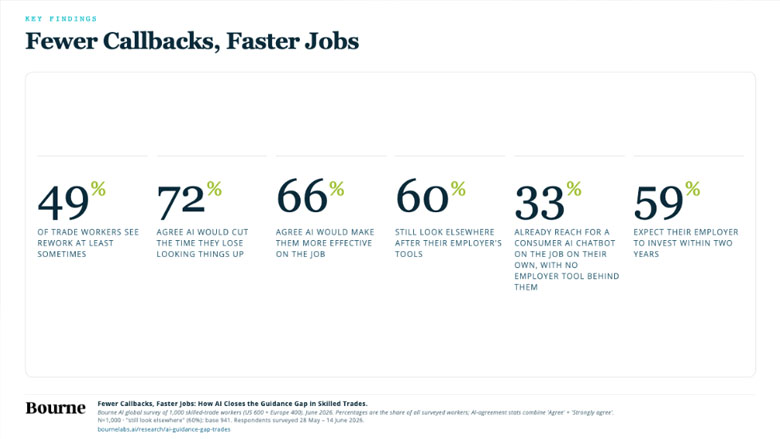 Image courtesy of Bourne.
Image courtesy of Bourne. A deepening labor shortage is raising the stakes
Across construction, manufacturing and other skilled industries, experienced employees are retiring faster than they can be replaced: the U.S. Department of Education estimates only two new entrants for every five workers who retire [1], with roughly 2.1 million skilled-trade jobs going unfilled by 2030 [2].
As seasoned tradespeople leave, their know-how walks out the door, onto a thinner, greener workforce where 47% of new hires take 7+ months to reach full productivity, according to the Bourne AI survey. That thinner bench is exactly where the survey finds the daily friction: too much work comes back as rework because the answers needed to get it right the first time take too long to track down.
The most-used "tool" in the trades is interrupting a coworker
According to the data, the #1 way tradespeople get unstuck on a difficult task is still asking a colleague or supervisor (60.5%), a human bottleneck that interrupts two people at once. And it isn't quick: 51% of lookups take 16 minutes or more, and a quarter take 30 minutes or more. When a fast answer isn't available, 28% proceed on best judgment and accept the rework risk, and that guesswork can often be where a callback begins.
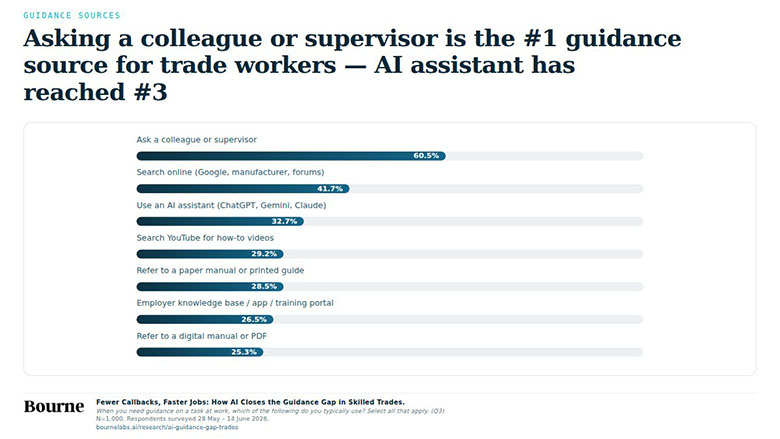 Image courtesy of Bourne.
 Nearly half see their work come back for rework — and they'd hand AI the fix
49% of skilled-trade workers say jobs in their field need a callback or rework at least sometimes, and workers ranked reducing mistakes and callbacks as the #1 AI use case, ahead of code/spec lookups, documentation, and new-hire training.
Reducing callbacks drives immediate ROI because they are the easiest cost to put a number on: industry benchmarks put a single HVAC callback at roughly $650 [3] and US construction rework at about 5% of project cost, more than $31 billion a year [4]. Every 16-minute lookup, meanwhile, is paid time a short-staffed crew can't bill back.
Even with employer tools, many still look elsewhere
Most employers already give crews some digital tools, just not AI-grade ones. Employees run scheduling apps, employer PDFs and the occasional one-off ChatGPT search, but most workplaces sit in a digitally-established-but-not-AI-central middle rather than at the leading edge. The gap shows up in behavior: 60% of workers still look elsewhere for guidance at least sometimes after using the tools their employer provides.
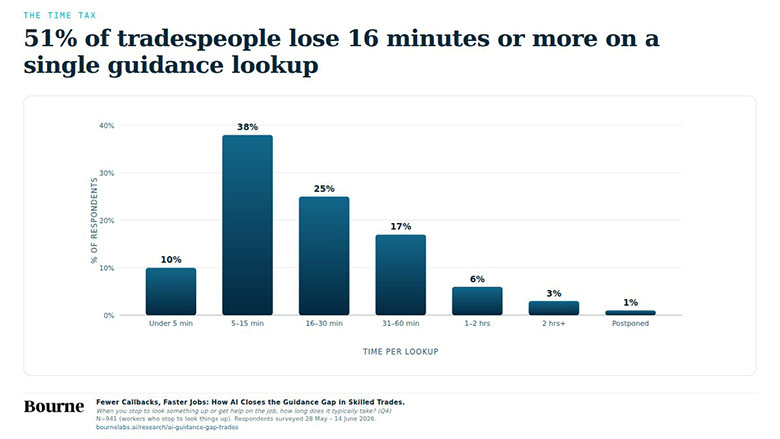 Image courtesy of Bourne.
 The trades are ready — and they expect it soon
If in-the-field employer tools fall short, the appetite for better ones does not. 72% of workers agree an AI guided-task app would cut the time they lose looking things up, and 66% say it would make them more effective. Some aren't waiting for employer tools at all — about a third have experimented with a consumer LLM on the job.
59% expect their employer to invest in AI guidance within two years, and the preferred surface is firmly smartphone-first: 71% would use an AI job-guide on the phone already in their pocket. Smart glasses rank last among the devices workers would use today, but as hands-free use cases mature, Bourne AI expects them to become a natural surface for this kind of on-the-job guidance.
Turning the guidance gap into fewer callbacks and faster jobs
In the report released today, Bourne AI maps where the guidance gap turns into rework and lost time, and what closing it is worth. Beyond these key findings, the full report breaks the data out by trade and by geography.
Building Services (HVAC, plumbing, electrical and facilities) is the most AI-ready large segment, with 81% saying AI would save lookup time and 42% already using consumer AI on the job. When looking at geography, the sharpest divide is in how much the problem hurts: European respondents report more rework and longer lookups than their US counterparts, even as both hold broadly similar views on AI.
The Fewer Callbacks, Faster Jobs study surveyed 1,000 skilled-trade workers across the United States and Europe (UK, Germany, France) between May 28 and June 14, 2026, with a margin of error of ±3.1 percentage points.
Looking for a reprint of this article?
From high-res PDFs to custom plaques, order your copy today!