Case Study: Noritz Hybrid Tank-Tankless System Install in Production Bakery
Texas contractor installs hybrid tank-tankless system to meet the super-sized hot water needs of new production bakery
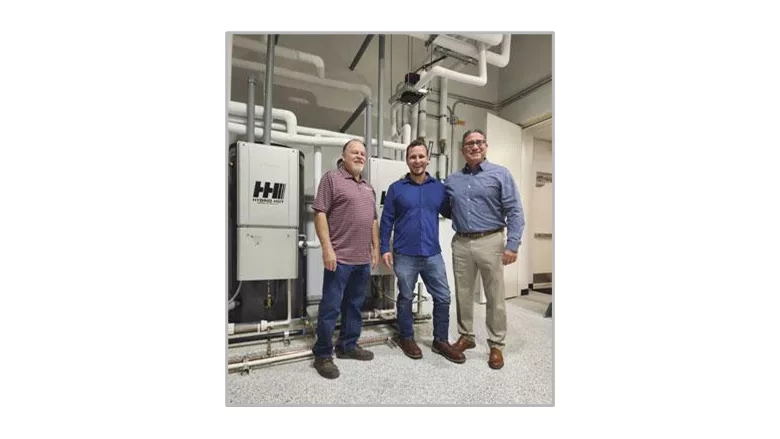
Tankless water heaters offer numerous benefits to designers and end users of commercial water heating systems: the energy savings of modern condensing technology, the space savings of wall- or floor-mounted rack installation, and the efficiency of “banking” two or more units together to respond quickly and smoothly to fluctuating hot-water demand. Unit redundancy is yet another advantage of a banked system: If one heater needs servicing, ample amounts of hot water at the right temperature remain available from the other units.
But for commercial and large residential applications that require substantial volumes of hot water intermittently, rather than a steady flow throughout the day, the ability to store large quantities of hot water to meet these “dump loads” is a compelling attraction, if not an inescapable need.
The Problem | 1,000 gallons within four hours daily
This is certainly the case at Del Sol Food Company’s 31,248-square-foot production facility in Brenham, Texas, located about 90 miles east of Austin. The 44-year-old company, well-known for making and marketing salad dressings under the BRIANNAS brand, is undergoing large-scale renovations to accommodate the relocation of the bakery operations of the recently acquired John Macy’s from Elmwood Park, New Jersey.
The fully integrated process encompasses every step of production, including dough mixing, proofing, baking, and, finally, packaging of the cheese sticks, crisps, and crostinis that comprise John Macy’s product lineup. The final stage of the process involves a thorough cleaning of all production equipment, adhering to the strict sanitation standards of the food processing industry.
That cleaning typically happens at day’s end once production has shut down. Spanning roughly four hours, sometimes more, the washdown process uses well over 1,000 gallons of 140°F water — a substantial fraction of the facility’s total daily consumption, including staff restrooms and other service areas.
In short, this daily demand requires a substantial “dump” of hot water within a relatively short period.
The solution initially specified by the system design engineer was a 199,900 Btu/hour commercial water heater with 100 gallons of built-in storage. But plant management wondered whether “a more efficient option would still fulfill the specification,” according to Joel Eggebrecht, whose employer, Moeller Plumbing & Electrical, would handle the installation.
Eggebrecht holds the title of Project Manager/Estimator while heading Moeller’s plumbing operation, which was launched in 2023. (Founded as an electrical contractor in 1952, Moeller was purchased by Mitchell and Aubrey Davis in 2022.) A 45-year veteran of the plumbing industry, Eggebrecht is well-versed in all types of water-heating products, including tankless. He also knows how to “value-engineer” a project without undercutting any of his customers’ overarching objectives.
So, in response to his Del Sol management’s request, Eggebrecht reached out to Beau Jolly, outside sales executive and account manager at the Tipton Company, a manufacturer’s representative covering Texas, Oklahoma, Arkansas, and New Mexico for numerous industry brands, including tankless water heater manufacturer Noritz America. “I have worked on numerous commercial projects with the Tipton team over the years,” says Eggebrecht.
Jolly and Tipton Vice President of Sales Jonathan Loos provided Del Sol “the data on the water heating capabilities of their product, showing it would meet the original spec,” he continues. “The owner then okayed the proposal, and the engineer approved the change.”
Eggebrecht reports that Del Sol management never hesitated to go with the Noritz product. “The owner’s rep was very open to the idea and offered no pushback. He told me, ‘Tankless will be a great option for our production needs.’”
The Solution | Combine tankless efficiency with ample storage
The product that Loos and Jolly quoted was not just a tankless water heater or even multiple banked tankless units. Instead, Tipton recommended three 199,900 Btu/hour condensing tankless water heaters (Noritz Model No.: NCC199CDV), each mounted onto a 119-gallon, cement-lined storage tank. Called the Hybrid Hot, each pairing has a capacity range of up to 11.1 gallons per minute and a maximum delivery rate of 317 gallons per hour.
As these numbers indicate, the system is engineered to convert cold water into large quantities of hot water. Drawing cold water from a side port of the attached tank, the tankless unit raises its temperature to the set point so that a built-in stainless steel circulator (Taco 009-FS5) can then pump it to another port near the top of the storage tank.
As Tipton’s Jolly explains, the tankless water heater takes its operational cues directly from the adjoining storage tank, and not from any of Del Sol’s production equipment: “A thermostat will indicate when the tank temperature drops below the set point, either because water is being drawn for usage or because it has been sitting idle too long. The tankless unit will then begin drawing and reheating water from the tank before pumping it back in.”
The tank’s half-inch cement lining is impervious to the adverse effects of the water, avoiding tank corrosion without the need for a sacrificial anode rod. Maintenance is minimized, while the lining and two inches of polyurethane foam insulation deliver energy and cost savings — as does Hybrid Hot’s thermal efficiency rating of 98% (0.95 UEF). The three water heaters were individually direct-vented through an exterior wall in the mechanical room, using two-inch PVC.
Up-front costs may have been the prime factor in Del Sol’s decision to go with the Hybrid Hot, but other factors played key roles as well:
Higher efficiency: The 98% efficiency rating of the Hybrid Hot units sits a couple of points above that of the originally specified commercial storage-tank heater. That difference may seem trivial, Eggebrecht comments. “But when you're heating more than 1,000 gallons of water daily, the extra points really help lower everyday operating costs” — especially when projected over 365 days a year and the expected ten or more years of service. (More on the longevity issue shortly.)
Smaller gas pipe diameters: Once again, small differences can have a big impact. The black-iron gas pipe run, which extends 425 feet from the meter to the header for the Hybrid Hot systems, is 1¼ inches in diameter for the five-pound gas service. The header-to-heater runs were done in ¾-inch. For the original specified product, the pipe runs would have required 2-inch and 1½-inch iron pipe. The three-quarter-inch difference for each pipe run delivered significant savings. (The vent run diameter of two inches was also smaller than it would’ve been with the original spec.
Longer warranties: The Hybrid Hot carries a 10-year warranty on the heat exchangers and the cement-lined storage tank. These three coverages exceeded the competition’s protection enough to command the customer’s attention. Del Sol could have purchased additional protection from the other manufacturer, notes Eggebrecht. “But the units we installed offered the longer warranties right ‘out of the box.’ Not only does our customer save some money on the initial equipment costs, but they also benefit from a longer equipment lifespan. My Del Sol contact is responsible for all operations inside this facility, so he knows that longevity will impact his maintenance team in a positive way.”
Local inventories: The water heater products Del Sol and Moeller chose to install were all readily available from a local distributor’s inventory. For Eggebrecht, that was a very big deal. “The originally specified product is not a stock item for wholesalers,” he explains, “so we would have had to build in several weeks’ of factory lead time into the construction schedule. With Tipton’s local distributor, we had no wait. In fact, they were ready to ship before we were ready to install them!”
Local distributor stocks are just part of the inventory backup Tipton provides installers and service technicians. The company maintains its own inventories to provide critical time-and-place utility. As Jolly notes, every day that a factory, hotel, or restaurant is down due to a lack of hot water usually results in significant financial losses. “We can’t have that,” he says.
“If something is going wrong with a piece of equipment, Tipton can help troubleshoot it, provide a replacement part, fix the problem and have them back up and running the same day or the next.”
The Result | Ample water supplies at the right temperature and pressure
The magnitude and complexity of the Del Sol renovations inevitably required the involvement of numerous trades. That, not surprisingly, meant Moeller could not complete the water heater installation all at once. “There wasn’t anything difficult about installing the three systems,” reports Eggebrecht, regarding his two-man crew of Plumbing Foreman Armando Peralez and Lead Plumber Patric Boykin. “It just took a little patience, accomplishing it one piece at a time,” while waiting on other trades.
The biggest surprise challenge was maintaining the correct water pressure, which needs to be around 60 pounds per square inch for the washdown operation to function effectively. A four-inch backflow prevention valve, required to handle city water, causes pressure loss. Additionally, the washdown operation itself results in pressure loss when plant personnel use three or four hoses simultaneously.
The solution, recommended by Tipton Co., was a booster pump near the mixing hose stations to maintain the required pressure, regardless of the number of hoses in use. Once the pump became operational, the hybrid water heating system performed as designed and to Del Sol management’s complete satisfaction.
Could Moeller have opted for a tankless-only system at Del Sol? Loos and Jolly are doubtful. Such a large fraction of the daily usage concentrated into only four hours (or less) would likely have demanded between nine and 12 banked tankless units, Jolly estimates: “All that equipment with its piping and venting probably would not have fit into Del Sol’s single mechanical room.
“From an economic standpoint and from a space standpoint, going all tankless would not have made much sense,” he continues. “The installation would have been a greater challenge with the additional piping, fittings, and flow sensors. With 12 units, instead of three Hybrid Hot units, maintenance would require more frequent flushing and cleaning. Plus, there likely would have been additional pressure-drop issues with water running through that many heat exchangers.”
On the other hand, the type of application found at Del Sol is far from unusual in today’s market. Plenty of commercial and industrial buildings consume large volumes of high-temperature water within narrow time frames. No wonder then that Loos and Jolly regard hybrid systems as an up-and-coming technology in the water heater industry.
“Whether because of water pressure problems or the need for dump loads, specifying engineers like designing storage into their domestic hot water systems,” says Jolly. “Home builders also like these systems for master bath showers with multiple heads and body sprays. You can meet the needs of the shower while still handling other hot-water demands in the home.”
Loos points to a custom home builder who plans to install not just one, but two hybrid systems in a very large home to handle such applications. Meanwhile, he recently completed a 42-room hotel project whose entire hot-water needs are supplied by a single Hybrid Hot setup.
“That is why I refer to it as our high-performance water heater.”
Looking for a reprint of this article?
From high-res PDFs to custom plaques, order your copy today!