
Designing out water stagnation in recreation plumbing systems
Smart flushing faucets and self-draining showers give plumbers new tools to manage water age and protect public health.
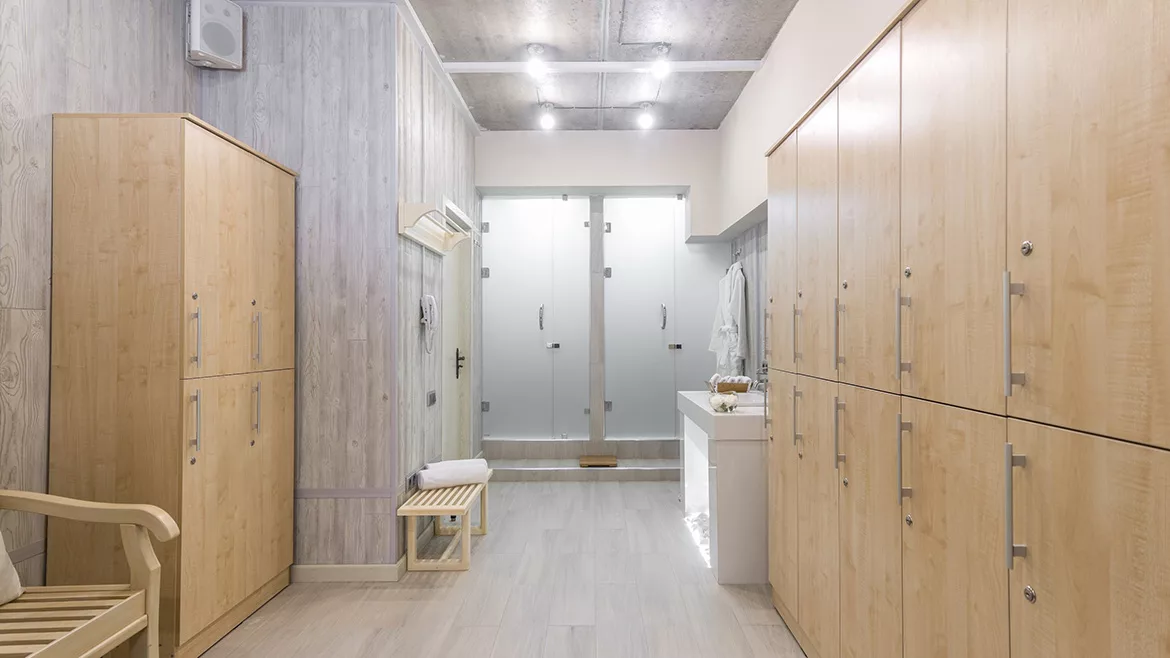
Stagnant water is the enemy of public health in recreation facilities that are intermittently used.
The goal of anyone taking time to work out at a local fitness or recreation center, high school gym, neighborhood YMCA, aquatic facility, or office workout space —is to get fit and stay healthy. That effort typically involves sweating, straining, swimming or striding, followed by a visit to the locker room to shower and the restroom to wash up.
However, those health benefits can be undermined if the facility’s plumbing systems are not properly managed. Inadequate flushing of water pipes serving restrooms and locker rooms can expose users to significant health risks. Stagnant water is the enemy of public health in recreation facilities that are intermittently used. Fortunately, recently introduced plumbing technologies are enabling maintenance teams to more effectively and efficiently protect the health of facility users.
What is lurking in the pipes
Legionella pneumonia first gained national attention in the 1970s, yet it continues to pose a serious threat today. As recently as late 2025, outbreaks have been reported in Paterson, NJ, Detroit, MI, and Oakland, CA, with multiple hospitalizations and deaths.
These outbreaks typically occur when plumbing systems experience periods of low or no use. As water sits in pipes and fixtures, disinfectant levels—such as chlorine—dissipate, creating conditions that allow bacteria to multiply and colonize biofilm along pipe walls.
Unlike many communicable diseases, Legionella is transmitted through aerosolized water. Turning on a faucet or shower can create a fine mist that carries bacteria into the air. Infection occurs when individuals inhale this mist or ingest contaminated water.
Legionnaires’ disease is a severe form of pneumonia and is fatal in approximately one out of every ten cases. Other pathogens that thrive in stagnant water include Pseudomonas, which can affect the eyes, skin, and muscles, and Acanthamoeba, a microorganism capable of causing widespread and serious infections.
Pipe flushing minimizes stagnant water risks
Water is essential to all life—including pathogens—making it an effective carrier and incubator for disease, particularly when it remains stagnant. Low-flow or no-flow conditions occur in virtually all facilities. In recreation centers, these conditions often arise during summer breaks, long weekends, holidays, or seasonal closures.
Water will take longer to flow during these periods from the point of delivery through a sink or a shower, possibly exposing users to the microorganism hazards. Flushing water though faucets at the point of use is essential for systems that have lapses in use of the water system to prevent bacteria growth and transmission at the point of water delivery.
During extended periods of non-use, water can take longer to travel from the point of entry to sinks and showers, increasing water age and potentially exposing users to microbial hazards. Flushing water through fixtures at the point of use is a critical strategy for preventing bacterial growth and transmission.
Regular, scheduled flushing removes aged water and disrupts biofilm within pipes, reducing the conditions that allow bacteria to thrive. The Centers for Disease Control and Prevention (CDC) recommends that facilities implement a Water Management Program (WMP) to reduce the risk of Legionella. ASHRAE Standard 188 outlines key program elements, including risk assessment and control measures, and these guidelines were expanded further with ASHRAE Standard 514, enacted in 2023.
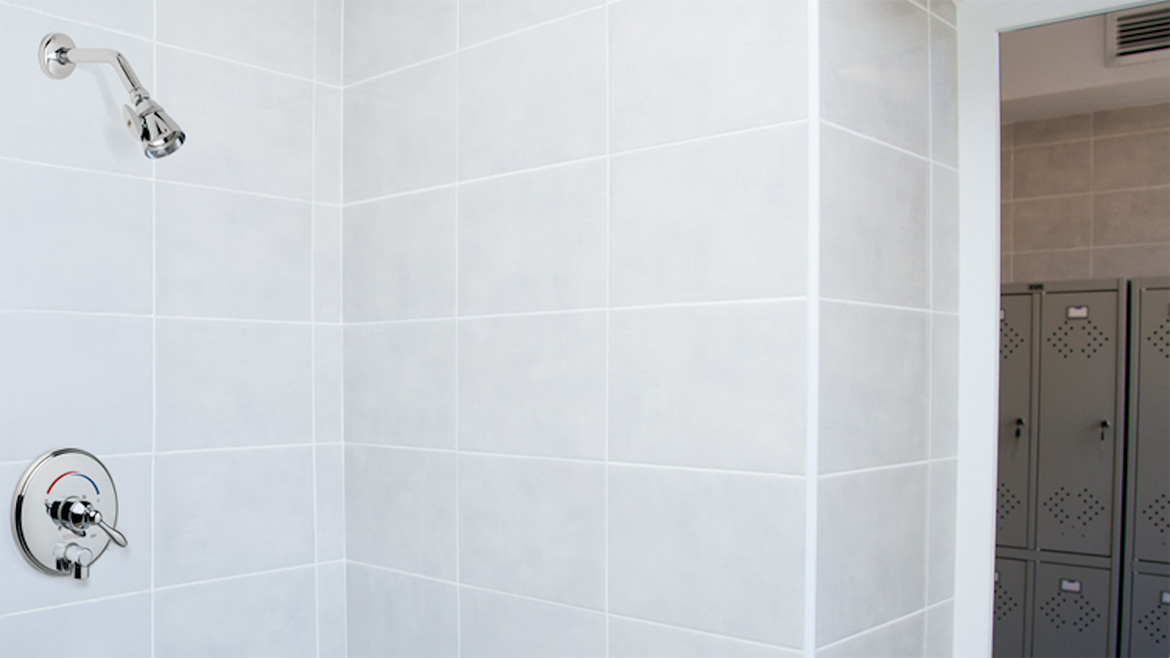
Automatically draining shower valve systems are increasingly being specified in new construction and renovation projects. Image courtesy of Chicago Faucets
More efficient pipe flushing
An increasing number of facilities are installing touchless faucets in restrooms and locker rooms. These sensor-activated fixtures provide well-established benefits:
- Reduced germ transmission: Hands-free operation limits the transfer of germs between users and surfaces.
- Water savings: Automatic shutoff can reduce water use by up to 70 percent compared to manual faucets.
- Ease of use: Simple hand motion activates and stops water flow.
- ADA compliance: Improves accessibility for users with limited mobility.
- Lower maintenance demands: Reduced physical contact minimizes wear, cleaning, and repairs.
Beyond these advantages, manufacturers have added Bluetooth™ connectivity to many touchless faucet platforms. This capability allows facility staff to configure, monitor, and manage faucets using a dedicated mobile application on a smartphone or tablet. The app offers facility managers a simple and intuitive operation, configuration and monitoring of individual or groups of faucets. For sensor faucets that lack built-in Bluetooth, retrofit options are often available.
Through the app, facility managers can implement use-based, interval-based, or volume-based flushing strategies. Longer pipe-flushing cycles can be programmed for remediation purposes. The app allows users to define the number of flushes, duration, and intervals, and to save presets for user detection sensitivity, operating modes, and hygiene flushing. These presets can be named and deployed across multiple faucets for consistent system-wide management.
Available faucet operating modes typically include:
- Normal: Faucet activates when hands are detected by the sensor.
- Hygiene flush: Automated flushing to reduce stagnant water using interval- or volume-based settings.
- Pipe flush: Extended purges for remediation and water quality management.
- Metering: Run times tailored to specific usage patterns.
- Watersaver: Run times set from three to 30 seconds with optional cycle delays for conservation.
- Volume control: Maximum run times set from five to 45 seconds.
- Cleaning: Temporarily disables the sensor to allow cleaning without accidental activation.
These capabilities allow plumbing teams to centralize and simplify maintenance, eliminating the need for time-consuming, manual fixture-by-fixture flushing.
Self-draining shower systems
Shower systems present another critical area of concern. Flushing shower piping to prevent disease transmission can now occur automatically after every use, without staff intervention. A reliable solution is the installation of automatically draining shower valve systems from the start and recommend specifiers include them in renovation or update plans.
Automatically draining shower valve systems are increasingly being specified in new construction and renovation projects. Already deployed in professional sports facilities such as NFL locker rooms, these systems prevent stagnant water from remaining in behind-the-wall piping and handheld spray hoses—areas where Legionella is most likely to flourish.
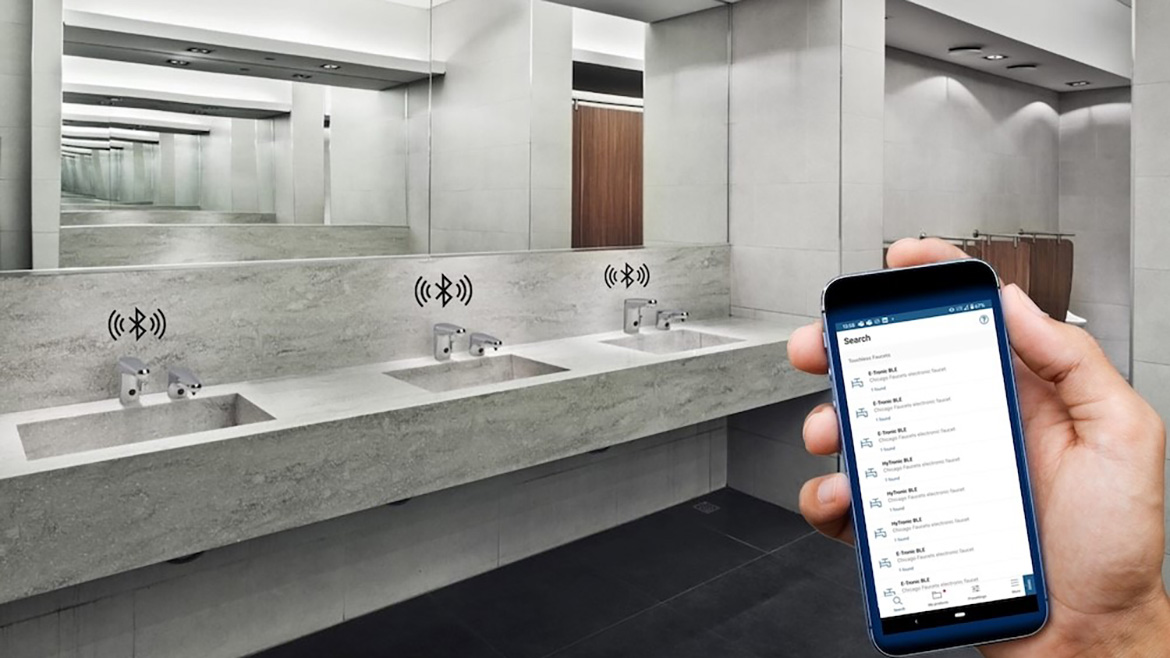
Manufacturers have added Bluetooth™ connectivity to many touchless faucet platforms. Image courtesy of Chicago Faucets
For existing recreation facilities, handheld shower hoses can often be retrofitted with instant water-discharge models that incorporate auto-draining valves.
By removing residual water from pipes and hoses immediately after use, self-draining shower systems significantly reduce the potential for bacterial growth and support higher standards of safety and regulatory compliance. This system offers a modern, evidence-based enhancement aligned with best practices for minimizing waterborne pathogen risks.
How the system works:
- After the shower is turned off, an automatic draining valve opens to release remaining water.
- It effortlessly discharges water trapped between the valve and showerhead is discharged within approximately one minute.
- Systems are compatible with pressure-balancing and pressure-balancing /thermostatic mixing valves.
- Diverter valves enable complete drainage in dual-spray shower configurations.
- Auto-draining hoses eliminate the need for manual repositioning by the plumbing team.
- Valves are designed for durability in demanding recreation center environments.
For users, the system operates invisibly and safely, making this one part of water system that the plumbing team does not have to drain. For recreation facilities, it removes one of Legionella’s preferred breeding locations while protecting public health and organizational reputation.
Reducing stagnant water is essential to safe recreation center operations. Combining app-controlled faucet flushing with automatic, self-draining shower systems provides a comprehensive and proactive approach to water management.
While recreation center users may never realize the role these systems play in protecting their health, plumbing teams and facility managers will recognize the benefits. These technologies not only save time and resources, they help save lives.
Looking for a reprint of this article?
From high-res PDFs to custom plaques, order your copy today!


