
Training and Education
How Do Volunteers Save Lives Through Ship Plumbing Training?
Mercy Ships’ partnership with SkillCat trains volunteers to maintain life-saving plumbing systems aboard hospital ships.

The clang of wrenches and the hum of generators echo across the deck as a group of plumbers gather below the waterline; not to repair a ship, but to prepare it for healing. Aboard the Global Mercy, volunteers are learning how plumbing can save lives. Here, every pipe, valve and fixture supports something far greater than comfort — it sustains clean water, sanitation and the dignity of care.
At sea, there’s no backup system for clean water. Every drop must be filtered, pumped and protected — and that’s where plumbers come in. On Mercy Ships’ floating hospitals, skilled volunteers work to maintain these life-sustaining systems, ensuring that the ability to deliver safe, reliable care doesn’t leave when the ship sails away.
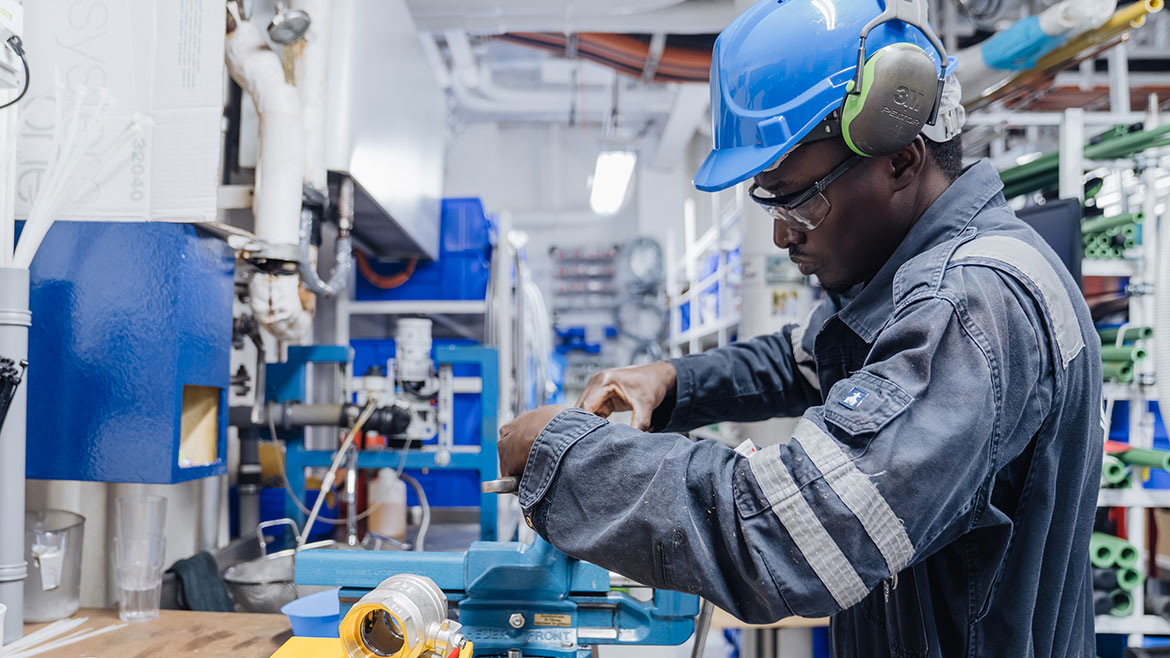
Amogo Tendeng, a volunteer plumber aboard the Global Mercy. © 2025 Mercy Ships Photo Credit Eugene Danso
The mission
Mercy Ships, headquartered in Garden Valley, Texas, is an international charity. It operates the largest civilian (non-governmental) hospital ships in the world; responsible for providing life saving surgeries and surgical training in Africa. It has two ships currently in its fleet; the Global Mercy, a 174-meter (570 ft 10 in), 37,000-ton ship that features 12 decks, and the Africa Mercy, a 152 m (498 ft 8 in), 16,572 GT (gross tonnage) hospital ship. Africa Mercy was converted from a rail ferry in 2007.
The organization was founded in 1978 by Don and Deyon Stephens, inspired by the humanitarian efforts of the SS Hope, as well as the birth of their disabled son. Since its founding, the organization has been dedicated to providing surgical care and surgical education to communities suffering from painful disfigurements and other issues.
According to Mercy Ships’ website, a person dies every two seconds from a surgically treatable disease. About 5 million people lack access to safe surgery. "Mercy Ships exists to change that narrative."
According to the United Nations, about 40% of the world’s population lives near a coast. That’s why floating surgical centers like the Global Mercy and Africa Mercy are so important; they are able to reach more people, in communities that often suffer from a lack of care. Specifically, Mercy Ships goes to African countries, where there are only 2 physicians per 10,000 people. They’ve visited over 14 African countries, including: Togo, Ghana, Ivory Coast, Guinea (Conakry), Guinea-Bisseau, South Africa, Senegal, Benin, Gambia, Liberia, Democratic Republic of the Congo, Cameroon, Sierra Leone and Madagascar.
The work that Mercy Ships puts in every day is, without a doubt, incredibly important. But, as we all know, the important work that goes on in emergency situations like surgery can’t happen without clean, safe water and qualified people there to keep it that way.
Everyone working aboard Mercy Ships is a volunteer. The doctors, surgeons and nurses, of course, but the plumbers and engineers, too. Everyone works together towards the organizations’ goal of providing medical care, healing and hope.
The systems
Just as in land-based healthcare facilities, plumbing reliability is essential for infection control, sterilization and patient safety. A single system failure can ripple across the hospital. The stakes are high; even a brief interruption in plumbing services can have serious consequences. "An interruption of water services has the potential to lead to infection control issues," Nick Ford, hospital engineer at Mercy Ships, told us. "The inability to provide water for handwashing, and the lack of steam needed to sterilize surgical instruments, would prevent surgeries being performed."
The ships rely most heavily on the domestic freshwater and sanitary systems, which are critical to maintaining hospital operations. "While in field service, Mercy Ships receives its water from the host country, which may not be the best quality of water for hospital use," Ford explained. "Mercy Ships filters this water and sanitizes it to ensure it is free from waterborne pathogens."
Maintaining these complex systems presents a unique set of challenges. "When we are in field service in Africa, the ability to find specialized repair parts for a ship’s plumbing system is virtually impossible," Ford said. "Many of our systems have redundancy and a well-stocked storeroom for repair parts." Preventive maintenance is, therefore, a cornerstone of operations, and trained volunteers play a vital role in ensuring the ship’s plumbing systems remain reliable. "Having a trained and experienced volunteer plumber that knows how to respond to a failure, mitigate and repair the system, allows us to continue to provide surgical services and patient care with minimum disruption."
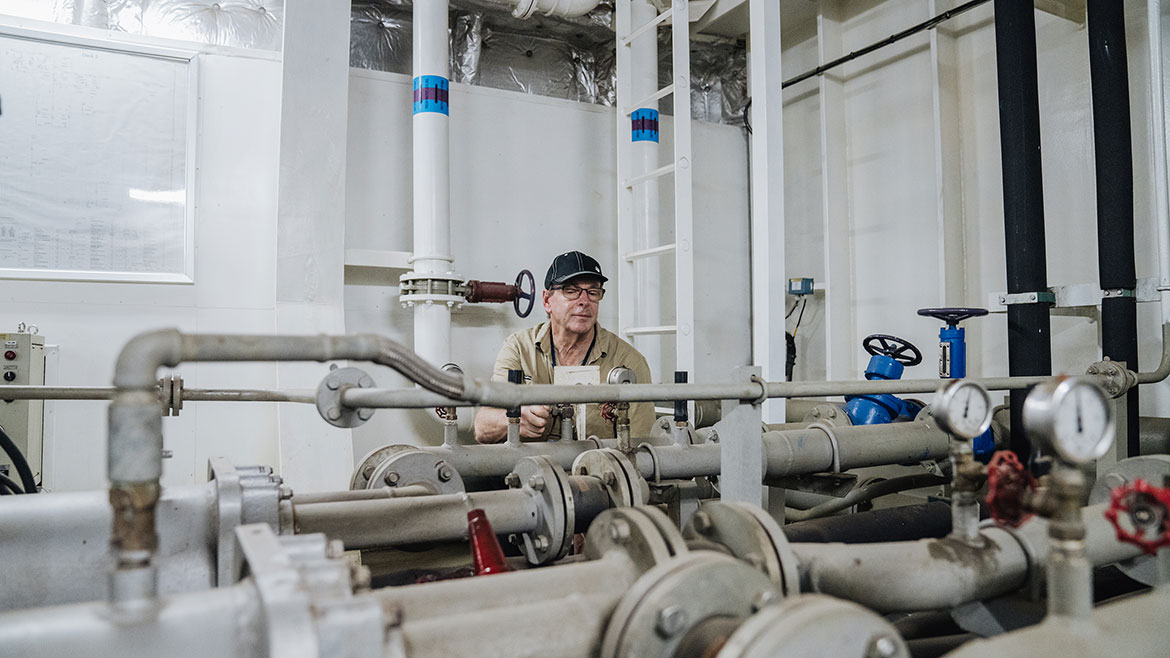
John Lean, Hotel Engineer for Mercy Ships, is checking meters in the engine room. © 2024 Mercy Ships Photo Credit Abigail Beinetti
Recognizing the importance of skilled trades in sustaining their mission, Mercy Ships recently partnered with SkillCat, a company specializing in online training for the HVAC and plumbing industries. The partnership brings modern, mobile-friendly technical education to the volunteers aboard the ships — a critical advancement for an organization that depends on specialized labor in remote environments.
"SkillCat’s self-paced plumbing training gives Mercy Ships crew the flexibility to learn anytime, anywhere — even while at sea," Emi Avtalion, the head of marketing at SkillCat, explained. "Lessons are short, mobile-friendly, and designed to strengthen essential skills that support safe, efficient ship operations without disrupting daily schedules." The curriculum emphasizes preventive maintenance, safety and environmental resilience — key priorities for such important. "Every course reinforces preventive maintenance as the key to reliability and cost control," Avtalion noted. "This is an essential approach when resources and parts are limited."
Safety is another pillar of the program. "Safety is built into every SkillCat lesson," Avtalion continued. "Each simulation begins with the proper use of safety gear and protocols, ensuring that safe work habits become second nature." For volunteers, this focus not only protects themselves, but also safeguards the entire hospital environment, from the volunteer-crew to the patients.
The training also emphasizes risk management and operational resilience in complex systems like potable water distribution, wastewater management, and sterilization. As Nick Ford noted, "We must pump the ship’s sanitary system into the host country’s sanitation lines; we do this by ensuring the sanitary pumping system is well maintained by our plumbers. The ship has sanitation holding tanks and if the pumping system failed, eventually this would cause the ship to stop supplying fresh water for handwashing and toilets due to the inability to pump these tanks into the host country’s sanitation lines." Proper training equips volunteers to respond to these scenarios confidently and efficiently.
Ultimately, the collaboration between Mercy Ships and SkillCat underscores a deeper truth about the connection between skilled trades and global health. "This partnership highlights the vital connection between skilled trades and global health," Emi Avtalion said. "Reliable plumbing is essential for clean water, sanitation, and infection control — core elements of Mercy Ships’ mission. Together, we’re making technical training more accessible to those helping deliver life-changing care around the world."
From ship to shore
As Mercy Ships continues its work across the African coast, the addition of structured, tech-enabled plumbing education ensures that the next generation of trades volunteers will have the knowledge and confidence to keep vital systems flowing smoothly. Without safe, reliable water and sanitation, as Ford put it simply, "the growth of pathogens is likely to occur and could lead to sickness and death. Skilled plumbing professionals are needed to maintain, repair, and continually provide freshwater and an operating sanitary system."
At sea, there’s no backup system for clean water. Every drop must be filtered, pumped and protected — and that’s where plumbers come in.
The broader impact of the training that goes on aboard the Global Mercy and Africa Mercy doesn’t just affect the work being done on the ships themselves. They have real, life-changing effects on the volunteers; these volunteers leave the program equipped to maintain critical systems at sea, skills that strengthen the local infrastructure when they return home. This creates a ripple effect, empowering communities with technical knowledge that supports long-term health and sanitation improvements.
Not only that, SkillCat’s digital certification ensures that volunteers can document and showcase the courses they’ve completed. These credentials can help trainees connect with future employment opportunities, opening doors to roles in commercial plumbing, HVAC, and humanitarian-focused technical work. As Avtalion explains, "This partnership highlights the vital connection between skilled trades and global health. Reliable plumbing is essential for clean water, sanitation, and infection control — core elements of Mercy Ships’ mission."
For the industry at large, this model demonstrates how targeted trade training can directly impact global health resilience. By emphasizing preventive maintenance, safety protocols and emergency response, the program ensures that essential services — like potable water distribution and wastewater management — remain reliable even in resource-constrained environments.
As Mercy Ships’ Nick Ford noted, "Without safe, reliable water and a sanitary system, the growth of pathogens is likely to occur and could lead to sickness and death. Skilled plumbing professionals are needed to maintain, repair, and continually provide freshwater and an operating sanitary system."
In essence, the training program serves as a blueprint for trade-based humanitarian initiatives: technical expertise, combined with education and certification, equips volunteers to safeguard public health in challenging environments. It underscores the broader role that skilled trades play in global health — demonstrating that plumbing is a cornerstone of human safety and community resilience.
The broader impact of the training that goes on aboard the Global Mercy and Africa Mercy doesn’t just affect the work being done on the ships themselves. They have real, life-changing effects on the volunteers.
Mercy Ships’ partnership with SkillCat shows how technical training can have a profound, lasting impact — aboard the ship and beyond. By equipping volunteers with the knowledge and confidence to maintain complex plumbing and HVAC systems, the program ensures that essential services remain uninterrupted during missions, directly supporting patient care and surgical operations. Nick Ford emphasized, "Having a trained and experienced volunteer plumber that knows how to respond to a failure, mitigate and repair the system, allows us to continue to provide surgical services and patients with minimum disruption."
The ripple effect extends even further once volunteers return to their communities. Graduates carry their newly honed skills into local infrastructure projects, strengthening water and sanitation systems that are vital to public health. SkillCat’s self-paced, mobile-friendly curriculum and digital certification make it easier for volunteers to continue learning, track their progress, and leverage their expertise in future roles.
For the trades industry, Mercy Ships’ program offers a compelling model: skilled tradespeople are not just essential for construction and maintenance, but for safeguarding global health. Reliable plumbing and HVAC systems form the backbone of infection control, safe water and resilient sanitation — all critical components of humanitarian work. As Avtalion notes, "Reliable plumbing is essential for clean water, sanitation and infection control — core elements of Mercy Ships’ mission."
Ultimately, the program is a testament to the power of combining skill development with humanitarian service. It demonstrates that investing in trade education is much more than an investment in individual careers; its value also lies in safeguarding the health and well-being of communities worldwide. Through partnerships like this, the impact of skilled trades reaches far beyond the classroom — or the ship — creating safer, healthier and more resilient communities around the globe.
Looking for a reprint of this article?
From high-res PDFs to custom plaques, order your copy today!