From complexity to confidence
Evolving approaches to seismic bracing.
When it comes to seismic resilience, a building’s structural stability is only the beginning. For mission-critical facilities such as hospitals, data centers and government buildings, operational continuity after a seismic event is equally vital. Seismic bracing plays a crucial role by protecting non-structural systems that maintain life safety, environmental control, and essential building services.
Beyond structural resilience
The evolution of seismic code and construction standards in the past decade reflects a significant shift from a focus on structural survival to operational continuity. In high-stakes environments like hospitals, HVAC systems must continue to maintain negative pressure in critical zones. Electrical systems must keep emergency power flowing. Clean water and safe drainage must remain reliable.
According to Prasad Naik, a professional engineer at Gripple, ensuring continuous system operation in critical facilities is extremely important. “From the health and safety perspective, certain labs, for example, are kept at negative pressure to isolate hazards. These systems must remain operational—not just for comfort but to contain the hazard.” Naik further explains, “Without power, nothing can operate. In critical facilities, systems like power distribution, transformers, and emergency generators must remain functional after an earthquake.” Even within non-critical facilities, like offices or schools, systems need to be restrained to prevent collapse and consequential damage and injury.
Coordination challenges and the role of BIM
It is crucial for consulting engineers to design for these protections early in the planning phase, while contractors face the challenge of installing them effectively within increasingly complex project timelines and space constraints. One of the pressing challenges with seismic bracing systems is spatial conflict within crowded ceiling spaces. Mechanical, electrical and plumbing systems often compete for limited overhead real estate, complicating bracing installations.
Building Information Modeling (BIM) significantly eases these coordination issues. Through clash detection, project teams can visualize and proactively address spatial conflicts, thus minimizing costly retrofits and scheduling delays. BIM allows designers and contractors to foresee installation challenges, facilitating earlier and more efficient planning.
Early integration of seismic bracing into BIM models reduces the common issue of seismic protection being an overlooked, last-minute addition. When this occurs, cable-based seismic bracing offers substantial retrofit capabilities, allowing post-installation without disrupting existing infrastructure.
Enhancing jobsite efficiency
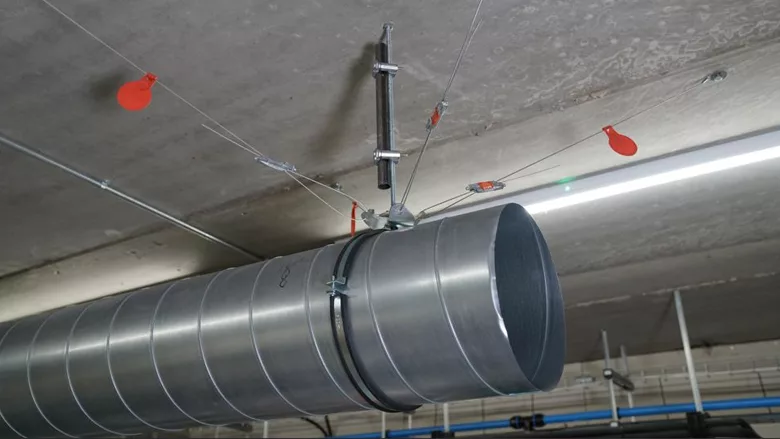
Emerging innovations in seismic bracing materials, particularly cable-based assemblies, address jobsite logistics and installation complexities. Compared to traditional rigid strut systems, cable-based solutions offer numerous advantages.
According to James Jaffrey, global product manager for Seismic at Gripple, "using cable, you're completely minimizing the amount of material used. You are improving sustainability and efficiency of the project, as large sticks of threaded rod and strut do not have to be carried or cut on the job site. It is easy to move and install, and this also reduces material waste." Cable systems also allow flexible installation angles, easing contractor challenges in congested environments.
As Cullen Rostveit, director of seismic sales at Gripple notes, “A traditional rigid system can be difficult to maneuver and install around existing services in congested ceiling spaces often found within hospitals and data centers. Lightweight cable systems allow for varying angles and lengths, giving contractors greater flexibility.”
Engineering compliance from design through installation
Effective seismic bracing isn’t just about good products; it’s about ensuring those products are used correctly. For engineers, this means access to systems that come with full documentation—pre-engineered kits with published evaluation reports, stamped engineering drawings, and clearly defined compliance with state and national codes. For contractors, it means systems that are easy to install correctly the first time with little room for error, something that has historically been difficult to achieve in the seismic bracing space.
A seismic brace that performs well in theory means little if it’s improperly installed. That’s why increasing attention is being paid to human error reduction. Systems that are preassembled, quality tested, and designed with error proofing in mind—like automatic locking mechanisms and simplified hardware—are helping raise the baseline for performance in the field.
Some manufacturers are meeting these needs with a full-service approach, offering not just products but engineering support, on-site training, and post-installation assistance. At Gripple, for example, the company has invested in a robust network of territory managers across North America who work directly with both engineers and contractors—from early design coordination through installation and beyond. Rostveit adds, “We have teams of Gripple personnel and partners with the right qualifications to assist directly with project personnel in every state.”
Gripple cable assemblies are designed to simplify installation while ensuring compliance; they are tested and verified by IAPMO and OSHPD/HCAI to meet all applicable building codes and standards. Jaffrey explains, “Gripple kits are pre-made and factory crimped under stringent quality systems within ISO-9001 certified facilities. With our seismic bracing, the final assembly uses automatic locking devices designed and quality-tested to meet code compliance. We're removing human error from installation.” Because these systems are factory engineered, they remove many of the variables that lead to field error, helping both design professionals and installers meet code with greater ease.
Gripple ensures rapid product availability and safety through complete control over their manufacturing process. As Jaffrey notes, “We die-cast the locking mechanisms of our products ourselves. We don't source materials externally—we perform all quality inspections on-site in the US. We have full traceability and supply chain control, enabling us to quickly respond to customer needs.” This level of control not only minimizes lead times but also ensures consistently high product quality, critical for safety-sensitive installations.
Innovation on the horizon
As buildings become smarter and more integrated, seismic bracing is poised to evolve even further. Emerging product trends like cast-in-place anchor systems avoid the risks of post-installed cracking and are gaining popularity with structural engineers. Prefabricated racks, multi-trade supports and integration with BIM data for pre-planned anchor placement are also shaping how bracing fits into future builds.
There’s also a growing interest in the use of smart sensors and AI-driven monitoring systems that could identify post-event stress points or alert emergency personnel to compromised systems after a quake. While these technologies are still in development, they signal a broader shift toward proactive resilience strategies.
As seismic activity continues to threaten vulnerable regions across the globe, the construction industry’s understanding of resilience must evolve with it. A standing building is no longer enough. Functionality, operability, and continuity of service are the new benchmarks of safety and success. Seismic bracing plays a crucial role in delivering on those promises. Whether you’re a consulting engineer working to meet code and futureproof your design, or a contractor navigating on-site complexity, embracing smarter, more integrated bracing solutions is essential. The goal isn’t just compliance, it’s confidence—in your systems, your structure, and your ability to keep people safe when it matters most.
Looking for a reprint of this article?
From high-res PDFs to custom plaques, order your copy today!