
Strategic Plumbing Insights | Christoph Lohr
The plumbing industry survey we need
It’s time plumbing engineering was recognized as an essential, specialized field.

Image source: Thapana Onphalai / iStock / Getty Images Plus
I wrote an article last September about how, in my experience, plumbing engineering is often underestimated. However, I am also seeing firsthand how much more complex it’s becoming. Too many people still think of plumbing design as simple, but modern challenges — like water conservation, water quality issues and the rising threat of Legionella — are proving that old “rules of thumb” just don’t cut it anymore. In the past, I argued in meetings that plumbing deserved more attention and resources, but there’s still a mindset that HVAC is more critical. The reality is that if we don’t adapt and develop specialized expertise in plumbing, firms will face serious consequences, whether it’s financial losses, legal troubles or even risking reputations. If the industry continues to overlook the importance of plumbing professionals, they’re setting themselves up for costly mistakes. It’s time we start recognizing plumbing engineering for the essential, specialized field it truly is.
A needed solution I discussed in the article was a “by industry, for industry, state of the industry” survey for plumbing design professionals. Some expansion on that idea can be found below.
Industry survey
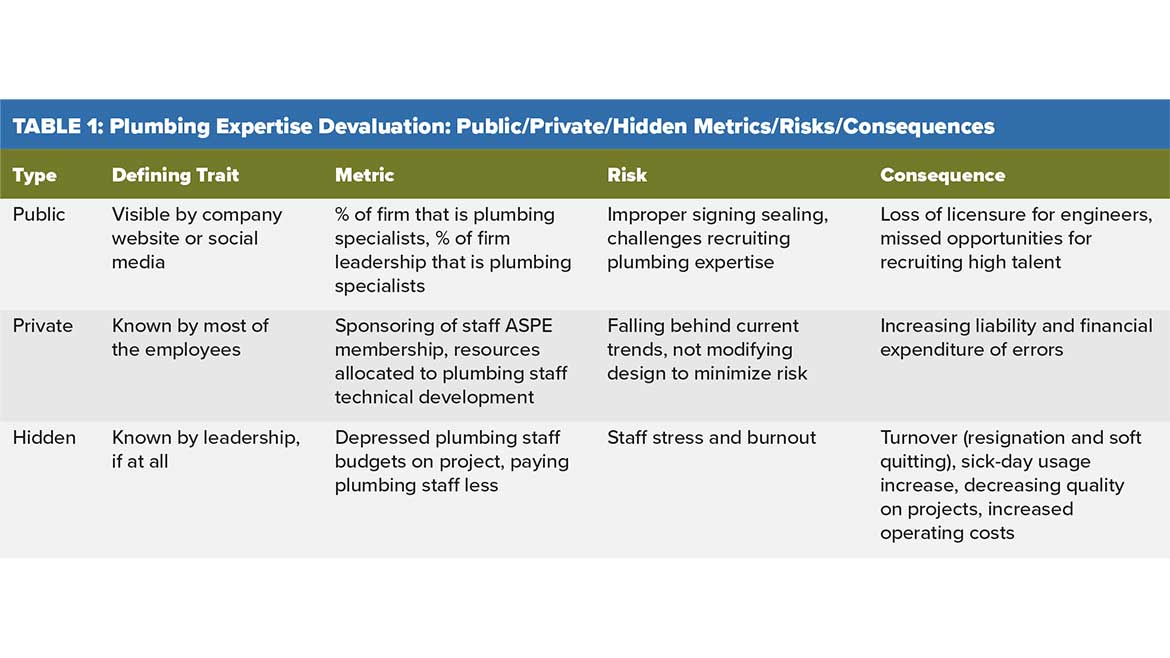
In my previous article about the subject, I detailed three types of metrics and their associated risks: public, private and hidden. I created a table that I am republishing below as a refresher. To better serve society, digging into these questions will be vital. Each set of questions below is organized to illuminate answers for each metric.
Courtesy of NewVantage Partners
It is worth noting that data like this is critical to better decision-making. In a Harvard Business Review webinar, “Data Driven Culture,” a NewVantage Partners survey was cited, indicating that data-driven cultures are rare in the U.S., with over 70% of all U.S.-based firms citing adoption of data as a struggle. Other organizations, like Google, which I highlighted in one of my columns years ago, were able to use data to predict the optimal number of interviews to improve confidence in hiring. For an industry that is more data-starved than others, industry surveys are vital in allowing us as a whole to take the next steps.
I am also seeing firsthand how much more complex it’s becoming. Too many people still think of plumbing design as simple, but modern challenges — like water conservation, water quality issues and the rising threat of Legionella — are proving that old “rules of thumb” just don’t cut it anymore.
Public metric questions
These questions are focused on companies’ most visible traits. They aim to determine if companies are limiting their recruiting abilities for plumbing or potentially running into signing/sealing issues for certain disciplines.
- How many overall staff does your company employ?
- How many (or what percent) plumbing staff does your company employ?
- How many (or what percent) HVAC-focused staff does your company employ?
- How many (or what percent) mechanical design generalists does your company employ?
- How many senior leaders (e.g., principals) does your company have?
- How many plumbing professionals are senior leaders (e.g., principals)?
- How many professionals make up your C-Suite?
- How many plumbing professionals are in your organizations’ C-Suite?
- In your company’s marketing literature (website, pamphlets, social media) what percentage of the time do you estimate HVAC accomplishments or abilities are highlighted?
- In your company’s marketing literature (website, pamphlets, social media) what percentage of the time do you estimate that plumbing accomplishments or abilities are highlighted?
- On a scale of 1-10, 1 being not at all and 10 being very likely, do you feel plumbing professionals have equal opportunity compared to other disciplines for promotion at your organization?
- On a scale of 1-10, 1 being not at all and 10 being very likely, do you feel HVAC professionals have equal opportunity compared to other disciplines for promotion at your organization?
Private metric questions
These questions tend to focus on staff development and minimizing errors and omissions.
- Does your organization give you time to attend ASPE chapter meetings?
- Does your organization give you time to attend ASHRAE chapter meetings?
- Does your organization cover your meal cost to attend ASPE or ASHRAE lunches?
- Do you attend any other industry chapter events? (e.g., ASSE, IAPMO, ASHE, etc.)
- How many plumbing trainings (like ASPE) have you attended in the past 12 months?
- Does your organization cover your meal cost to attend these other industry chapter events?
- Does your organization give you time to attend codes and standards meetings in person?
- Does your organization dedicate time/resources to develop plumbing engineering staff?
- Does your organization dedicate time/resources to develop HVAC engineering staff?
- If you do not regularly attend ASPE chapter meetings, why not?
- Do you sign and seal your own plumbing construction documents?
- Do you feel that the P.E. signing and sealing your construction documents know the same or more about plumbing than you do? (Answer yes if you sign and seal your own drawings.)
- Plumbing designers only: On a scale of 1-10, with 1 being not at all and 10 being absolutely yes, do you feel that your organization develops plumbing technical expertise to the same level as other disciplines?
- HVAC designers only: On a scale of 1-10, with 1 being not at all and 10 being absolutely yes, do you feel that your organization develops HVAC technical expertise to the same level as other disciplines?
Hidden metric questions
These questions attempt to uncover data that no one at your firm may know: Is there staff burnout by discipline? Does one discipline feel singled out? Is there a risk of turnover by discipline?
- How many people have left your organization over the past year?
- How many of those people who left your organization were plumbing professionals?
- What is your title at your organization? (e.g., mechanical engineer, plumbing engineer, plumbing design 3, lead engineer, etc.)
- Do you design HVAC systems, plumbing systems, or both?
- What is your base salary?
- What is your average yearly bonus?
- What is your total compensation (include other company-paid benefits such as health insurance)?
- Overall: Do you feel your projects have too much, adequate, or too little budget available to produce a quality set of construction documents?
- For plumbing system designers: Do you feel your projects have too much, adequate, or too little budget available for plumbing to produce a quality set of construction documents?
- For HVAC and both system designers: Do you feel your projects have too much, adequate, or too little budget available for HVAC to produce a quality set of construction documents?
- Have you heard in the past year that out of all disciplines, plumbing construction documents were the worst?
- Have you been told in the past year that out of all disciplines, plumbing construction documents were the worst?
- What are the most critical HVAC or plumbing topics at this time?
- Which emerging HVAC concerns does your company spend time considering?
- Which emerging plumbing concerns does your company spend time considering?
- Has your firm spent resources to develop water quality expertise? (ASSE 12080, Legionella, disinfection, etc.)
- Has your firm been involved in a water management team?
- Does your firm provide water management programs?
- For plumbing only: On a scale of 1-10, with 1 being very little and 10 being very much, do you feel that your organization values plumbing design compared to other disciplines?
- For HVAC or both only: On a scale of 1-10, with 1 being very little and 10 being very much, do you feel that your organization values plumbing design compared to other disciplines?
- For plumbing only: On a scale of 1-10, with 1 being very little and 10 being very much, do you feel that your organization values HVAC design compared to other disciplines?
- For HVAC and both only: On a scale of 1-10, with 1 being very little and 10 being very much, do you feel that your organization values HVAC design compared to other disciplines?
The data potential, and your thoughts
Obviously, this kind of survey will lead to a treasure trove of data. The benefits of this data are multifold:
- Engineering firms can use this data as a benchmark to see how they compare to their competitors that also employ plumbing design professionals. Notably, the “hidden” data may help an organization avoid significant technical challenges. There is an opportunity to use this information to highlight the top MEP firms where plumbing design professionals can work. Thresholds to make the cut could include the following:
- Greater than 20% of staff is plumbing-focused (by proof of staff title);
- Greater than 15% of overall leadership is plumbing-focused;
- Greater than 10% of the senior leadership team came from the plumbing discipline;
- Sponsoring all plumbing staff for ASPE membership;
- Sponsoring 100% of staff to attend four plumbing training events per year;
- Involvement in plumbing standards and code development; and
- Plumbing staff turnover rate below 5%.
- For plumbing, HVAC, and general mechanical design professionals, this data gives them an opportunity to see how they compare across the industry. Understanding how peers at other firms feel could also potentially lead to developing a better professional network to help mitigate some of the training concerns. Providing plumbing design professionals with compensation data better allows these specialists to map out careers and achieve personal goals. Further, this type of survey can also lead to improved understanding between disciplines and a greater awareness of how other perceive things.
For decades, plumbing systems have tended not to utilize electronic controls, which has led to a lack of data and the inability to anticipate problems. Similarly, we have lacked data on what plumbing design professionals experience, leading to an inability to preemptively deal with concerns. Business data is more important than ever as part of decision-making. What do you think? Are any additional questions needed? How would you utilize the data collected if/when such a survey is created?
Looking for a reprint of this article?
From high-res PDFs to custom plaques, order your copy today!


