
Renewable Heating Design | John Siegenthaler
Do hydronics systems need internet connectivity?
Forget passwords...
Image courtesy of Saklakova / iStock / Getty Images Plus.
Perhaps you occasionally forget some of those less frequently used or complex passwords that have to contain upper and lower case letters, numbers and at least one unique symbol such as ? & #, etc. After a few tries, you may resort to the “forgot password” link which directs you to other sites to reset your password, and perhaps back to your smartphone to find a security code as part of that process. When you type in the original password you’re informed that it’s already taken and to create a new one. Why can’t you just find out what the password you forget was, and use it again…?
Some of the websites you work with, especially those related to finances, likely require monthly updating on those passwords.
You’ve been told never to keep a list of passwords near your computer, so maybe you have them scribbled down on a sticky note pasted to the bottom drawer of your desk, or maybe you’ve entered them on a spreadsheet on your computer. You trust that your hard drive will never crash sending all those passwords into the digital ether forever.
I suspect everyone reading this has dealt with those vague security questions like the name of your first friend (Umm…starting in Kindergarten?) the name of your first pet (assuming you had a pet), or the dealer from whom you purchased your first car (I bought mine from my parents, and can’t remember if I made the deal with mom or dad).
Do you keep many of your essential documents on the cloud rather than a hard drive? Doing so should protect them from destruction if your office is compromised or destroyed. But under normal circumstances, the pathway to those documents requires access to the internet, and passage through gates latched with passwords. If your router or Internet Service Provider is down, or the wireless signal is weak because you’re out of your office on a job site, you can’t access any of those documents.
How about when a nearby lightning strike zaps your router, or some of the sensitive digital innards on those circuit boards inside all your connected devices? Maybe one of them survives long enough to send a final message to your phone: “Game over, contact customer support for further assistance, good luck and have wonderful day…”
Is IoT essential?
I admit that I could not do my job — at least for long — without access to the Internet, and I suspect that’s true for most of you, as well. Still, I remain unconvinced that all “good and modern” HVAC systems must be connected to the Internet.
Today, we are constantly being told that the Internet of Things (IoT) is becoming the hub for the coordinated operation of the latest crop of HVAC devices such as thermostats, boilers, heat pumps, furnaces and even circulators. Apparently, all these devices need to “talk” with each other.
The house I grew up in had a Honeywell T86 thermostat that never “talked” to the B&G Series 100 circulator on the Thatcher boiler, yet I vividly recall the consistent comfort these non-communicating devices worked together to provide.
I often find myself coming back to the fundamental question: If all this microcircuitry, firmware, Internet access and layers of cybersecurity are essential, how did we create heating and cooling systems that kept millions of people comfortable for many decades, without all this digital overhead?
Perhaps our predecessors understood that there are some simple, reliable and accurate analog or mechanical approaches to controlling HVAC systems. Contrast that with a modern product development mindset that increasingly defaults to the “cloud” for all control, updates and service-related information.
Simple, reliable and even “smart”
One device that’s been around for many decades, and continues to provide unique opportunities for creative designers is the thermostatic radiator valve (TRV for short).
If you’re unfamiliar with these devices here’s a quick description based on the diagram in Figure 1.
FIGURE 1a

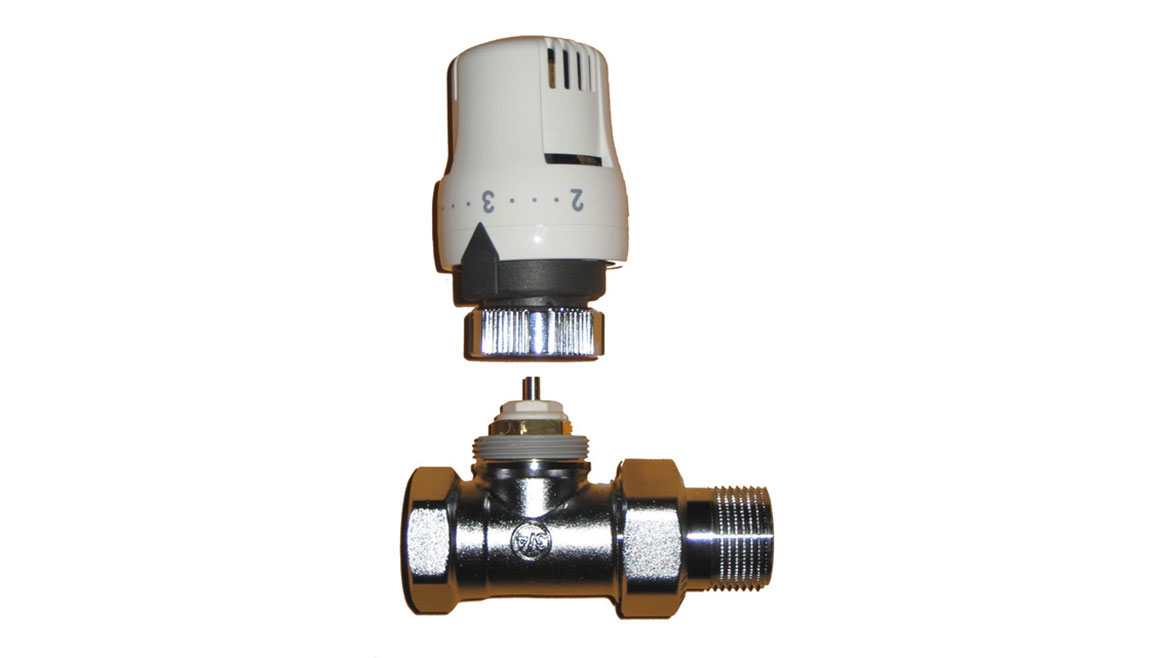
FIGURE 1b
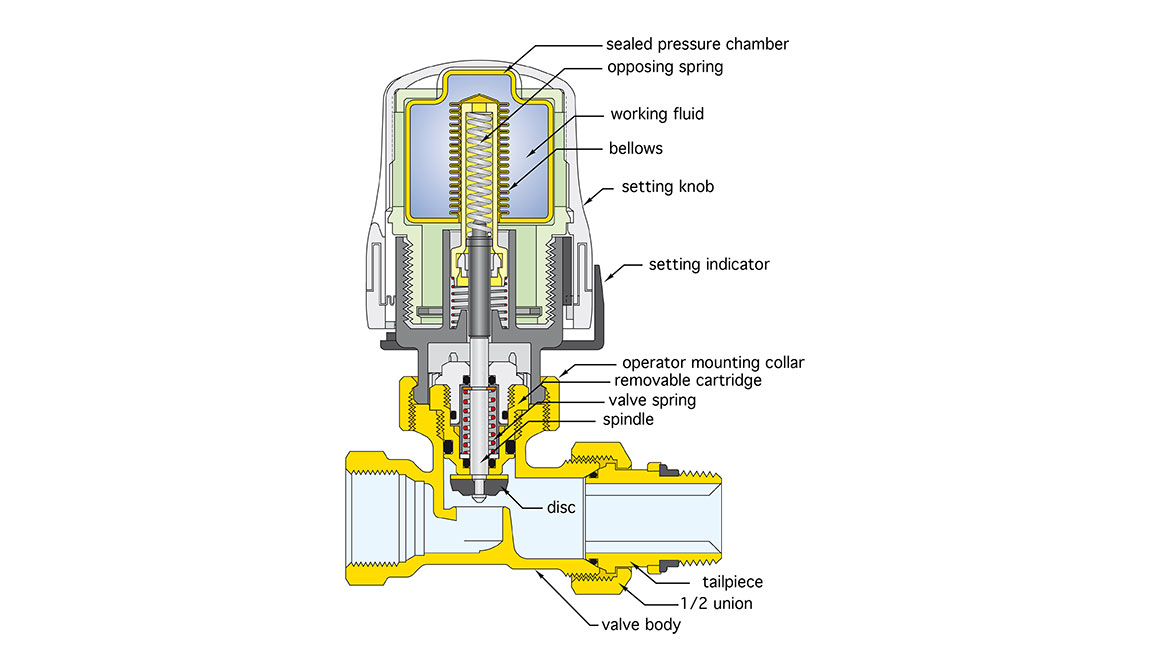
Image courtesy of John Siegenthaler
The term thermostatic radiator valve represents a broad range of products. Most of them can be thought of as two subassemblies that work together: first, a valve body, and second, a thermostatic operator.
The valve body has a globe valve design with a spring-loaded shaft. The shaft moves up and down rather than rotating like the shaft in a typical globe valve. When the shaft is fully pressed down, the disc closes over the valve’s seat, preventing any flow. When the valve’s shaft is allowed to “spring” outward, the disc is a few millimeters above the seat, and the valve is at its maximum flow configuration. The valve shown in Figure 1 would mount external to a radiator. However, some panel radiators come with an integral valve mounted in the radiator’s upper right corner.
The thermostatic operator has a bellows that contains a “working fluid” or wax compound that expands when warmed, and contracts when cooled. This expansion and contraction causes the bellows to move. In doing so, it either presses inward on the valve’s spring-loaded shaft or allows that shaft to move outward. The shaft moves the disc toward or away from the valve’s orifice, and thus determines the flow rate through the valve. More flow means more heat output from the radiator and vice versa.
The thermostatic operator shown in Figure 1 simply screws onto the valve body. It has numbers ranging from 1 to 5 on the knob. These are “comfort settings” — 1 is “cool” (about 55° F), 3 is typical heating season room temperature (about 68° F), and 5 is hot (about 79° F). Many TRVs also have a “snowflake” setting that’s meant to provide freeze protection by maintaining a space at about 45° F.
I think it’s brilliant to have “comfort settings” of 1 through 5 rather than temperatures on the thermostatic operator knob. You don’t need to know the room temperature to know if you’re comfortable.
The occupant just turns the knob to align one of these numbers to the pointer, and the thermostatic operator takes it from there. If the room begins to cool slightly, the valve automatically allows more flow through the radiator and vice versa. It’s analog cruise control for room comfort, and it doesn’t get much simpler. No wires, no batteries, no internet needed. TRVs were the first “wireless” method of automatic zoned heat output control for hydronic heating systems, and they remain so today.
Over the years, we’ve specified hundreds of thermostatic valves in a wide range of hydronic systems. They’ve provided room-by-room comfort control in systems using fin-tube baseboard, towel warmers and a variety of panel radiators.
Still applicable
As the global hydronics market continues to transition toward low-temperature distribution systems, TRVs remain ready willing and able to handle the comfort nuances present in modern low-energy buildings.
One of my favorite approaches to heating these buildings is multi-zone heating distribution system using panel radiators with integral TRVs. All the radiators are connected into a homerun distribution system as shown in Figure 2.
FIGURE 1b
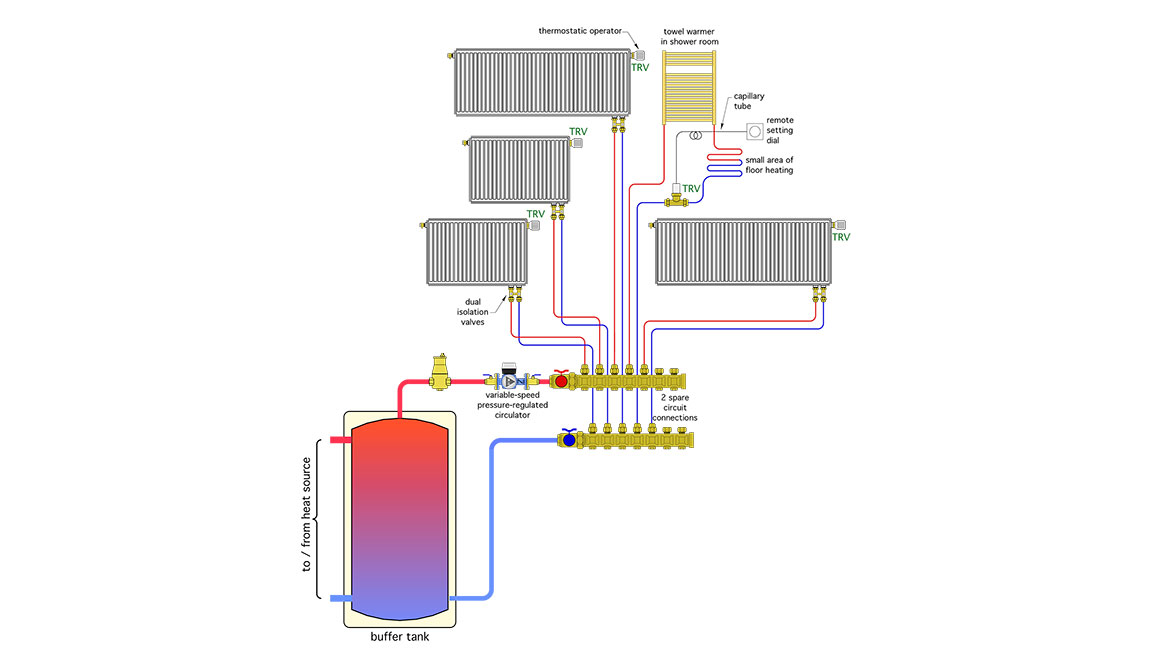
Image courtesy of John Siegenthaler
Heated water is supplied from a buffer tank, which could be heated by a boiler, heat pump, solar collectors or a combination of these heat sources. Flow from the buffer tank to the manifold station is provided by a variable-speed pressure-regulated circulator that automatically adjusts speed as the different TRVs open, close or modulate flow through their respective heat emitters.
Figure 2 shows more details that further expand the concept. One of them is the towel warmer tied in series with a small area of underfloor heating. This is a great approach for a typical bathroom with tile flooring. Warm/dry towels and a barefoot-friendly floor. Try doing that with a mini-split — even if you politely and explicitly ask Alexa or Siri how to command that little white fan-coil on the wall.
Flow through the towel warmer and floor circuit is controlled by a TRV, but in this case, the valve body is mounted a few feet away from the setting dial. A capillary tube connects the valve body and actuator to the setting dial. The working fluid passes back and forth through that tiny capillary tube.
Another detail is to provide at least one extra set of connections on the supply and return manifolds. This allows for simple future expansion of the system. Just mount the new radiator, screw the thermal operator onto the radiator’s integral valve, run a set of 1/2-inch PEX tubes to it, connect those tubes to the manifold, and you’ve got another independent heating zone. No wires, batteries or digital “handshakes” required.
Hydronic systems don’t have to be complex to be sophisticated. They don’t have to be Wi-Fi compatible to be elegant. Simple devices like TRVs can deliver the ultimate goal of any heating system — superior comfort, and they pull it off without requiring a single password.
Looking for a reprint of this article?
From high-res PDFs to custom plaques, order your copy today!