Saving money with heat pump water heaters
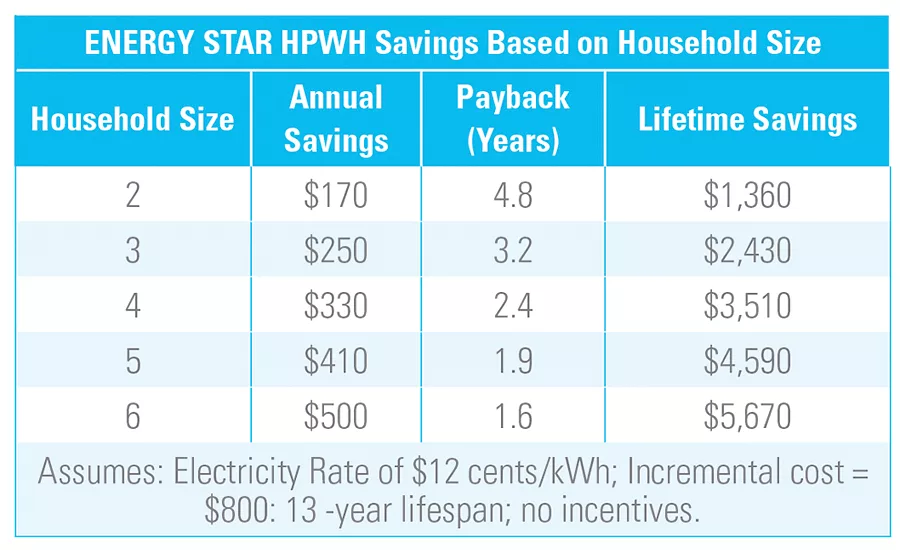
Table 1: Heat pump water heater savings based on household size. Photo credit: Energy Star

Table 2: An example of utility incentives for installing a heat pump water heater. Photo credit: Energy Star
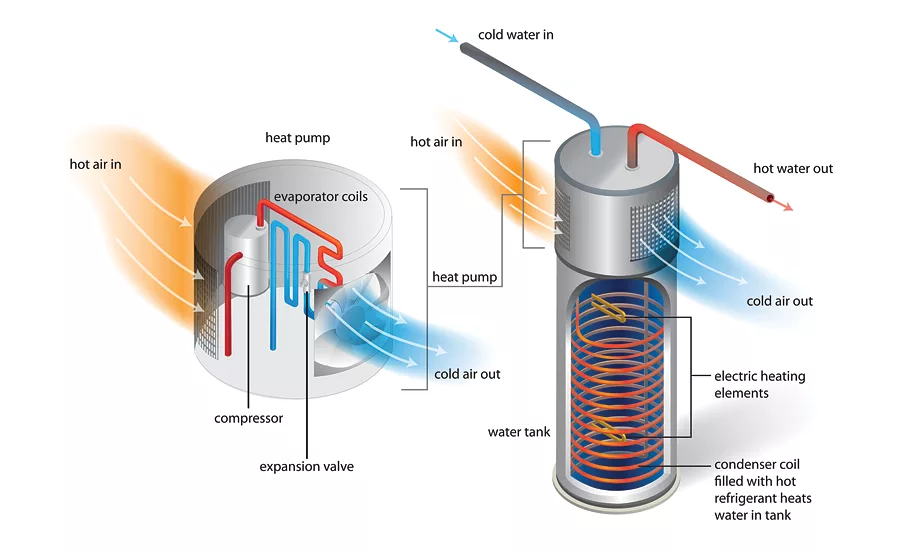
Heat pump water heaters use the same technology as a refrigerator, albeit one run in reverse, to heat water. A HPWH transfers heat from surrounding air to the water in the tank, producing cool, dry air along with hot water. Photo credit: Energy Star
Do you know what the second-largest home energy user is? Most would guess the refrigerator, dishwasher, lighting or washer/dryer. Or you might even be inclined to point to the large screen TV that seems to be on all the time. However, despite often being out of sight, water heaters earn the distinction of being the second-largest home energy user. Those hot showers and baths will cost a family of four more than $600 per year with a standard electric water heater.
There is now a way to cut these electric water heating costs in half and save your customers thousands of dollars over the lifetime of the water heater — by recommending and installing Energy Star-certified heat pump water heaters. Take a moment to learn how much HPWHs save, how they qualify for generous incentives, and how to explain to your customers the difference between HPWHs and conventional electric water heaters.
Energy Star-certified HPWHs will turn a routine electric water heater replacement into an opportunity to save your customers enormous amounts of money, support a healthier environment, and position yourself as the go-to expert in installing an innovative energy-saving technology.
1. How will the technology impact my customers?
Heat pump water heaters cut the high costs of electric water heating in half and represent one of the most cost-effective and significant savings available in a home. Table 1 shows HPWH savings based on household size.
The benefits to your customers will depend on the household, but the savings are significant regardless of family size. A family of four can save $330 per year with a HPWH compared to a conventional electric water heater. Costing roughly $800 more than a standard model, the energy savings will pay for that incremental price in 2.4 years. Over the 13-year lifetime of the HPWH, a family of four can save an astounding $3,500 and prevent more than 20 tons of greenhouse gas emissions. For a family of six, they can save more than $5,500. These savings assume an electricity rate of 12 cents per kWh, which is the national average.
2. How much are utilities offering in incentives?
Thousands of dollars in lifetime savings is a big incentive for purchasing an Energy Star-certfied heat pump water heater, and generous utility incentives sweeten the deal even further. Utilities understand energy-efficient products often cost more and that first-cost is a difficult barrier to overcome, regardless of how compelling long-term savings are. To push the market toward efficient products, they often offer incentives on energy-saving products.
Table 2 shows examples of the utility incentives available across the country for HPWHs. Some incentives are as high as $1,000, more than the estimated cost differential compared to standard models, to encourage consumers to purchase HPWHs. Check with your local utility to determine which incentives are available in your area for your customers.
3. How is a HPWH different?
Heat pump water heaters use the same technology as a refrigerator, albeit one run in reverse, to heat water. A HPWH transfers heat from surrounding air to the water in the tank, producing cool, dry air along with hot water.
These models can be set to self-regulate based on hot water demand or be programmed manually. During periods of high demand, HPWHs automatically switch to standard electric resistance heat, which is why they are often referred to as “hybrid” hot water heaters. The diagram above shows the functionality of both electric heating elements and hot refrigerant lines in the heat pump, which sits atop the water heater.
In addition to hybrid mode, HPWH programmable settings include an economy mode, which uses only the heat pump to heat the water, and vacation mode, which shuts down the heater for a set amount of time.
Due to this unique method of heating water, HPWHs have some simple requirements regarding location. An ideal space for a heat pump water heater is in an unheated basement near a furnace or a garage in a very hot climate. In general, HPWHs should be installed in unoccupied space where:
- Cooling of the space will not be an issue;
- Sufficient height and a condensate drain are available; and
- At least 1,000 cubic ft. of surrounding air is available that remains between 40° F and 90° F year-round.
Also, you should be aware that a HPWH will be heavier than a conventional unit due to the heat pump, make noise, like a dehumidifier, when it is running, and dehumidify the air — perfect for basement settings.
A tried and true technology, HPWHs have been installed in homes for more than a decade and are manufactured by companies you know and trust — such as A. O. Smith, American Water Heaters, Bradford White, GE, GSW Water Heating Co., Lochinvar, Rheem, State Water Heaters and Stiebel Eltron. They are available at all major distributors and big-box retailers. And Energy Star-labeled HPWHs have been third-party certified to meet stringent efficiency standards.
To ensure Energy Star-certified heat pump water heaters are installed on your next call for an electric water heater replacement, please take the following steps:
- Check with your local utility to find out how large the rebates are for HPWHs.
- Talk to your distributor or retailer to check on the availability of this type of water heater for emergency replacements.
- Explain to your customers the enormous savings opportunity of installing heat pump water heaters by using Energy Star’s HPWH “Soak in the Savings” fact sheet. You can download a copy here.
This article was originally titled “The heat pump difference” in the January 2016 print edition of Plumbing & Mechanical.
Looking for a reprint of this article?
From high-res PDFs to custom plaques, order your copy today!