
search
cart
facebook instagram twitter linkedin youtube
  • Sign In
  • Create Account
  • Sign Out
  • My Account
  • NEWS
  • PRODUCTS
    • FEATURED PRODUCTS
  • CONTRACTORS
    • BATH & KITCHEN PRO
    • BUSINESS MANAGEMENT
    • HIGH EFFICIENCY HOMES
    • TECHNOLOGY
    • WATER TREATMENT
    • PMC COLUMNS
      • Dave Yates: Contractor’s Corner
      • John Siegenthaler: Hydronics Workshop
      • Kenny Chapman: The Blue Collar Coach
      • Matt Michel: Service Plumbing Pros
      • Scott Secor: Heating Perceptions
  • ENGINEERS
    • CONTINUING EDUCATION
    • DECARBONIZATION | ELECTRIFICATION
    • FIRE PROTECTION
    • GEOTHERMAL | SOLAR THERMAL
    • PIPING | PLUMBING | PVF
    • PME COLUMNS
      • Christoph Lohr: Strategic Plumbing Insights
      • David Dexter: Plumbing Talking Points
      • James Dipping: Engineer Viewpoints
      • John Seigenthaler: Renewable Heating Design
      • Lowell Manalo: Plumbing Essentials
      • Misty Guard: Guard on Compliance
  • RADIANT & HYDRONICS
    • RADIANT COMFORT REPORT
    • THE GLITCH & THE FIX
  • INSIGHTS
    • CODES
    • GREEN PLUMBING & MECHANICAL
    • PROJECT PROFILES
    • COLUMNS
      • Codes Corner
      • Natalie Forster: Editorial Opinion
      • Guest Editorial
  • MEDIA
    • EBOOKS
    • PODCASTS
    • VIDEOS
    • WEBINARS
  • RESOURCES
    • INDUSTRY CALENDAR
    • DIRECTORIES
    • PM BOOKSTORE
    • CE CENTER
    • MARKET RESEARCH
    • CLASSIFIEDS
  • EMAGAZINE
    • EMAGAZINE
    • ARCHIVE ISSUES
    • CONTACT
    • ADVERTISE
    • PME EMAGAZINE ARCHIVES
  • SIGN UP!
Bath & Kitchen Pro

Going Green in the Home: An Opportunity for Plumbers?

As Earth Day approaches and consumers consider ways to “green” their lifestyles, one opportunity is how they handle food waste.
April 21, 2014

By Michael Keleman


As Earth Day approaches and consumers consider ways to “green” their lifestyles, one opportunity is how they handle food waste.

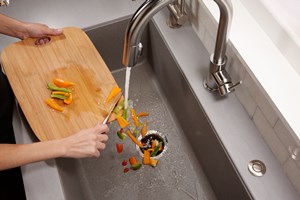
Disposer_In_Use_CloseView_300
Photo Credit: InSinkErator

Each year in the United States, nearly 34 million tons of food waste is trucked to landfills. According to the U.S. Environmental Protection Agency, food waste is the single largest component of municipal solid waste sent to landfills. Once there, it quickly decomposes and produces methane, an environmentally harmful greenhouse gas at least 21 times more potent than carbon dioxide.

One alternative that might be overlooked is a fairly common household appliance: the food waste disposer. Approximately 50% of all U.S.  homes have an installed disposer.

Food waste disposers convert food scraps, which consist of 70% water on average, into a liquid slurry that can safely flow into the sewage system or a septic tank. Sending food waste to a wastewater treatment plant rather than sending it to a landfill also reduces the potential contamination of groundwater.

While running a food waste disposer does involve running water and electricity, the environmental impact is minimal. Disposers use only about 1% or less of a household’s total water consumption (about as much water per day as one flush of a toilet) and cost on average less than 50 cents a year in electric usage.

So, will usage of food waste disposers increase as landfill space decreases? Perhaps — with the help of influencers like those in the plumbing industry. One area of opportunity is those households on a septic system where the use of food waste disposers is below average. A common myth is that households on septic can’t use a disposer when in fact a septic system is designed to safely treat and dispose of household waste from the kitchen and bathroom(s). If the system is sized to handle a dishwasher or clothes washer in addition to sinks and toilets, it can handle a disposer as well.

Another myth that holds people back from grinding food waste is that certain items can’t go down a disposer. The truth is that most food can down a disposer; certain models can even handle more troublesome waste like bones and fibrous materials like celery. As long as consumers follow these best practices for using a disposer, they should have nothing to fear:

  1. Run a moderate flow of cold water;
  2. Turn on the disposer;
  3. Gradually feed food waste in while disposer and water are both running;
  4. Continue to run cold water for a few seconds after grinding is complete; and
  5. Never pour grease or fat into your disposer or drain.

With better education and outreach to consumers, additional use of food waste disposers can be a win for both plumbers and the environment.


 Author bio: Michael Keleman currently serves as Manager of Environmental Engineering for InSinkErator, a business unit of Emerson, a manufacturer of food waste disposers. He can be reached at Michael.Keleman@emerson.com.  


HELPFUL LINKS:

  • InSinkErator
  • Follow PM on Twitter!
  • Find PM on Facebook!
  • Join PM on LinkedIn!


HELPFUL LINKS:

  • InSinkErator
  • Check out New Products
  • Follow PM on Twitter!
  • Find PM on Facebook!
  • Join PM on LinkedIn! 

HELPFUL LINKS:

  • InSinkErator
  • Check out New Products
  • Follow PM on Twitter!
  • Find PM on Facebook!
  • Join PM on LinkedIn! 
Source: InSinkErator
KEYWORDS: food waste disposers InSinkErator

Share This Story

Looking for a reprint of this article?
From high-res PDFs to custom plaques, order your copy today!

Recommended Content

JOIN TODAY
to unlock your recommendations.

Already have an account? Sign In

  • 2025 Next Gen ALL-STARS hero 1440

    2025 Next Gen All Stars: Top 20 Under 40 Plumbing Professionals

    This year’s group of NextGen All-Stars is full of young...
    Plumbing & Mechanical Engineer
    By: Kristen R. Bayles
  • Worker using the Milwaukee Tool SWITCH PACK drain cleaner

    Pipeline profits: Drain cleaning, pipe inspection create opportunities

    Drain cleaning and inspection services offer lucrative...
    Green Plumbing and Mechanical
    By: Nicole Krawcke
  • Uponor employee, Arturo Moreno

    The reinvestment in American manufacturing and training

    Plumbing & Mechanical Chief Editor Nicole Krawcke and...
    Plumbing News
    By: Nicole Krawcke and Natalie Forster
Manage My Account
  • eNewsletters
  • Online Registration
  • Subscription Customer Service
  • eMagazine
  • Manage My Preferences

More Videos

Popular Stories

Hot water pipes

Campus shutdown at Oakland University exposes hidden risks of aging hot-water infrastructure

Floor heating manifold cabinet with flowmeter and PEX pipe.

Elegance extended: How to use the homerun system of connecting heat emitters

Industrial pressure gauge on a tank.

From cutting edge to classic: How to modernize outdated pneumatic control systems

Poll

Will business be up or down in 2025?

Do you anticipate business in 2025 to be up or down in comparison to 2024?
View Results Poll Archive

Products

The Water Came To A Stop

The Water Came To A Stop

See More Products
eBook | 2025 Radiant & Hydronics All Stars

Related Articles

  • Nicole Krawcke

    Nicole Krawcke: Rise in remodel projects offers opportunity for plumbers

    See More
  • 0723 PM Kenny Chapman main image

    Kenny Chapman: The benefits of looking at adversity as an opportunity

    See More
  • April 2024 Guest Editorial Evan Heidenrich. Plumber working on water heater.

    Innovation for an important part of the home

    See More

Related Products

See More Products
  • Inspector Book.jpg

    Lessons Learned: A Guide to Boilers for Home Inspectors

  • Greening Steam: How to Bring 19th-Century Heating Systems into the 21st Century (and save lots of green!)

  • 51CHeeKvw4L._SX322_BO1,204,203,200_.jpg

    Hydronic Radiant Heating: A Practical Guide for the Nonengineer Installer

See More Products

Events

View AllSubmit An Event
  • May 15, 2025

    From Legacy to Leadership: Preparing Your Home Services Business for the Next Generation

    On Demand Whether you're passing the torch to a family member or grooming current employees for leadership, preparing the next generation of leaders is key.
  • September 11, 2025

    Optimized Plumbing Design for the 21st Century: Smarter Systems for Health, Affordability, and Sustainability

    On Demand The session highlights how modernized plumbing design can accelerate hot water delivery, reduce stagnation, and mitigate health risks, while supporting affordability, energy efficiency, and sustainability.  Earn: 0.1 IAPMO CEU; 0.1 ASPE CEU; 0.1 ICC CEU; 1 PDH; 1 AIA LU/HSW
View AllSubmit An Event
×

Keep your content unclogged with our newsletters!

Stay in the know on the latest plumbing & piping industry trends.

JOIN TODAY!
  • RESOURCES
    • Advertise
    • Contact Us
    • Directories
    • Store
    • Want More
    • Supply House Times
  • SIGN UP TODAY
    • Create Account
    • eMagazine
    • eNewsletter
    • Customer Service
    • Manage Preferences
  • SERVICES
    • Marketing Services
    • Reprints
    • Market Research
    • List Rental
    • Survey/Respondent Access
  • STAY CONNECTED
    • LinkedIn
    • Facebook
    • Instagram
    • YouTube
    • X (Twitter)
  • PRIVACY
    • PRIVACY POLICY
    • TERMS & CONDITIONS
    • DO NOT SELL MY PERSONAL INFORMATION
    • PRIVACY REQUEST
    • ACCESSIBILITY

Copyright ©2025. All Rights Reserved BNP Media.

Design, CMS, Hosting & Web Development :: ePublishing