
From Military Service to the Skilled Trades: Two Veterans Build Their Next Chapter
PHCC Educational Foundation scholarship recipients Derek Kivett and William Heisey share how military service, perseverance and education shaped their paths into HVAC and plumbing.
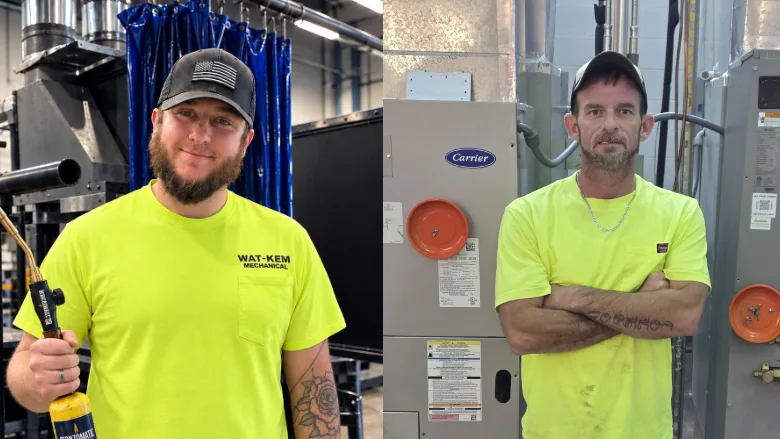
For many veterans, leaving the military marks the beginning of a transition that can be incredibly difficult to map out. The routines, responsibilities and sense of purpose that shaped their daily life in the service suddenly look very different, and figuring out what comes next — both personally and professionally — can take time.
For William Heisey and Derek Kivett, the path forward eventually led to the skilled trades. Their journeys, however, look very different.
Heisey served in the U.S. Navy from 2017 to 2020 and battled cancer during the final chapter of his military career. His route to plumbing came later, after he spent two years caring for his grandfather, a lifelong plumber who encouraged his grandson to consider following him into the trade. After his grandfather's death, Heisey took that advice: joining the same plumbing company where his grandfather once worked.
Kivett served in the U.S. Army from 2001 to 2005, including a yearlong deployment to Iraq and Kuwait. After leaving the military, he spent years battling addiction, cycling through jails and rehabilitation facilities before beginning to rebuild his life. Today, at 44, he is nearing completion of an Applied Science degree in HVAC at Guilford Technical Community College while already working roughly 50 hours a week running residential and commercial service calls.
Today, both men are building careers that they say have given them something beyond a paycheck: purpose, confidence and a future to work toward.
They also share another connection. Kivett and Heisey each received a $1,500 scholarship from the PHCC Educational Foundation in 2026, joining a record class of 80 students who received a combined $200,000 to support their education in the plumbing, heating and cooling trades.
Their stories offer two very different examples of what a career after military service can look like, and how the skills veterans carry with them can find a new home in the trades.
William Heisey: Carrying Forward a Family Trade
For Heisey, the path into the trades began as a way to care for someone else.
After serving in the U.S. Navy, Heisey went to work in the fitness industry. He had already weathered a major personal challenge during the final chapter of his military career, when he was diagnosed with cancer. But, it was another cancer diagnosis — this time his grandfather’s — that ultimately changed the direction of Heisey’s career.
Heisey became his grandfather’s full-time caregiver for two years. As his grandfather’s mobility declined, Heisey remodeled his bathroom to accommodate a wheelchair, improving access to the sink and making it easier for him to safely transfer to the toilet. His grandfather, a lifelong union and commercial service plumber, saw something in the work and encouraged his grandson to consider plumbing as a career.
Plumbing was already woven into Heisey’s family history. His grandfather’s uncle had first brought the trade into the family, later teaching Heisey’s grandfather and great-uncle. Some of Heisey’s earliest memories of the industry came from tagging along with his grandfather to Good Samaritan Hospital, where he was shown the mechanical rooms and systems that kept the facility operating.
“He wasn't just showing me his job; he was sharing a piece of himself and the trade he took so much pride in,” Heisey recalled.
After the death of his grandfather, Heisey applied to the same plumbing company where his grandfather had worked and was hired. What began as a way to honor his grandfather has since developed into a career of his own.
Heisey now works on residential and commercial service calls, complex rough-ins, remodels and field troubleshooting. He also helps mentor first- and second-year apprentices on jobsites. In October, he completed the PHCC of Ohio Academy’s four-year plumbing apprenticeship curriculum and is now preparing to take the state plumbing licensure exam in March 2027.
He has already enrolled in an online bachelor’s degree program in business administration through Southern New Hampshire University, with the goal of developing the skills needed to eventually operate his own plumbing company under the Heisey family name. From there, he hopes to pursue mechanical engineering.
That drive to keep moving forward is something Heisey traces, in part, to the challenges he experienced before entering plumbing. His own cancer diagnosis during his Navy service changed his perspective on time and the opportunities available to him.
“Going through something like that changes the way you look at the opportunities in front of you,” he said. “It teaches you that time is valuable, that life does not always go according to plan, and that you cannot take your health, your abilities, or the chance to pursue your goals for granted.”
His military experience has also followed him onto the jobsite. Heisey sees parallels between the military and the trades, particularly the emphasis on teamwork, problem-solving, accountability and continually developing new skills. Those qualities, he said, can give veterans an important foundation even when they enter an apprenticeship with little or no trade experience.
“Don't underestimate what you already bring to the table,” Heisey said. “The discipline, teamwork, accountability, and ability to adapt that many veterans develop during their military service are valuable qualities in the skilled trades.”
Derek Kivett: Rebuilding Through HVAC
For Derek Kivett, finding his way into HVAC was about more than choosing a career. It became part of rebuilding his life.
Kivett served in the U.S. Army from 2001 to 2005 as an E4 transportation specialist, including a yearlong deployment to Iraq and Kuwait. After leaving the military, however, his path forward was anything but straightforward. He spent roughly a decade struggling with addiction, including periods in jail and rehabilitation facilities.
A turning point came while Kivett was living at a rehabilitation center in Asheville, North Carolina. NC Works directed him to a career day, where he met a representative from a company involved in several skilled trades. Kivett shared some of his story with the man, who was also a veteran.
“Before I could walk away, he had given me a job,” Kivett recalled. “He believed in me at a time before I had started believing in myself.”
That opportunity helped introduce Kivett to a new direction. His older brother, who has spent 20 years in HVAC, also encouraged him to pursue the field and shared how rewarding service work could be.
Today, Kivett is nearing completion of a two-year Applied Science degree in HVAC at Guilford Technical Community College while working roughly 50 hours a week running residential and commercial service calls. He has also earned multiple industry certifications and hopes to continue developing his diagnostic and service skills.
At 44, earning his degree represents a milestone Kivett once struggled to imagine.
“Finishing something that I started is a big deal for me,” he said.
The trade has also given him something less tangible: confidence in his own abilities.
“My self-worth grows by the day,” Kivett said. “When I walk up to a unit, I know in my mind that I have the knowledge to fix whatever the issues are.”
Although Kivett and Heisey took different paths into the trades, both see a connection between the skills they developed in the military and those they rely on today.
Kivett points to work ethic and discipline, while Heisey sees parallels in teamwork, accountability, adaptability and problem-solving. For veterans considering the trades, Heisey said those experiences mean they aren't necessarily starting from scratch.
“You may be starting a new chapter, but you are not starting from nothing,” he said.
Education is helping both men build on that foundation. Kivett and Heisey were among 80 students awarded a combined $200,000 in scholarships from the PHCC Educational Foundation in 2026, the largest scholarship class in the Foundation’s history. Since 1987, the program has awarded 1,050 scholarships totaling nearly $3 million.
For both veterans, their individual goals represent more than career advancement. They are another chapter in lives defined by service, perseverance and the willingness to keep moving forward.
As Kivett put it, graduation means “one page closes, and another opens to continue the story.”
Looking for a reprint of this article?
From high-res PDFs to custom plaques, order your copy today!


