Beyond Lead-Free: New Priorities in Faucet Component Design
The move toward lead-free drinking water components is no longer an emerging trend in the plumbing manufacturing industry. Driven by years of regulatory change and growing awareness of water quality concerns, many manufacturers have already incorporated engineered polymers into products that were once exclusively dominated by metals.
As adoption expands, the conversation is moving beyond simple metal replacement. Engineers and product managers are increasingly evaluating how materials influence everything from product reliability and manufacturability to sustainability and total cost.
Today, the focus is on performance in real-world conditions, particularly in applications such as faucet mixing valves, where components must withstand years of exposure to hot water, chlorinated water, pressure cycling, and frequent use while maintaining leak-free operation.
In many residential and commercial applications, these components may encounter water temperatures ranging from 140°F to 194°F (60°C to 90°C), while being expected to deliver consistent performance throughout their service life.
Why Materials Matter More Than Ever
For decades, metals such as brass were the material of choice for faucet systems because of their proven durability and strength. Today, however, advances in materials science are expanding the range of viable options available to design teams.
Modern engineering polymers are demonstrating performance characteristics that make them suitable for increasingly demanding water-contact applications. High stiffness, strong mechanical properties, resistance to hydrolysis, and dimensional stability are allowing manufacturers to rethink traditional design approaches while maintaining confidence in long-term performance.
For product development teams, this creates opportunities not only to meet regulatory requirements but also to optimize products for manufacturing efficiency, reliability, and future market demands.
The Performance Equation
Transitioning from metal to polymer involves more than selecting a lead-free alternative. Materials used in faucet system components must tolerate a challenging combination of heat, moisture, chemicals, pressure, and repeated mechanical loads over many years of operation.
As a result, material suppliers have focused significant research and development efforts on improving the mechanical strength and long-term durability of polymers. Many newer materials are engineered to maintain stiffness and structural integrity after prolonged exposure to hot water while resisting dimensional changes that could affect sealing performance and lead to leaks.
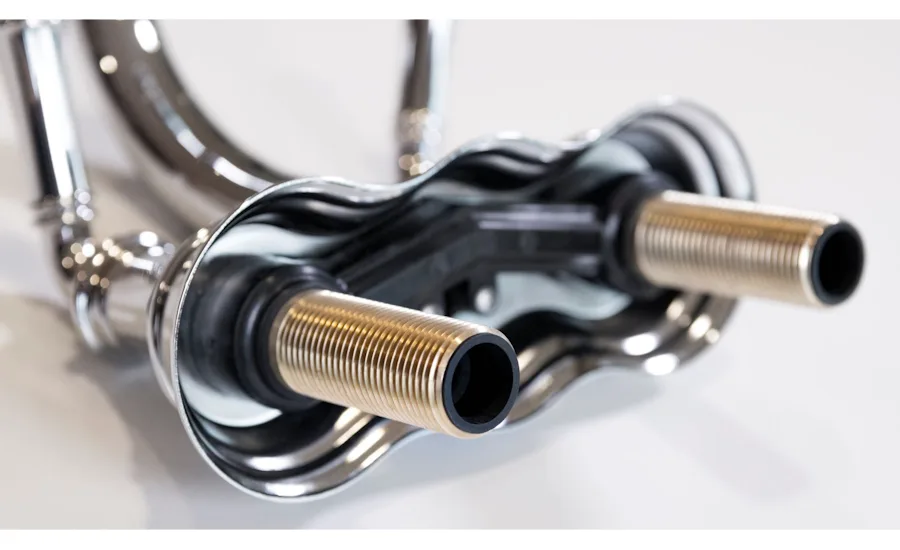
One example is Envalior's EcoPaXX PA410, which has been adopted by manufacturers for faucet mixing valve applications. According to the company, the material combines high mechanical strength with excellent hydrolysis resistance and has successfully completed testing exceeding one million operating cycles without water leakage.
Its performance highlights a broader trend within the industry. Engineered polymers are increasingly being evaluated not just as replacements for metal, but for their capabilities in meeting demanding performance specifications.
Manufacturing and Design Flexibility
Material selection also has important implications for manufacturing.
Engineers and product managers are under constant pressure to reduce complexity, accelerate development timelines, and improve production efficiency. Materials that offer wider processing windows, improved flow characteristics, and greater design flexibility can help manufacturers achieve those objectives while maintaining quality standards.
Advanced polymers can enable more complex geometries, improved integration of multiple functions into a single component, and potentially fewer assembly steps. Better flow behavior during molding can also improve part consistency and support high-volume production environments.
As plumbing products become more sophisticated, these manufacturing advantages are becoming increasingly influential in material selection decisions.
Sustainability Becomes Part of the Design Brief
Environmental performance is now a regular part of engineering discussions across many industries, including building and construction.
Manufacturers are looking beyond product functionality to understand the broader environmental impact of material choices throughout a product's lifecycle. This has increased interest in materials that incorporate renewable content or offer lower carbon footprints while maintaining the performance characteristics required for demanding applications.
Some bio-based engineering polymers are helping manufacturers pursue those goals. Envalior reports that its sustainable EcoPaXX grades, for example, are approximately 70% bio-based and can reduce the carbon footprint of a faucet mixing valve by as much as 30% compared with benchmark materials used for similar applications.
While sustainability metrics alone rarely determine material selection, they are becoming an increasingly important differentiator when combined with proven technical performance.
Looking Ahead
The next phase of the industry's lead-free transition is less about replacing metals and more about optimizing material strategies for a changing marketplace.
Engineers and product managers are being asked to balance regulatory compliance, product reliability, manufacturing efficiency, and sustainability, often within the same design. As a result, material innovation is playing a larger role in product development than ever before.
The evolution of the plumbing industry will be shaped by materials that enable safer, more durable, and more sustainable drinking water systems for the next generation of designs.
Looking for a reprint of this article?
From high-res PDFs to custom plaques, order your copy today!