How a New PHCC Program is Turning Inmates into Tomorrow’s Plumbers and HVAC Techs
A seven-week trades course for inmates, modeled after PHCC Academy’s curriculum
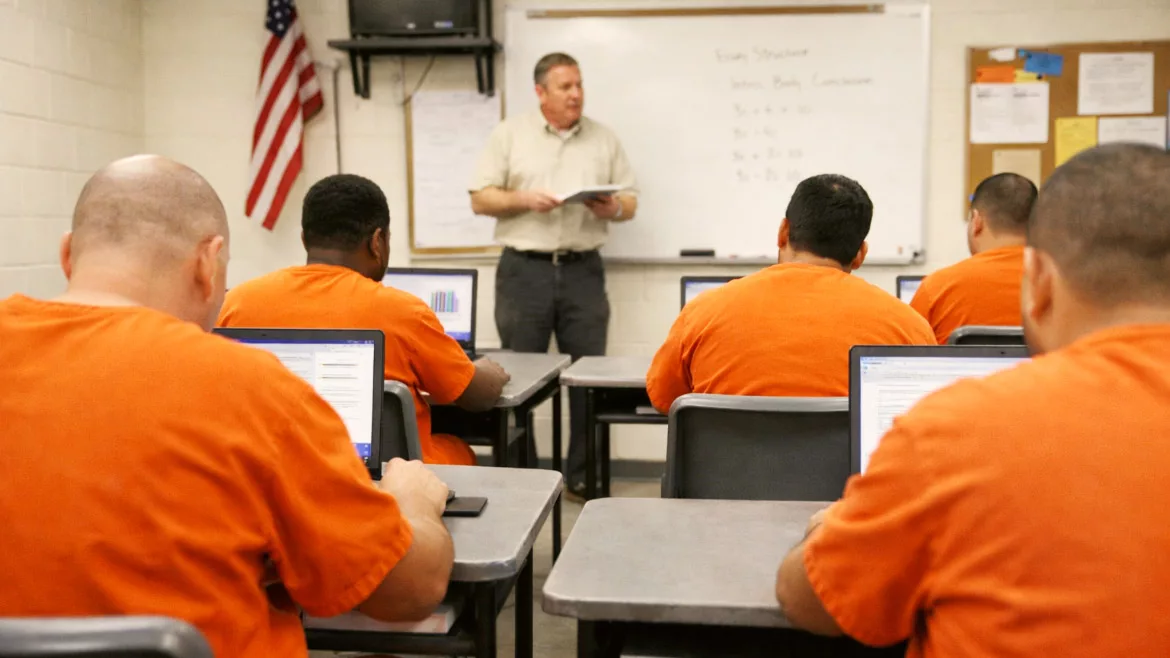
On a Wednesday afternoon in the Hamilton County Jail, a group of men in gray uniforms huddle around a table, flipping through worksheets and eyeing a piece of tubing and a press tool. One of them, a former union laborer, is showing the others how to join PEX pipe, demonstrating a skill that — until now — has mostly been reserved for job sites and apprentice halls.
“You see those wide‑open eyes — like, ‘you mean I can do this?’ — and just seeing that hope makes me excited,” says Chuck Gillespie, executive director of the Indiana chapter of the Plumbing-Heating-Cooling Contractors Association (PHCC), who teaches the class. “There’s a mentor‑mentee relationship forming in the classroom — you see students helping each other and stepping up.”
Gillespie’s classroom is the pilot site for a program with an ambitious goal: to turn incarceration into a launchpad for careers in the trades, while chipping away at Indiana’s — and the nation’s — crippling shortage of skilled workers.
A Second Chance – and a Workforce Solution
The seven-week re-entry initiative, spearheaded by the PHCC Indiana chapter and the PHCC Educational Foundation, is more than just another training program. Modeled after the PHCC Academy’s online pre-apprenticeship curriculum, it’s been adapted for in-person, paper-based instruction to meet jail security requirements — no internet access, no streaming videos.
For Gillespie, who spent years in HR and workforce development before joining PHCC, it’s personal. “This is a good career,” he says. “And it’s a good one for folks that do need that second chance.” He’s been helping people re-enter the workforce since his early days as a nonprofit board member, running mock interviews and teaching resume-writing in halfway houses and job centers. “We want to give people a chance — that’s what this industry has always been about.”
The urgency is real. By 2027, the U.S. could be short 225,000 HVAC technicians alone, according to industry projections. Indiana, flush with new manufacturing and data center projects, isn’t immune. “We have a full employment act here in Indiana for any skilled trade,” Gillespie says, only half-joking.
How the Program Works
The curriculum, developed by the PHCC Educational Foundation, covers HVAC safety, applied math, plumbing code, and the practical skills needed to start as a tech or apprentice. “When a contractor sees PHCC Academy, there’s credibility to that. It’s not a fly‑by‑night course,” says Dan Quinonez, now CEO of PHCC and former executive director of the foundation. “They’re getting some of the best‑prepared curriculum out there, and that’s going to help them get into the workforce.”
But the classroom isn’t just about theory. With help from a manufacturer, Gillespie is piloting a hands-on module on press technology — a widely used way to join PEX tubing. “Not only will they get this certificate from PHCC for completion of the pre-apprentice courses, but they will also get this press tool certificate from a very, very large leading manufacturer,” he says. The tool itself was specifically chosen because it can be approved for use inside the jail.
The first cohort — eight men serving time for non-violent offenses — meets weekly for two-hour sessions. Eligibility requires a demonstrated interest in the trades and approval by the jail’s TOWER program, which screens participants and provides broader re-entry support, including resume workshops and career fairs.
From Classroom to Jobsite: Can They Get Hired?
The biggest question, of course, is what comes next. Gillespie’s goal isn’t to guarantee jobs, but to guarantee an interview. “We’re not asking contractors to guarantee a hire. We’re asking them to give someone an interview,” he explains. “Some will say no — that’s legitimate — but others are willing to give folks a chance.”
The PHCC chapter has focused first on commercial and industrial contractors, who are often more open to hiring former inmates than contractors in home service, where bonding and customer trust can be barriers. “A lot of my members also have warehousing positions and other avenues that can maybe make it so that the bonding issue doesn’t become a stoppage for them to not be able to hire,” Gillespie notes. “The education that they’re learning would help them in so many different avenues of this industry — it doesn’t even necessarily have to be field work.”
For Quinonez, the program’s credibility is key. “When they get out into the workforce, when [contractors] see, ‘oh, you went to the PHCC Academy,’ there’s credibility in that, and they’ll take that seriously.”
Measuring Success — and Scaling Up
How will the program measure success? Gillespie boils it down: “Success is simple: are they getting interviewed, getting employed, and staying employed?” He’s already fielding calls from other Indiana counties interested in replicating the model. “If we can grow this in the state of Indiana, and can we duplicate this in other states? That’s the goal.”
The financial side, for once, isn’t the sticking point. Thanks to the foundation’s “gratefully, gratefully helpful, cost-effective” curriculum, Gillespie says, the program can run on a shoestring, especially if contractors see enough value to support it long-term.
Quinonez, too, is thinking national. “My hope is that we can start this going and support Indiana, and hope in 10 years we see many of these folks becoming PHCC contractors, telling their stories of how they started here. I truly see that happening in the future.”
A New Pipeline for the Trades
The program isn’t about quick fixes or magic wands. No one’s promising a six-figure salary out of the gate. “You don’t start at $200,000 — you start somewhere, and you build your skills and your confidence,” Quinonez says. “From the beginning all the way to owning a business, the learning never stops.”
For the men in Gillespie’s class, the opportunity is clear. “We just want to make sure we’re helping these individuals so they’re not going back to what they were doing,” he says.
In a state — and a country — where the help is desperately needed, it’s a start. Learn more about the PHCC Academy’s courses at phccacademy.org/courses/.
Looking for a reprint of this article?
From high-res PDFs to custom plaques, order your copy today!