Creating the complete technician
A look into the internship program at Lutz Plumbing, Inc. in San Francisco.

It’s a fact that we in the industry are all-too-familiar with: retirements are picking up, fewer young workers are entering the trades, and customer expectations continue to rise. As a result, more companies are taking a hard look at how they bring new technicians into the business and prepare them for long-term success.
At Lutz Plumbing Inc. in San Francisco, that led to a shift away from informal, learn-as-you-go training toward a more structured, multilayered apprenticeship program. Rather than relying solely on ride-alongs and on-the-job exposure, the company built a system designed to develop technical skills, character, communication and cultural fit. The goal was to do more than just to train plumbers; it was to define what the company calls a “complete technician.”
I spoke with Vice President of Lutz Plumbing Inc., Phil Hotarek, to learn more about their internship program, how it works and why it works.
Rethinking training from the ground up
What prompted Lutz Plumbing, Inc. to completely rethink their training program? According to Hotarek, it was because of a transition within the company.
The company was feeling the pressure from the aging-out workforce. “I basically had to build a team from scratch,” Hotarek told me. “We had some technicians who aged out, just retired.”
Starting over fresh with three apprentices certainly had its challenges, but it also had a distinct advantage: they could create the culture that they wanted, and cultivate the skills that they deemed important.
As Hotarek explained, rebuilding the team meant defining expectations from day one. “We made a commitment to identify the culture that we want,” he says. “Anybody who was going to stay on board had to buy into that culture. If they didn’t buy into it, they didn’t stay.”
For Hotarek, culture was not a vague concept, but something to seriously consider when it came to their decision-making. Accountability, professionalism and respect — for customers, coworkers and the trade itself — were nonnegotiables. “There are character skills and attributes that require zero talent,” he says. “You can already build value with no experience at all.” Those traits, he added, were prioritized long before technical mastery ever entered the conversation.
Starting with apprentices made it easier to reinforce those standards. Rather than unlearning habits, new hires were taught from the very beginning of their journey how Lutz Plumbing expected work to be done — from jobsite preparation and organization to customer interaction and follow-through.
One of the main qualities they wanted to cultivate: being proactive. “You’re not just standing there watching,” Hotarek says. “You’re anticipating what the lead needs, keeping the site organized, and making their job as easy as possible.”
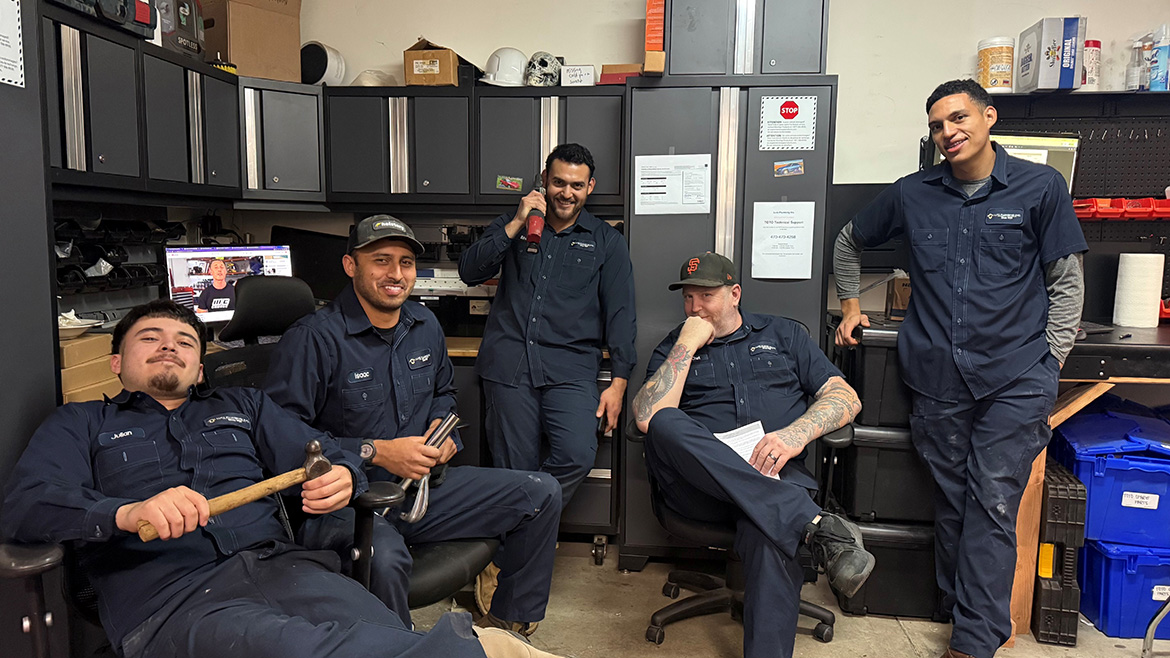
At Lutz Plumbing Inc., there was a shift away from informal, learn-as-you-go training toward a more structured, multilayered apprenticeship program. Image courtesy of Lutz Plumbing Inc.
That focus on culture-first training became the foundation for everything else: technical instruction, soft skills development and long-term career progression. By setting expectations early and clearly, Lutz Plumbing turned what could have been a disruptive transition into an opportunity to build a more cohesive, resilient workforce.
Where technical skills meets professionalism
At Lutz Plumbing, the apprenticeship program is anchored by a simple but broad mission: “enhancing the quality of life for everyone.” It makes perfect sense for the company; in addition to their essential services, they also provide fixtures that really improve quality of life such as: water filtration solutions, smart toilets/bidets, steam and sauna, and hydronic systems. According to Hotarek, the phrasing of their mission is deliberate; and it extends well beyond customer satisfaction.
“It’s not just customer-facing,” he explains. “It’s inclusive of our trade.” In practice, that means the company views its work as improving quality of life for employees, customers and the broader community through essential services such as clean water, reliable heating and improved water quality. “We provide essential services — toilets, running water, heating and comfort,” Hotarek says. “That’s safety.”
From the apprentice’s first day, traits like accountability, organization and respect for the jobsite are treated as baseline requirements, not skills to be developed later. “You don’t need technical competency to buy into our culture,” Hotarek says.
“Technical competency is what you learn and build on to advance in our company,” he said. That separation allows Lutz Plumbing to hold consistent cultural standards across the organization, while still giving apprentices room to grow at different speeds on the technical side.
The end goal of that growth is what Hotarek calls the “complete technician.” It is a concept that goes well beyond hands-on plumbing skills. “It’s not just included with appliances and what you’re working on,” he says. “It’s also soft skills, people skills and business acumen.”
For Lutz Plumbing, a fully developed technician is one who can operate with a high level of independence. “Our ultimate advancement is being fully independent to the point where they’re basically running their own business out of their own truck,” Hotarek explains. Technicians are expected to communicate with customers, close work and take ownership of their schedules and projects, with the company providing operational support in the background.
Alongside technical instruction, they learn how to communicate clearly, present solutions and understand the business impact of their decisions. “When I become fully independent, I control my own schedule. I control my projects. I do my estimates. I close,” Hotarek says. “That’s how they advance, and those are the highest-paid technicians.”
By integrating technical training with culture and professionalism, Lutz Plumbing positions its apprentices as professionals capable of carrying the company’s mission forward: one job, and one customer interaction, at a time.
Standardized training
One of the most interesting things I noted about Lutz’ internship program is its structured, standardized approach. Rather than leaving learning outcomes to chance or to the habits of individual supervisors, the company has built an organized framework that gives every intern a clear starting point and a consistent path forward.
“I wish there was a structured apprenticeship program when I started,” Hotarek said. “Because then I would have been able to see what my path is. Here are the steps. Here’s what I want to be.”
That clarity shapes the internship experience at Lutz Plumbing. Interns aren’t expected to just absorb knowledge through exposure. Instead, expectations are documented; checklists, standardized inspections and defined workflows ensure that no matter who an intern is riding with, the baseline experience and expectations remain the same.

While trades schools and external programs provide valuable foundations, they’re somewhat limited on how much they can prepare technicians for the realities of a specific company. Highwaystarz-Photography / iStock / Getty Images Plus
Hotarek compares it to a medical visit. “When you go to a doctor’s office, they don’t care if you came in yesterday,” he explains. “They do intake. They put you on a scale. They have a standard checklist, essentially an inspection, every time you walk in.”
The same logic applies in the field. Measuring water pressure, documenting conditions, and following a general inspection checklist are taught as non-negotiable first steps. That process helps interns understand systems completely, while also reducing risk for the company and its customers.
The structure also benefits senior technicians. With a clear framework in place, leads aren’t forced to invent training on the fly, or compensate for gaps in experience. Interns arrive with the same training and expectations — making them more effective helpers, and accelerating their development.
For Hotarek, organization is about confidence rather than control. “Without that structure, you’re just kind of winging everything,” he says. “It affects your confidence because you don’t know what’s expected of you.” By standardizing how interns learn, Lutz Plumbing removes that uncertainty: creating an environment where interns can focus on growth rather than guessing what comes next.
Because the program is standardized, Lutz Plumbing can measure its effectiveness in concrete ways. Every step — from ride-alongs to job-site inspections — produces outcomes that feed into accountability and improvement. Hotarek points to on-the-job performance as a key metric: “One metric is when they’re on the job as a helper or assistant. If the job goes well, if you get good feedback from the customer and good feedback from the lead tech…then we know the training is working.”
Practice makes perfect
Another important aspect of Lutz’ internship program is their use of shop-based simulations. These simulations give apprentices a controlled environment to practice new skills before facing the pressure of a customer call. Lead techs will have the interns run simulations and watch their techniques, then learn from their criticism.
These exercises cover everything from standard repairs to complex troubleshooting. An apprentice might rebuild a shower valve while a lead technician observes and offers guidance. That hands-on experience builds skills and confidence.
“It’s a controlled environment. They’re getting that practical, hands-on muscle memory.” Hotarek explained. “As a technician, you can tell if somebody knows what they’re doing, if they don’t know, or if they're out of practice or sloppy.”
The impact of this approach goes beyond skill-building. Giving apprentices a space to practice and make mistakes – and more importantly, learn from them – reduces the risk of errors on the job. “You’re opening yourself up to constructive criticism, but you’re doing it in a controlled environment versus on a job where you’re going to be judged. You’re on the clock, and if something happens, we’re going to get dinged for it.”
While trades schools and external programs provide valuable foundations, they’re somewhat limited on how much they can prepare technicians for the realities of a specific company.
Employer-lead training fills that gap. From day one, apprentices learn the company’s expectations and standards. Instead of learning generic procedures, they learn how Lutz Plumbing works. “Every company has a different culture, so they may have different expectations.”
Technical competence is fantastic, but that alone isn’t enough. Techs need to understand the culture and service standards of the company they work for. “If somebody goes to trade school, they might get a general foundational knowledge of the trade, but as an employer, you don’t know what they’re learning in there, and how it’s going to be applied to your company.”
Evolving the program
Lutz’ internship program has already proven to be quite successful, but stagnation just doesn’t work in this industry. They still plan to update their methods to meet changing needs. Their next phase is dependent on using feedback data to improve what they already know works.
One thing they’ve quickly realized: there’s no one-size-fits-all program. “People learn differently. Just because it works for one person, it may not work for the other.”
Hotarek can see the program changing by taking that into account. Identifying different personality traits in their technicians, creating “archetypes” based on that, and creating different training modules or methods that work for that type of technicians.
Training is no longer just about gaining new skills. It’s about preparing professionals who can operate in increasingly complex technical environments while maintaining clarity, confidence, and credibility in front of customers.
He remembers two interns who started at the same time. One completed all of his online training quickly, while the other one said he really struggled with it. “He was honest with me. He said, ‘This is one of the reasons why I went into the trades, because I don’t want to do this.’” Hotarek adapted, helping the apprentice figure out what worked for him in the place of online training.
Cases like this one pushed the program toward more flexible delivery models — combining hands-on instruction, shop-based simulations, ride-alongs and optional online training — allowing apprentices and technicians to train in a way that works for them, through multiple channels.
The long-term objective is balance: maintaining structure without creating rigidity. Consistency doesn’t mean training should be a box-checking exercise; structure should support growth, not restrict it.
That balance is even more important as the trade itself changes.
Looking ahead, Hotarek sees the future of plumbing being shaped by technology, data and advanced diagnostics. With things like digital tools, AI-assisted diagnostics and smart equipment becoming commonplace, there are new expectations for technicians.
For example, Hotarek is currently field-testing utilizing meta glasses to help with troubleshooting steps.
Using AI as a tool in your kit, rather than a replacement for thinking, is quickly becoming a way for skilled technicians to set themselves apart. “Being able to utilize technology and AI as an asset and supplement, not fully relying on it and replacing knowledge, skill and ability, but using it as an asset.”
But, industry professionals aren’t the only ones with access to new technology. Customers have it now, too. Knowing how to handle a customer who asked Chat GPT what was wrong with their malfunctioning shower (and it may be correct, but it might not) is important.
“Customers think they are more equipped with access to information, so technicians need to be able to identify discrepancies and where those problem areas might be.” He told me. “AI will recommend something to a customer, and it doesn't fit their configuration, or the product that it recommended doesn't work, or is not right for their system.”
Being aware that customers have access to new information – sometimes good, sometimes not – reinforces the fact that technicians need to be able to understand and explain a problem and the fix.
That reinforces the technician’s role as a problem-solver; not just someone who installs and repairs, but someone who diagnoses systems, communicates risk, explains options, and builds trust.
In that context, training is not just about gaining new skills. It’s about preparing professionals who can operate in increasingly complex technical environments while maintaining clarity, confidence, and credibility in front of customers.
Before developing manuals, checklists or progression pathways, leadership needs to define what the organization actually values: how technicians are expected to treat customers, how they interact with teammates, how accountability works, and what professionalism looks like in daily operations.
As the program evolves, its purpose remains consistent: develop technicians who are not only technically competent, but adaptable, data-informed, customer-aware and equipped to grow alongside the trade itself.
Create your culture
“If you have your own program, you can tailor it from day zero. you can shape that person from the very first day that they enter the trade," Hotarek told me.
For those looking to update their internship program, Hotarek advises that you start with the culture. “You can build all the training systems you want, but if the culture isn’t right, it won’t work,” he said.
Before developing manuals, checklists or progression pathways, leadership needs to define what the organization actually values: how technicians are expected to treat customers, how they interact with teammates, how accountability works, and what professionalism looks like in daily operations.
Equally important is listening to the technicians who are already in the field.
Hotarek emphasized that effective programs aren’t built in isolation. They’re shaped by real operational experience. What actually happens on jobs? Where do breakdowns occur? What creates callbacks, and what frustrates both technicians and customers? The only ones who can answer those questions are the ones in the field.
“If you don’t listen to the people doing the work, you’re guessing,” he said.
Data discipline is another foundational requirement. Hotarek pointed to the importance of understanding business performance before designing training pathways.
“You have to know your numbers,” he said. “You have to know what jobs you’re good at, what jobs make money, and where your problems come from.”
Structurally, Hotarek advises contractors to build incrementally.
Rather than attempting to launch fully developed, multi-year apprenticeship frameworks at once, successful programs grow in stages: starting with basic structure, then layering consistency, then adding accountability metrics, then refining through feedback.
It won’t be perfect the first time. You build it, you test it, and you fix it.
That approach allows businesses to adjust without overwhelming staff or creating overly-rigid systems that fail under real-world pressure.
At the core of all of it, Hotarek believes that employee satisfaction is key. If your people aren’t supported, customers will feel it. “I think in the past, customer service blueprints were very happy customer-centric, whereas I actually think it starts with the employee,” he told me. “The employee has to be happy because if you have happy employees, you're going to have happy customers. It's almost guaranteed.”
Confident technicians communicate better. Supported technicians make better decisions. Engaged technicians create better customer relationships.
For contractors considering formal training models, look around you. Listen to your technicians. Create a culture that works for you, and with you.
The challenges facing the plumbing and mechanical trades aren’t going away. Retirements are accelerating, fewer people are entering the trades, and customers expect more — more professionalism, more transparency, more technical competence. For contractors, that’s forcing a real rethink of how new technicians are brought into the business and prepared for long-term success.
At Lutz Plumbing Inc., they went far beyond tweaking a training manual or adding a few ride-alongs. They rebuilt their approach from the ground up. Training stopped being something that “just happens on the job” and became something intentional — structured, measured, and tied directly to culture, performance and business goals.
What they’ve created is a system that blends technical development with professionalism, accountability, communication and independence. Apprentices aren’t just learning how to fix plumbing systems: they’re learning how to operate as professionals, problem-solvers, and representatives of the company in the field.
For contractors facing the same pressures, the message is simple: don’t just hire for today’s needs. Build systems that develop people for tomorrow.
Looking for a reprint of this article?
From high-res PDFs to custom plaques, order your copy today!