
Project Profile
Case study: Solving for shower safety and layout flexibility
How drainage innovation supported the first hospital built in Celina, Texas.

Methodist Cedina Medical Cetner in Celina, TX.
In one of North Texas's fastest-growing communities, the city of Celina recently reached a pivotal milestone with the development of Methodist Celina Medical Center—the city's first-ever hospital. The 200,000+ square-foot facility was designed to provide comprehensive care, including medical/surgical services, intensive care, labor and delivery suites, and diagnostic imaging. Neil Stimach, a consulting engineer at WSP, a global engineering and professional services firm with deep experience in healthcare infrastructure, assisted with the building's plumbing system design and led plumbing fixture coordination efforts. Perkins & Will, an interdisciplinary firm known for its focus on health, wellness, and patient-centered spaces, led the architectural design.
From the outset, the design team recognized that drainage would play a critical role in ensuring long-term safety and functionality for the hospital showers. Stimach explains:
"Hospital bathroom layouts have evolved significantly over time. What used to be a small, enclosed shower area is now often part of a larger, more open space designed for accessibility and caregiver assistance. With that shift, we sometimes need more than one drain to manage water effectively. No matter how the room is laid out, removing water quickly remains critical—it's one of the most important steps in preventing bacteria growth and maintaining a hygienic environment."
On complex healthcare projects, where schedules are tight and teams are balancing multiple design and compliance requirements, drainage will often receive less early attention. However, in patient environments, it's a critical component that directly affects safety, accessibility, and maintenance.
"Given how quickly healthcare facilities are being built today, it's essential that drain design keeps pace," says Stimach. "Proper drainage is fundamental to preventing water-related issues and supporting long-term performance."
The team initially explored traditional center-point drain systems, but quickly found them lacking flexibility, aesthetics, and installation efficiency. These systems required four-directional sloping, which limited layout adaptability and created labor-intensive installs.
With varied room sizes and accessibility standards in play, it became clear that a more versatile solution was needed.
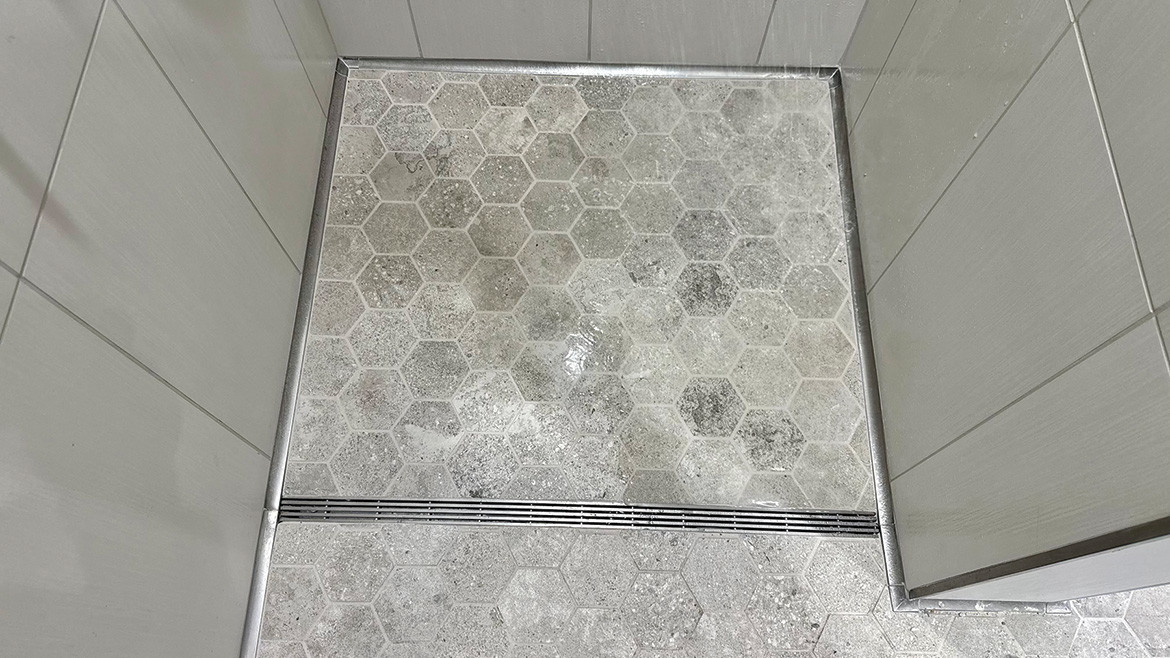
QuickDrain ProLine Linear Shower Drain in patient bathroom. Made from 316L marine-grade stainless steel, the ProLine drain is highly resistant to corrosion and bacterial growth. Image courtesy of Oatey Co.
Solution
Working closely with Oatey representatives, architects and contractors, WSP specified a variety of custom Oatey QuickDrain ProLine Linear Drains and QuickDrain 6-inch SquareDrains for the project. These systems were selected for their clean appearance, ADA compatibility, and proven reliability for drainage in healthcare environments.
The QuickDrain ProLine Linear Drain proved to be an ideal fit for the project's curbless shower design. According to Stimach, "With today's accessible bathrooms, we're no longer working with a boxed-in shower space. We needed a solution that could adapt to multiple layouts while keeping water off the floor. ProLine gave us that flexibility without sacrificing performance."
Made from 316L marine-grade stainless steel, the ProLine drain is highly resistant to corrosion and bacterial growth. The removable cover can be lifted by hand, making it easy for maintenance staff to keep drains clear of debris like soap scum and hair.
One of the biggest advantages of the ProLine system was its on-site flexibility. Installers could adjust the drain cover height using stackable spacers, while the trough extensions and covers were easily trimmed for wall-to-wall coverage. The system connects directly to the drain line without a clamping collar, allowing curbless showers to be constructed with minimal disruption to the subfloor. Drain lengths and outlet sizes could also be customized to fit the unique layout of each room.
"That kind of flexibility makes a big difference when you're dealing with dozens of different bathroom layouts," Stimach said. "Contractors didn't have to compromise on slope or waterproofing just to make things fit."
To manage overflow in larger bathrooms and serve as the primary drain in public, staff, and patient restrooms, QuickDrain 6-inch SquareDrains were installed. These drains, made from 18-gauge 304 stainless steel, offer the same durability and cleanability as the linear system. Their tile-in covers allow them to blend in with surrounding finishes, preserving a clean, cohesive look across various spaces.
Maintenance is straightforward thanks to a built-in debris basket and a removable cover key. A threaded outlet adapter also helps installers fine-tune the height of the drain to sit flush with the finished floor.
Shower spaces ranged from 10 to 15 square feet within bathrooms that averaged between 50 and 75 square feet. The drainage layout varied depending on the size and function of the room. Larger bathrooms typically included a linear drain at the shower threshold and a centrally placed square drain for overflow. In smaller bathrooms, the linear drain alone provided sufficient drainage.
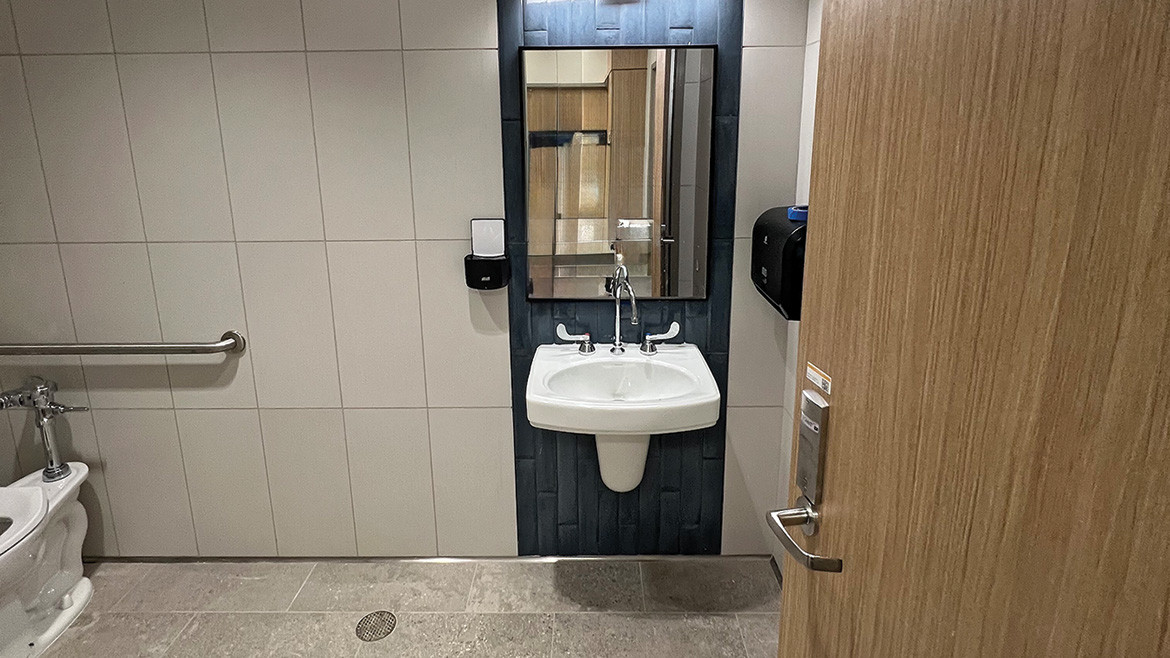
QuickDrain SquareDrains are made from durable 18-gauge 304 stainless steel, and their tile-in covers create a seamless, cohesive look. Image courtesy of Oatey Co.
The ProLine's lightweight stainless steel construction proved to be another practical benefit. "When you're ordering over a hundred drains, every pound matters in terms of labor and cost," said Stimach. "The lighter weight made them easier to move and install for the contractor, which helped keep things on track."
To help ensure a smooth install, Oatey's technical team provided early-stage onsite support. Installers who were unfamiliar with the system received walkthroughs and hands-on guidance.
"It was our first time specifying QuickDrain, so we wanted to ensure everyone was aligned," Stimach recalls. "After the first walkthrough, the contractors were on board. The install process made sense and didn't slow anyone down."
Results
The Methodist Celina Medical Center officially opened in early 2025, providing essential healthcare services to the growing community. The project met performance, accessibility, and aesthetic goals, with the drainage system contributing to both the construction process and long-term functionality.
The QuickDrain linear and square drains supported code-compliant, hygienic design throughout the hospital. The ProLine linear drain simplified construction by requiring only a single slope, reducing labor and improving layout flexibility. Its integration with large-format tile enabled the team to eliminate traditional thresholds and achieve a barrier-free aesthetic aligned with the architect's vision.
The use of durable stainless steel throughout provided confidence in long-term performance, while the ease of cleaning helped support infection control protocols. Feedback from the design and construction teams has been overwhelmingly positive, and the same drainage systems have already been specified by WSP for a second healthcare facility—an upcoming nine-story hospital in Plano, Texas.
"Once you've used it and seen how easily it installs, you want to use it again," says Stimach.
By aligning performance, cleanliness, and design flexibility, Oatey proved to be a valuable part of delivering Celina's first hospital, setting a new standard for healthcare facilities in the region.
Looking for a reprint of this article?
From high-res PDFs to custom plaques, order your copy today!