Boiler efficiency starts with water chemistry
Why testing before installation matters.

There’s more than meets the eye in the water that runs through any boiler installation. Knowing what is in that supply – and adjusting for it – can mean the difference between smooth installation and operation or a unit failure that can lead to the loss of a customer.
The impact of water chemistry on boilers cannot be overemphasized. Scale buildup as little as one-sixteenth of an inch can result in a 20 percent loss in heating efficiency. Worse, it can contribute to corrosion within pipes and heat exchangers, leading to leaks and complete boiler failure.
Simple and low-cost solutions can help pinpoint elements in water that impact boiler performance. Before any installation, it’s essential to analyze water chemistry and determine precisely what steps are required to ensure proper long-term performance.

The accumulation of magnetite can cause failures with boilers, including damage to pumps, valves and other components. Photo courtesy of NTI Boilers
Take the test
Test kits are critical in determining how water could impact a boiler. While some testing kits can be costly, an inexpensive kit from a boiler chemical supplier, hardware or swimming pool store can deliver the information an installer will be seeking.
Water testing helps identify key imbalances that can reduce efficiency, cause corrosion and scale buildup, and lead to costly repairs.
One of the most crucial readings is determining the pH level of the water circulating through the system. This reading measures the acidity or alkalinity of the water. A pH level of 7 is neutral, meaning the concentration of hydrogen and hydroxide ions is balanced. A lower reading means the water is more acidic, with a higher concentration of hydrogen ions. A higher reading means fewer hydrogen ions and a higher concentration of hydroxide ions.
While there is no perfect number, the pH level should range between 6.5 and 8.5. A lower pH level will start to cause pipe corrosion. A higher figure could cause mineral deposits, such as calcium and magnesium, to cause scale buildup and reduce heat transfer efficiency. It can also lead to foaming, which can impact steam quality and interfere with steam distribution and efficiency.
There are other important metrics that can be evaluated through the test, including alkalinity, chloride levels, iron, and sulfite.
The Killer Within

Magnetite forms when iron reacts with oxygen, and can lead to corrosion. The reaction can be accelerated by high temperatures, pH imbalances and other factors that increase the rate of corrosion. Photo courtesy of NTI Boilers
The pH level will be the most important reading from the test, as it will reveal the likelihood of the buildup of magnetite.
Magnetite forms when iron reacts with oxygen and can lead to corrosion. The reaction can be accelerated by high temperatures, pH imbalances and other factors that increase the rate of corrosion. For hydronic systems, the pH level should be between 8 and 8.5. Once magnetite develops, it can accumulate and form a layer of sludge within the system.
The accumulation can cause mechanical failures within the system, including damage to pumps, valves and other components that can lead to costly repairs. It will also decrease efficiency, reducing the flow of water and increasing the pressure required to circulate it. The system thus works harder, resulting in less efficiency and higher energy costs. It can also cause blockages, resulting in lower flow rates and potentially shut down the entire system. Similar to the buildup of cholesterol in humans, development of magnetite can bring the entire hydronic system to a grinding halt.
There are options that stymie this heating system stopper. A magnetic filter captures and removes metal debris. The filter prolongs system life, improves efficiency and reliability, and reduces maintenance. With cleaner water circulating throughout the system, heat transfer is more effective, and the system operates at peak efficiency, reducing heating costs and saving energy.
Chemical cleaners, like Fernox F3, added to the heating system water can break down and dissolve magnetite and other debris. The cleaning solutions also loosen deposits from internal surfaces, and the system is then drained to remove the contaminated water.
After the system has been flushed and cleaned from magnetite, chemical protectors like Fernox F1 can be injected to help prevent future magnetite from forming.
Hard water
According to a report, 85 percent of the United States has hard water, which is characterized by high levels of minerals such as calcium and magnesium and can cause significant problems to heating equipment.
Hard water leads to limescale buildup and creates several problems. Foremost, limescale deposits reduce efficiency by acting as thermal insulators, inhibiting thermal heat transfer from the element to the water. The building requires more energy to heat the water to the desired temperature, increasing energy costs.
Limescale can also build up in components, such as heat exchangers, shortening the life of the appliance. Corrosion caused by limescale deposits can lead to costly equipment breakdowns, and maybe even equipment replacement. Limescale can also build up in pipes, reducing water flow and increasing pressure within the system.
Water softeners can remove minerals but can also create pH imbalances, which can lead to corrosion. They also add sodium to the water, and high sodium levels can adversely affect heat exchangers, which are the heart of the boiler.
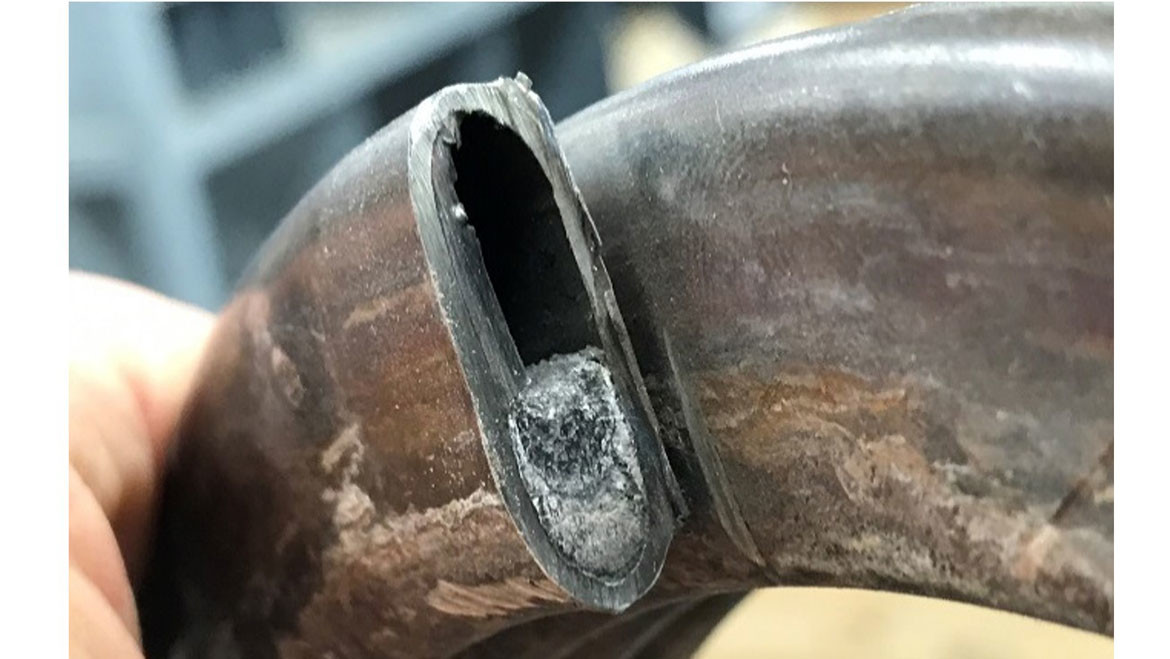
Magnetite accumulation decreases efficiency, reducing the flow of water and increasing the pressure required to circulate it. It can also cause blockages, which could potentially shut down the entire system. Photo courtesy of NTI Boilers
Water remedies
Once the tests reveal the water chemistry, it’s critical to take measures to adjust the chemistry.
Before water even enters the boiler, it should be pretreated to help prevent scale buildup and corrosion. Softening will remove calcium and magnesium ions that cause hardness. Reverse osmosis allows the passage of water molecules and removes contaminants that could affect the boiler. Dealkalizers remove alkalinity ions from water, and deaeration physically removes dissolved oxygen and carbon dioxide before water enters the boiler.
Boiler treatment chemicals include corrosion inhibitors to protect internal surfaces, phosphates to remove and prevent scale, scavengers to remove oxygen, and defoamer, which removes foam that can occur when steam bubbles form and is caused by high levels of dissolved solids, impurities, high presence of chemicals and an increase in water level.
Know the system
Installers of hydronic systems need to know more than how to install and maintain boilers. Water is a precious resource, but also amazingly complex. Knowing water chemistry and making adjustments is an important part of the job for any contractor.
Every installation is different, and water chemistry will vary for each job. Pre-treatment and constant monitoring along with proper maintenance will help keep the boiler running efficiently and extend its lifespan.
Looking for a reprint of this article?
From high-res PDFs to custom plaques, order your copy today!