Radiant Comfort Report
Australia training facility chooses geothermal
The IAPMO/PICAC Narre Warren campus is the first net zero energy education and research facility in the state of Victoria.
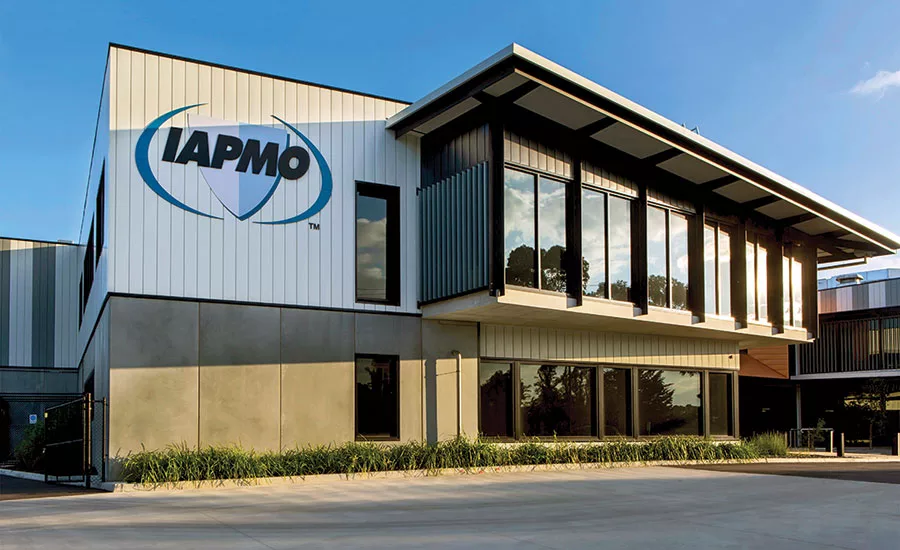
The IAPMO/PICAC Narre Warren net-zero energy campus is the first facility in Australia to utilize building foundation screw piling to source geothermal energy for the building’s heating and cooling requirements.


The state-of-the-art fuel gas appliance test rig at the IAPMO/PICAC Narre Warren campus.

The state-of-the-art facility houses IAPMO R&T’s Oceana research center and product testing laboratory, itself a vital conduit for innovative manufacturers of plumbing products to gain certification to applicable code and standards for their fixtures, fittings and other new technologies.
In order to achieve a more environmentally friendly footprint for its new education and research campus in Narre Warren, Australia, IAPMO and the Plumbing Industry Climate Action Centre (PICAC) chose one technology rooted quite literally in the earth.
The IAPMO/PICAC Narre Warren campus is the first net zero energy education and research facility in the state of Victoria. The training facility, designed for the plumbing industry, generates all energy required to support the operation of the building on-site through the incorporation of numerous renewable energy technologies.
The state-of-the-art facility houses IAPMO R&T’s Oceana research center and product testing laboratory, itself a vital conduit for innovative manufacturers of plumbing products to gain certification to applicable code and standards for their fixtures, fittings and other new technologies.
“As evidenced by the state-of-the-art facility in Narre Warren, IAPMO practices what the hydronics industry preaches — net zero with geothermal and other sustainable energy solutions,” IAPMO COO Dave Viola says.
Early in the design process, it was apparent a geothermal system offered numerous advantages to the net zero objective by tying in with other clean energy technologies, such as water heat recovery, solar water heating, solar photovoltaic panels and geo-exchange.
IAPMO/PICAC Narre Warren is the first facility in Australia to utilize building foundation screw piling to source geothermal energy for the building’s heating and cooling requirements. Geothermal Industries Australia (GIA), a specialist in ground-sourced thermal energy, dug 192- by 13-meter-deep energy piles, and 28 geothermal bores were drilled to a depth of 100 meters using a new specialized Commachio drill from Italy. Together, the 220 wells are used for the ground-source heat pump (GSHP) system to heat and cool the building. The GSHP system integrates thermal heat loops within the structural screw piles for geothermal heat exchange.
GIA drilled an initial 100-meter hole for a thermal conductivity test, collecting data for 48 hours in order to design the appropriate system for the facility’s location and geology. The discovery of swelling clays at deeper depths than anticipated presented a challenge, prompting the necessity of the Commachio drill and enabling crews to drive casing past the troublesome zones and keep the project on schedule. GIA achieved 100% success getting each ground heat exchanger installed to depth on the first attempt.
The project has both type water-source heat pumps that either add heat or remove heat from air in ductwork or water in pipes that, when passed through a heat exchanger, create hot water for the radiant floor system and domestic water heating. There are additional units connected to the ground loop that both heat air or cool air directly.
“The training facility, designed for the plumbing industry, generates all energy required to support the operation of the building on-site through the incorporation of numerous renewable energy technologies.”
The building HVAC system and water heating are insulated from outdoor air temperature swings that result in loss of both capacity and efficiency. The building gets both heating or cooling year-round with a simple two-pipe system. One major advantage of the geothermal side is the ground temperature is stable. Outdoor air may force equipment to heat or cool with outdoor temperatures below zero to above 140° F on a roof. A ground loop may only vary 50° annually.
The common loop in the building is connected to all the units, and the ground then “nets” these loads. For example, a unit in cooling heats the loop, a unit in heating cools the loop and the ground then dissipates the net to the ground. The geothermal loop now acts as storage as well as a source. The loop in the ground is designed to handle the building without getting too cold or too hot with all the equipment in the middle creating an efficient system.
Weather makes heating and cooling loads higher, but this system is connected to the ground. For example, the core of the building needs air conditioning (cool air) and the perimeter or the lobby needs hot air, or warm water for the radiant floor. The two offset each other not only simultaneously, but instantly and cyclically as the loop temperature in the ground and in the building is always in comfort balance as designed. Radiant heating is easy because the ΔT is low, and the temperature in radiant cooling or heating is low compared to other systems. The result is the whole system on the source side or the load (building side) are all at favorable temperatures — no extremes.
Extremes cost money in operating cost and effect equipment life. With geothermal ground-source heat pumps and radiant, everything works at high efficiency in harmony to satisfy the building’s requirements.
The building also features an insulated wall design that consists of a building shell comprising precast sandwich panels on the ground floor and a lightweight metal cladding composite wall system on the first floor. This insulation system achieves an R-value that exceeds the requirements of the National Construction Code and assists in maintaining thermal comfort.
“I am certain that people from all sectors of the building industry, the energy sector, all levels of government and the wider community will want to see the system in operation,” says Clint Patzack, GIA managing partner and general manager. “There is a genuine business case supporting geothermal energy as a source of heating and cooling. We are going to see an increase in interest in this proven technology in Australia, particularly as energy costs from traditional sources continue to escalate and the focus on clean energy increases.”
Looking for a reprint of this article?
From high-res PDFs to custom plaques, order your copy today!