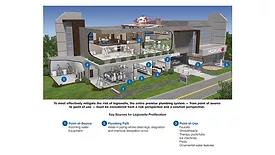
While the risk of Legionella exists across many types of buildings, healthcare and long-term care facilities are particularly vulnerable. These buildings often have large, complex plumbing systems with extensive pipe networks, variable water usage, and numerous fixtures, all of which can create conditions conducive to bacterial growth if not properly managed. As a result, even well-designed and well-maintained systems require ongoing attention to minimize risk.
As part of ASHE Engineering Week 2025, Chicago Faucets will host an hour-long webinar.
October 21, 2025
The webinar, "Plumbing Design Strategies to Control Waterborne Pathogens in Healthcare Facilities," will take place on Wednesday, October 22 from 12:00 PM to 1:00 PM CDT.
The webinar aims to help facilities comply with emerging legionella regulations
June 5, 2025
Spenser Johnson to present "Navigating Evolving Water Management Regulations: Ensuring Compliance & Public Safety” Thursday, June 19, 2025, at 11:00 am CDT.
In a recent whitepaper written by Dr. Janet Stout and Abraham Cullom of the Special Pathogens lab – both legionella experts – it’s reported that legionaires disseas is on the rise, particularly in the healthcare setting. Cliamte change, aging infrastrcuturem increasing population are all identified factors that increase legionella cases.
Chicago Faucets is hosting a free webinar designed specifically for facility teams — to help you take control of water safety. Join Megan Canright Racicot (MPH, CIH), a leading industrial hygienist in building water risks, on Wednesday, April 30.
Despite being the oldest and most widely accepted technique for the detection of Legionella bacteria, it is well documented that lab culture testing has many limitations. Foremost, most lab culture tests take 7-10 days to return results. Yet Legionella can double in a day.
Sustainability in commercial plumbing focuses on modern pipe sizing to reduce material use and Legionella risk. Efficient layouts and lower-carbon materials like PEX and recycled PVC can lower greenhouse gas emissions, while improved equipment efficiency and training help reduce operational and embodied carbon emissions.






.webp?height=168&t=1738777830&width=275 "AdobeStock_191907697 (1).jpg")


