The Astounding Cost of Missing Calls
And how to move your numbers in the right direction
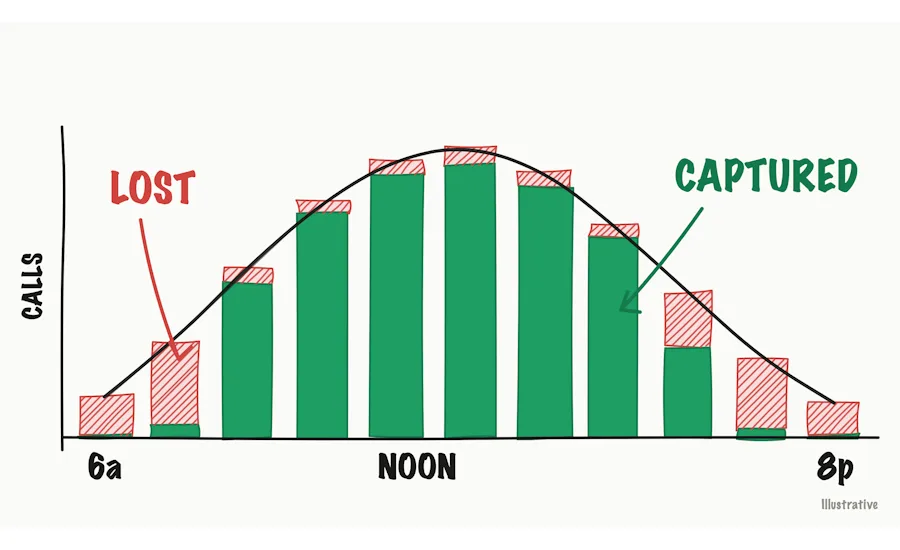
I want you to try something this week. Pull up your phone system's call log, your VoIP dashboard, your answering service report, whatever you use. And look at what happens to calls that come in after 5 p.m. on a weekday. Then look at weekends. If you run a supply house, look at what happens before 7 a.m. too, when the trucks are already loading and the counter isn't open yet.
If you're like most contractors or branch managers, you'll find one of two things:
Those calls went to voicemail, or
They went to an answering service.
In both cases, someone on your team called back the next business day. But how many of those callbacks actually connected? How many callers dropped without leaving a message? And how likely is it that they’ll call again? Spoiler: not very.
The Measurement Paradox
We all know how to track revenue, close rate, average ticket. But how do you track dollars that never enter pipeline? How do you track callbacks that don’t connect, voice messages that don’t get left, or the stock-check that never got a callback?
Invoca, a call tracking platform, reports that about 26% of inbound calls to businesses go unanswered. In my experience, the smoking gun is nights and weekends, where upwards of 80% of calls go unanswered. And it’s a compound-cost. Because the calls that come in before an after-hours tend to be high-intent callers. They’re calling for a reason, and it’s not to price shop! They (or their client) have an inch of water in the kitchen. Would you leave a message? Or just call the next company on the list?
The challenge is that these things are invisible. You don’t get notifications for missed calls. They don't show up on your daily sales report as an “almost” sale.
They leave no obvious operational trace, except sluggish marketing ROI. You might think it’s time for a fresh campaign, or a new agency. But the real problem is much simpler: we’re fumbling 1 of 4 revenue opportunities. And with everything from AI voice agents to outsourced call centers now available, the gap between "we answer 75% of calls" and "we answer every call, 24/7" has never been smaller.
Here's a simple diagnostic you can run on your own business this week:
Pull your call volume by hour. Most VoIP systems or call tracking platforms (CallRail, ServiceTitan, Housecall Pro) can show you calls by time of day. What percentage of your total calls come in outside office hours?
Check your answer rate. Not overall, break it out by hour of the day. What's your answer rate during business hours vs. evenings vs. weekends? Branches should ask the same question about the 6-7 a.m. window and the hold-abandon rate on the counter and will-call lines.
Track callback conversion. Of the after-hours calls you return the next morning, how many actually book a job or place an order? Compare that to your conversion rate on calls that are answered live.
Most companies that run this exercise find that 20-30% of their call volume comes outside business hours, they miss 80% of those calls, and their next-morning callback conversion is a fraction of their live-answer rate (half of them will take 3 attempts just to make contact).
Wholesale counters have their own version of this, and it hides in plain sight.
We recently analyzed 309 calls over a 6-week period at a plumbing supply company. Nearly half (47%) were product and stock questions.
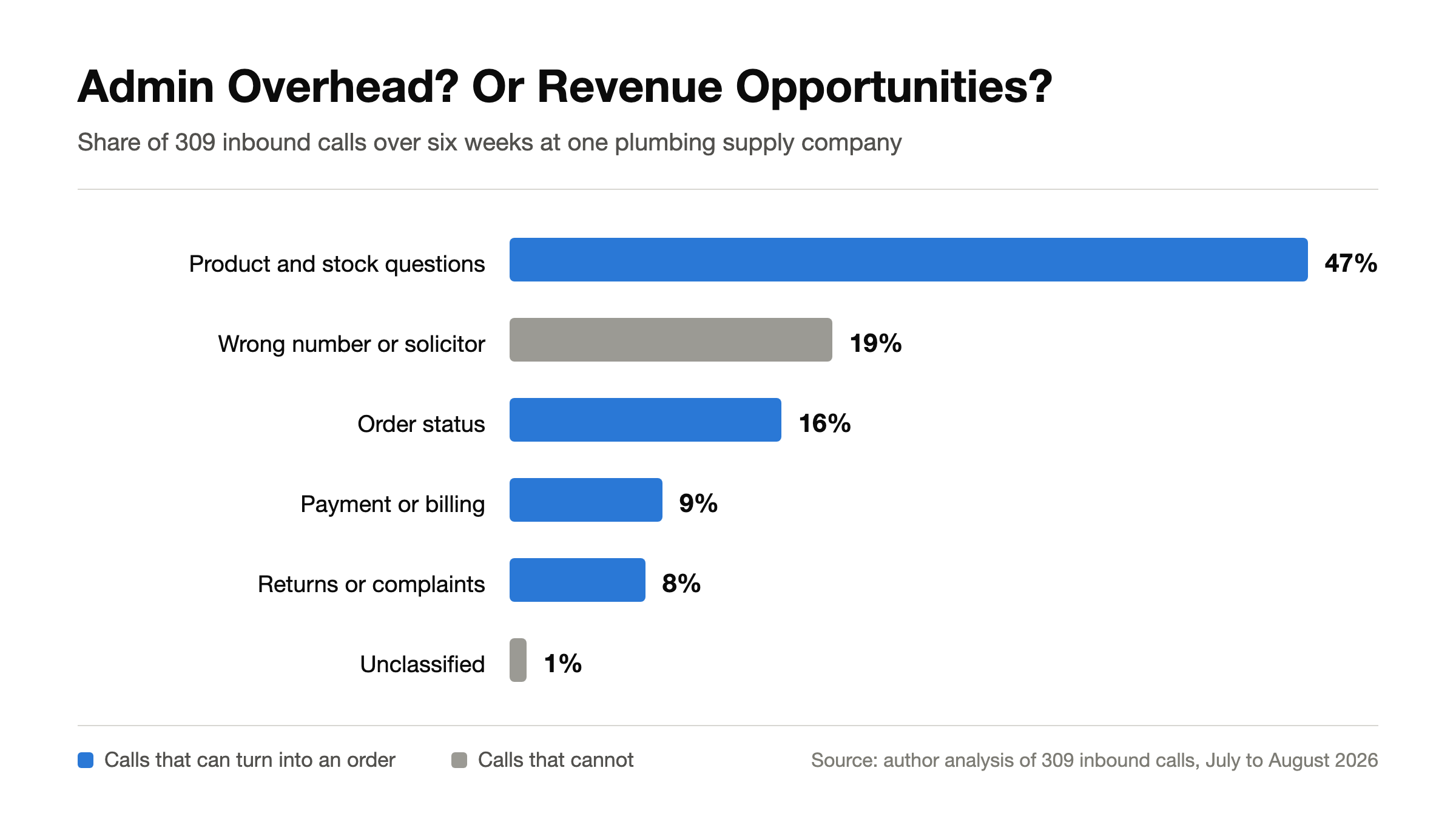
Image courtesy of Chris Mechanic.
It's easy to lump this all into “administrative overhead”. I have seen supply houses actually hide the phone number on their website so they don’t have to deal with all the calls. But savvy operators see this and smell opportunity. That caller will buy it today if the answer is yes. That's about as close to a sale as a phone call gets.
So the highest-volume calls coming into a supply house are exactly the ones most likely to convert into revenue. That’s a great problem to have. And if you look at it that way, the phone is actually not a cost center at all. It's more like the order desk!
Why the Real Cost of Missed Calls Is Even Higher
This is where the math gets uncomfortable.
The job or the order that you missed is just the tip of the iceberg. To understand the full impact, we also have to factor in customer lifetime value (CLTV), or the expected value of future purchases that would’ve been made had you acquired that customer.
The real cost is the lifetime value you never capture.
Think about how your best customers behave. A homeowner calls you for a clogged drain. You show up on time, fix it right, charge a fair price. Six months later, their water heater fails. They’re not going to Google. They’re calling you. Two years after that, they're remodeling a bathroom. They call you. They refer you to their neighbor. Their neighbor refers you to a coworker.
A single residential plumbing customer who stays with you is worth somewhere between $10,000 and $20,000 over their lifetime in your service area, depending on your market and service mix. Some are worth much more.
So that missed call at 7 p.m. on a Friday isn't an $800 problem. It's a $15,000 problem. Multiply that by even two or three missed calls a week, and you're looking at 6-7 figures in lifetime value that you now have no chance of re-capturing. Everything else could be working. Techs could be great. Marketing could be firing on all cylinders. And the only reason that business is “okay” this year instead of “amazing” is that the phone rang and nobody answered.
The distributor version of this math is bigger, and it compounds faster.
Homeowners call a contractor two or three times over five years. A plumbing or mechanical contractor calls their supply house two or three times a week, every week, for as long as they're in business. Stretch that across a five- or ten-year relationship and the number can dwarf almost any single homeowner's lifetime value.
The failure mode is worse too. A homeowner tries again, maybe leaves a voicemail, before calling a competitor. A contractor with a crew idling in the driveway doesn't wait. They're on hold at 6:45 a.m. with a truck full of techs getting paid to stand around, and the branch three miles away has a person answering the phone. They hang up and drive there. Once that crew gets used to a new counter, and an inside sales rep who knows their jobs, they often don't come back. Losing that account isn't losing one order. It's losing a gushing stream of orders that would’ve come flooding in for years.
What Contractors and Distributors Are Doing About It
There's no single right answer here. The best approach depends on size, call volume, and the gaps you want to cover. But companies I've seen close this gap tend to do one of a few things:
Staggered CSR shifts. If you have enough call volume to justify it, extending your phone coverage from 7 a.m. to 8 p.m. (and/or adding Saturday morning coverage) can capture a significant chunk of after-hours calls without overhauling anything. The cost is one additional part-time CSR. The math usually works for shops running 15+ calls a day. Similarly, suppliers can stagger one rep's shift to start at 6 a.m. to catch the pre-job rush.
Overflow routing to a trained team. Some contractors partner with specialized trade answering services that understand the difference between an emergency and a maintenance call. A service that only takes messages doesn't fully solve the problem. Look for services where the operators can actually book jobs in your system. Distributors run into a version of this at the counter itself: the person ringing up a walk-in can't also answer the phone. Plan for that in advance. Have an inside sales or backup line that reps can transfer to when they can’t pick up.
AI-powered call handling. This is the newest option. AI voice agents can now have natural conversations, qualify urgency, answer common questions, and book appointments directly into your scheduling platform, 24/7. The technology has improved dramatically in the last two years. It's not for everyone, but for contractors who get consistent after-hours volume, it's worth evaluating. AI answering is gaining popularity also among distributors, where repetitive informational calls (stock-check, pricing, order status, delivery ETA) make up the bulk of the volume, which makes them a natural fit for AI. The catch is that those are revenue calls. It’s not about deflection. It's about answering now, answering accurately, and capturing orders.
The common thread is that every one of these approaches replaces silence with a live response. The tech is just the “how”. The principle is: when customers call, we answer.
The Compound Effect
Here's what I think gets overlooked in these conversations. Answering the phone isn't just about capturing a single job. It changes the trajectory of your business over time.
The contractor who answers at 9 p.m. gets a five-star review that says "they picked up when nobody else would." That review becomes the reason the next homeowner picks them off the search results page. That homeowner becomes a repeat customer. Their referral becomes another repeat customer.
Meanwhile, the contractor who let it go to voicemail never knows any of this happened. They look at their marketing spend and wonder why growth has stalled.
Distribution runs on the same compounding, just without the reviews. Nobody leaves a Google review for their supply house. But a contractor who gets you on the first ring at 6:45 a.m., or who gets a straight answer on stock without getting put on hold, remembers which branch did that. Contractor loyalty is the moat. There's no meaningful difference between one branch's pipe and another branch's pipe. Reliability and speed are two of the few levers a branch fully controls.
Demand for plumbing is huge. The constraint for most shops isn't generating leads or customers. The phone ringing is a good problem to have. Make sure you’re harvesting that bounty, and harvesting it well.
Where to Go From Here
Carve out some time this week to run the diagnostic and review your own numbers. Be honest with yourself. Is the gap smaller than you thought? Bigger? Either way, consider it good news. Because you can close the gap. All the way down to 0% missed calls (or close). And as you do, revenues will quietly grow, margins will expand, and before long, your whole P&L will be singing like it’s never sung before.
Here’s to a 100% answer rate.
Looking for a reprint of this article?
From high-res PDFs to custom plaques, order your copy today!