
WarmlyYours Q2 Sales Report Shows Floor Heating Drove Growth
Q2 2026 floor heating sales grew 14.3%
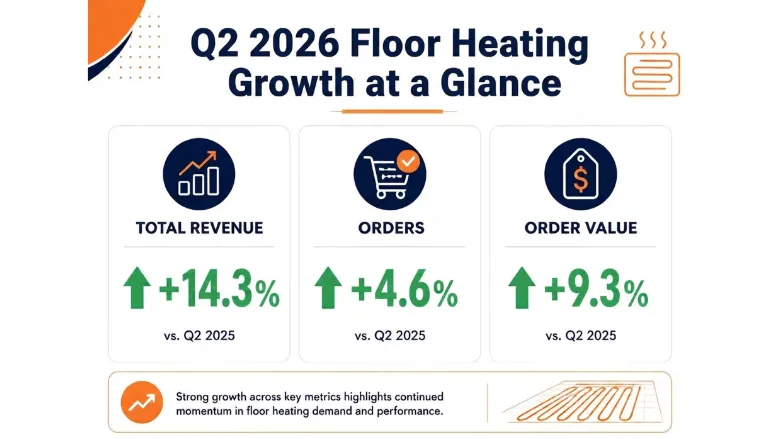
WarmlyYours reported 14.3% year-over-year growth in floor heating revenue in Q2 2026 — the company’s largest product line and the primary driver of total sales growth. The increase in the floor heating product line helped to propel total consolidated sales growth for WarmlyYours to 28.3% compared with the second quarter of last year.
As a core product line, double-digit growth in floor heating reflects a substantial change in consumer habits that merits substantial exploration.
In this report, we analyze the sales data from Q2 2026 and compare it to the same period in 2025 to generate proprietary data insights and explore the underlying drivers behind these trends.
Q2 2026 Sales Performance
The second quarter told a clearer story than the first. While Q1 was defined by weather-driven urgency and a late-season snow melting surge, Q2 was defined by something more consistent: floor heating. Radiant floor heating reached 14.3% growth and remains the company’s largest category by a wide margin.
What makes this quarter strategically important is not the headline percentage. It is the distribution beneath it. Floor heating did not grow because one channel spiked or one product outperformed in isolation. It grew across professional customer types, across product families, across room applications, and across price points at the same time — and it did so while the housing market that typically supports renovation demand was contracting.
Read the order metrics together and the shape of the quarter becomes clear. Orders increased 4.6% while average order value rose 9.3%. Order volume increased modestly, while average order value grew at roughly twice the pace. This is not simply an expansion in customer count. It reflects a shift toward larger project scopes — more zones, broader room coverage, and more full-system specifications rather than single-room retrofits.
Product-Level Highlights & Labor Efficiency
At the product level, the Slab Heating Mat recorded the fastest growth rate at 75.6%. That increase reflects renewed activity in slab-on-grade and poured concrete applications — basements, garages, and additions where installation efficiency matters.
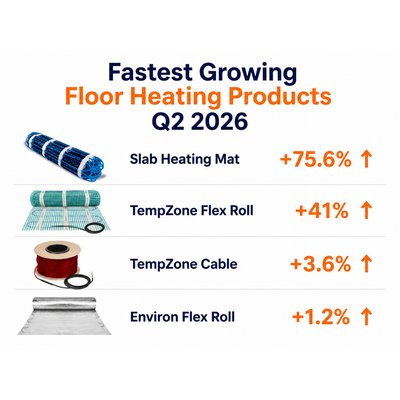 Image courtesy of WarmlyYours.
 But the number that carries the quarter is TempZone Flex Roll at 41% growth. It is the highest-volume product in the category, and growth at that scale is what moved the total. This product is incredibly popular with both busy professionals and DIY homeowners because it provides fast installation and even heating.
There is another advantage to the growth of TempZone Flex Roll that does not show up directly in the sales numbers: labor efficiency. Floor heating installers, like much of the skilled trades, are being asked to do more with limited crews. Products that reduce installation time and complexity give those crews a way to increase capacity without necessarily increasing headcount.
TempZone Flex Roll is well suited to that environment. With the heating cable integrated into a flexible mesh roll and a custom installation layout provided with the system, installers can spend less time laying out individual cable runs and more time moving the project toward completion. WarmlyYours even maintains installation resources built around getting the system installed efficiently, including a demonstration of a TempZone Flex Roll installation completed in 40 minutes.
That matters as the category expands. If floor heating demand continues to grow while skilled labor remains constrained, installation efficiency becomes part of the value proposition. The products that are easiest to install can help contractors take on more projects with the crews they already have—and that creates another potential tailwind for TempZone Flex Roll.
TempZone Cable increased 3.6% and Environ Flex Roll 1.2% — both stable, both positive, and both indicating that gains in Flex Roll represent expansion rather than internal product shifting.
Commercial Specification & Professional Channel Expansion
The driver of that expansion is the professional channel, and specifically its commercial edge.
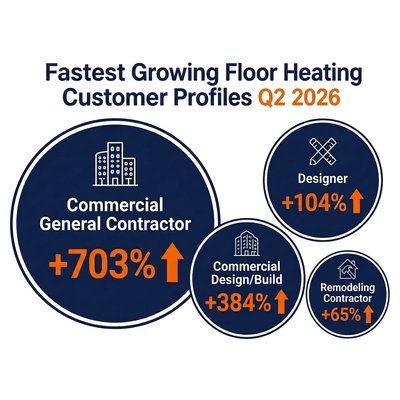 Image courtesy of WarmlyYours.
 Commercial general contractors grew sharply (up 703%) and there were significant gains in commercial design/build firms (up 384%). Both figures come off smaller prior-year bases, and that context matters. These are emerging segments, not yet dominant ones. What they signal is more important than what they currently contribute. Radiant floor heating is increasingly being specified into commercial environments where it would previously have been value-engineered out — hospitality bathrooms, entryways, and experience-driven spaces where floor comfort is part of the offering.
Julia Billen, Owner and President of WarmlyYours, sees the growth among professional customers as a sign that radiant heating is becoming less of an afterthought and more of a deliberate part of the project specification.
“The interesting thing about this quarter is that radiant heating isn’t just sneaking into more projects—it’s getting invited to the party earlier,” said Billen. “When designers are specifying it and contractors are building it into the scope, that tells us something important: they’re seeing the value before the project ever gets to the installation stage. And once a customer experiences a properly designed heated floor, it’s pretty hard to convince them that cold tile was a better idea.”
Beneath that commercial growth sit the segments that give the quarter its weight. Designer activity more than doubled (up 104%), and remodeling contractors posted strong gains (up 65%) from established volume levels. That combination is the core engine. Designers specify the system early; contractors execute the installation. When both grow at the same time, it indicates that floor heating is being integrated at the front end of projects rather than added late — and it provides a direct explanation for the increase in average order value.
The National Housing and Remodeling Markets
The macroeconomic backdrop makes that growth more notable. Existing-home sales continued to decline, extending a period of constrained transaction volume. Fewer home sales typically reduce renovation activity tied to move-in upgrades, which has historically been a key driver of radiant heating demand.
According to the National Association of Realtors (NAR), existing-home sales decreased by 2.4% month-over-month in June 2026.
“The back-and-forth in monthly home sales activity, driven by mild fluctuations in mortgage rates, shows how sensitive home buyers are to affordability conditions,” said NAR Chief Economist Lawrence Yun. “However, job gains—more than half a million since the beginning of the year—will continue to provide support for the housing market.”
Despite that optimistic note, pending home sales in June decreased by 5.4% month-over-month and 0.3% year over year, according to NAR.
Additionally, projections from Harvard’s Joint Center for Housing Studies indicate that remodeling growth is expected to moderate in the latter part of 2026. The LIRA forecasts that annual growth for home remodeling and upkeep expenditures will hit 2.1 percent this summer before slowing to a 1.6 percent rate by December. A downshift in remodeling introduces a clear headwind for categories tied to discretionary renovation spending.
“Single-family home sales and permitting activity have picked up modestly from very low levels, which should support a nominal increase in remodeling activity this year,” said Rachel Bogardus Drew, Director of the Remodeling Futures Program at the Harvard Joint Center for Housing Studies. “Even with some deceleration later in the year, overall annual homeowner spending on improvements is expected to reach $518 billion by the end of 2026.”
So how does floor heating grow into that environment? Because the “stay-put” dynamic observed earlier in the year has become more entrenched. Homeowners who are not moving are reinvesting in the homes they already occupy, and they are prioritizing improvements that deliver daily functional value. Radiant floor heating fits that pattern. It is experienced every day, not deferred until resale, and is therefore less sensitive to transaction volume.
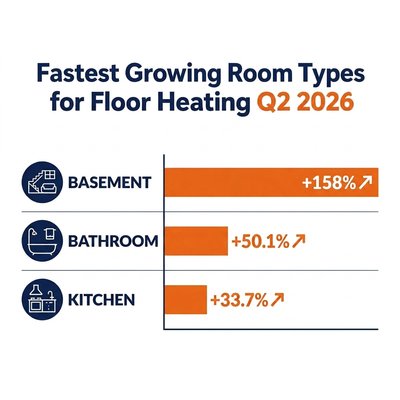 Image courtesy of WarmlyYours.
 Room-level data reinforces that shift. Basements showed the strongest growth, increasing 158% year over year. This reflects a broader trend of homeowners converting existing square footage into usable living space — offices, guest areas, and multi-purpose rooms. Bathrooms (up 50.1%) and kitchens (up 33.7%) also posted strong gains, remaining central to renovation activity and well-aligned with radiant heating applications.
While the fastest growth rate was with basement projects, the roughly 50% increase in bathroom projects implies a massive level of volume growth as bathroom-related projects make up around 70% of all floor heating projects for WarmlyYours.
Floor covering data remains consistent with established patterns. Tile, marble, and stone account for the majority of installations (67.5% of all floor heating projects), reflecting both thermal performance and common use in high-traffic areas. Smaller contributions from vinyl (5.7% of all projects) and laminate (1.6% of all projects) categories remain notable. While still limited, these segments represent potential expansion as material compatibility continues to improve and cost-sensitive applications adopt radiant systems more broadly.
Taken together, Q2 results show that floor heating growth is being driven by multiple reinforcing factors: larger project scope, earlier-stage specification, and expansion into new applications. The category is not only maintaining performance in a constrained market — it is extending into areas that were previously underpenetrated.
Looking for a reprint of this article?
From high-res PDFs to custom plaques, order your copy today!


