
LG Advances in U.S. Department of Energy's Commercial Building HVAC Technology Challenge
LG’s next-generation heat pump rooftop unit passes lab validation.
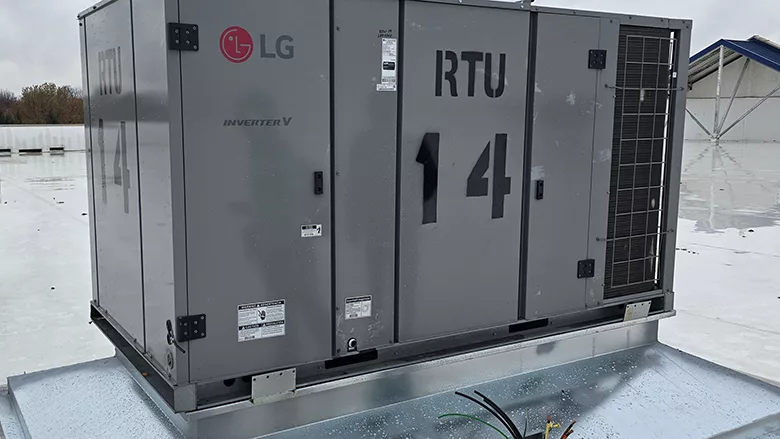
LG Electronics announced that its commercial heat pump rooftop unit has successfully completed the laboratory validation phase of the U.S Department of Energy (DOE) Commercial Building HVAC Technology Challenge. Spearheaded by LG’s U.S. Air Conditioning Technologies division, this achievement supports LG’s ongoing development of high efficiency, all-electric HVAC equipment intended to help reduce energy consumption and energy costs in commercial buildings, subject to application and operating conditions.
LG’s participation in the DOE’s Commercial Building HVAC Technology Challenge "reflects the company’s commitment to accelerating the availability of high-efficiency, market-ready heat pump rooftop units (RTUs) for commercial customers." LG’s 10-ton, all-electric and compact unit is developed to support performance in cold climates, delivering heating capacity and efficiency across a range of ambient conditions, including low temperatures, subject to installation and operating conditions. The unit also integrates R-32 low-GWP (Global Warming Potential) refrigerant as a core component of its configuration.
“Our successful validation in the DOE Technology Challenge highlights LG’s commitment to meeting commercial market needs,” said Gautham Devarakonda, HVAC product development and engineering manager at LG Electronics USA. “LG’s 10-ton heat pump RTU, participating in the challenge’s 10- to 14-ton category, demonstrated strong heating performance and efficiency in laboratory testing, including operation at low ambient temperatures down to minus 10°F, while supporting broader performance efforts.”
According to the company, the LG heat pump RTU is engineered to support efficiency and flexibility. The unit employs technology that allows for precise refrigerant flow control, compressor and electric heating capabilities, and dual-sensing control for humidity and temperature, enabling it to provide performance in extreme cold climates while minimizing the reliance on electric resistance heating. This approach aims to help improve overall system efficiency depending on system configuration and operating conditions.
Key features of LG’s validated RTU include:
- High Heating Performance: Achieves high heating capacity and Coefficient of Performance at low ambient temperatures, in accordance with applicable DOE test conditions where specified. The unit demonstrated performance improvement in controlled testing conditions including IVHEC, H-10Max Capacity, H10Max COP2 and IVEC, with results varying based on application and conditions.
- Low-GWP Refrigerant: Utilizes a SNAP-approved refrigerant.
- Advanced Controls: Supports integration with building automation systems with additional grid-interactive and demand flexibility capabilities planned for future phases of development.
- Application Flexibility: Enables integration into both new installations and replacement applications, aiming to help streamline across a range of project conditions.
Following successful laboratory validation at Intertek, LG’s heat pump RTU has entered its initial phase of real-world performance assessment through field trials. A prototype unit has been successfully installed at a large retail store in Zionsville, Indiana, and a second prototype unit is scheduled for installation at the Pacific Northwest National Laboratory research facility in Richland, Wash. Data collected from this first phase of field trials at these sites will be evaluated to assess energy performance, operation and reliability.
Additional field testing is planned for the summer to further validate performance across diverse commercial environments. Testing will be ongoing process through 2027, and the insights gained may inform future utility incentives, procurement specifications and regulatory consideration.
Looking for a reprint of this article?
From high-res PDFs to custom plaques, order your copy today!


