
The hybrid heat advantage: decarbonizing water heating for a resilient future
Hybrid water heaters are becoming the default choice in jurisdictions racing toward net-zero.

Conventional electric resistance units remain common but are being replaced by high-performance, lower-emission options.
Ask any contractor, and they’ll tell you: customers are asking more questions than ever about energy efficiency, utility bills and what it really means to "future-proof" their homes. At the same time, new codes and incentive programs are pushing the trades toward smarter, lower-emission technologies. The push for decarbonization is steadily growing, and building systems are being scrutinized to see how they can be improved.
Water heating is a significant contributor to energy use, both residential and commercial. These systems are vital—anyone who's come home from a long day needing a hot shower will attest to that—but their contribution to emissions means that they need to be updated to meet the growing demands of the states and cities that are determined to meet ambitious decarbonization goals.
That’s where hybrid water heaters come in. These systems are quickly gaining traction as a reliable and cost-effective upgrade that doesn’t just check the efficiency box, but keeps performance and sustainability front and center.
Hybrid systems offer a critical bridge in the transition from fossil fuel reliance to full electrification. For contractors working in colder climates or retrofitting older homes, all-electric heat pump systems can be a tough sell. Hybrid units, however, deliver measurable emission reductions while preserving consistent output and adaptability. They offer a realistic path forward, helping homeowners and building owners make meaningful upgrades today—without compromising comfort or requiring extensive electrical overhauls.
These systems are doing more than reducing emissions. They are helping customers transition from fossil fuel dependency while maintaining the comforts of modern living — hot water on demand, reliable performance, and increasingly intelligent connectivity. In short, hybrid systems are making decarbonization practical.
Hybrid water heating 101
Hybrid water heaters — often referred to as heat pump water heaters (HPWHs) with backup electric resistance or gas elements — combine advanced heat pump technology with traditional components to ensure consistent performance. These systems extract heat from ambient air and use it to heat water, operating with impressive efficiency. Compared to electric resistance units, HPWHs can use up to 75% less energy.
"Nowadays, it doesn’t make much sense for homeowners to replace an electric resistant water heater with the same type of unit," notes Roch Naleway, A. O. Smith market development manager for the utility segment. "Users can get the same hot water through a more cost-efficient and environmentally friendly unit."
From a performance standpoint, HPWHs are engineered to meet demand, even during high-use periods. Backup elements provide peace of mind and speed up recovery times, which helps them compete with tankless or conventional systems.
"Hybrid systems, particularly heat pump water heaters, are among the most efficient water heaters on the market, saving up to four times as much energy compared to traditional models." Rheem’s Senior Product Manager, Scott Petty, told us. "They reduce direct fossil fuel use by replacing traditional gas or resistance electric water heaters with electric models that rely on ambient air rather than combustion. From a performance standpoint, today’s hybrid systems are engineered to maintain reliable hot water delivery—even in cold climates—by combining heat pump technology with backup electric elements when needed."
What sets hybrid systems like this apart is their mode flexibility. Most models offer multiple operating settings such as: efficiency, electric, high demand and vacation/away modes, allowing homeowners or building operators to prioritize energy savings, hot water recovery time or off-peak scheduling depending on usage patterns. For contractors, this means more tailored installations and happier clients — whether the goal is cutting energy bills or ensuring reliable hot water for a family of five.
Smart app integration and Wi-Fi connectivity also enhance user control and system diagnostics, making maintenance and optimization easier than ever. This flexibility, combined with utility rebates and long-term savings, positions hybrid systems as a practical, future-ready upgrade for residential and light commercial installs.
"Smart control technology is one of the most requested features in water heating technology," says Naleway. "At the touch of their fingertips, homeowners can control the set point, monitor diagnostics, and ensure optimal operation." Homeowners can also use smart features to adjust settings remotely, ensuring they never run out of hot water. For instance, Rheem’s EcoNet app allows users to shift modes, track usage and manage schedules all from their phone.
You’re not alone if you’ve ever had a customer ask, "Will this thing actually keep up with my family’s hot water needs?" One of the most common myths about heat pump water heaters is that they can’t handle high-demand situations. And, while it’s true that heat pump-only mode recovers more slowly than traditional electric models, that’s exactly why hybrid systems were designed with built-in electric resistance elements. They kick in automatically when the system senses a spike in usage or a drop in tank temperature, delivering reliable hot water when it’s needed most.
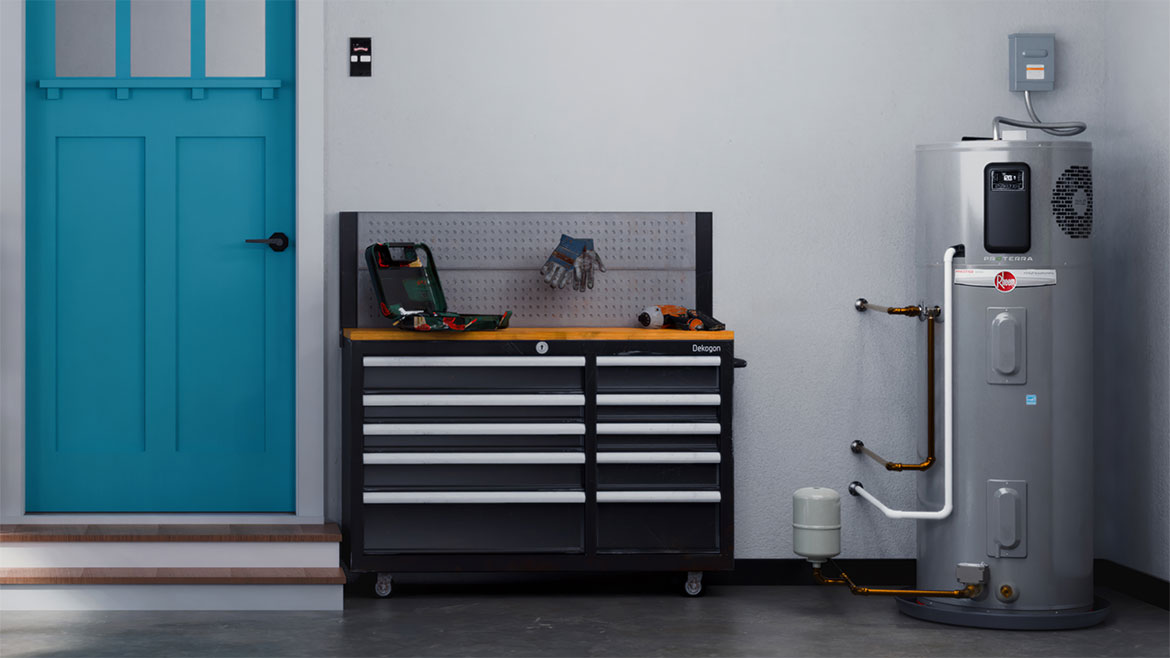
Hybrid systems like Rheem’s ProTerra with smart controls can help homeowners reduce peak demand and integrate renewables. Image courtesy of Rheem
In practice, most users never notice the transition. "We haven’t encountered much concern from customers about heat pump-only water heater recovery times," says Naleway. "Most users set the unit to run on the hybrid setting and let it do its thing."
For pros in the field, that means fewer performance complaints and more confidence recommending a product that balances efficiency with peace of mind. Hybrid mode does the heavy lifting, toggling between savings and speed without the customer having to lift a finger.
Where do these systems perform best?
If you have a homeowner asking where a hybrid heat pump water heater will really shine, the answer starts with location. According to the U.S. Department of Energy, these units perform best in spots that stay between 40º–90ºF year-round—think basements, garages, or utility rooms with good airflow. If the space fits the temp range and has the volume, you’re in business. ""HPWHs demonstrate their effectiveness in cooler climates such as Maine," Petty notes, "which has the highest per capita number of heat pump water heaters installed in the country."
It’s also worth looking at the size and layout of the mechanical area. A tight closet or small utility nook won’t give the heat pump enough air to work efficiently. Most manufacturers recommend at least 700 to 1,000 cubic feet of air around the unit. If the install area is snug, consider a ducted model or look for nearby spaces to draw air from.
Homes with steady or high water usage — and especially ones with solar panels or time-of-use electric plans — can really maximize the value of a hybrid unit. And, with smart controls, users can preheat during cheaper electricity hours or when their solar system is generating power, then tap into that reserve when demand spikes.
But, it’s not just about ideal conditions — it’s about bridging the gap to full electrification. Homes with steady or high water usage can really maximize the value of a hybrid unit. With smart controls, users can preheat during cheaper electricity hours or when their solar system is generating power, then tap into that reserve when demand spikes. These capabilities make hybrid systems a practical step toward reducing fossil fuel dependence while maintaining comfort and control.
Residential properties aren’t the only ones who benefit. "In commercial settings the shift toward electrification is quickening, especially in new construction and retrofit projects tied to sustainability goals," said Rheem’s Scott Petty. "Facilities are increasingly turning to electric heat pump systems, but many are taking a hybrid approach—pairing electric with gas to manage load during peak demand or in colder climates."
"Commercially, there is often a need for higher outlet water temperature," Naleway agreed. "While the recovery time of a HPWH can be longer, the new technological advancements of HPWH’s make it easier to find units that fit installation needs. These advancements make it easier for facility managers to transition away from fossil fuels while still providing optimal hot water output."
Commercial hybrid water heaters are increasingly viable — and often optimal — for large-scale hot water demand. They offer substantial operational savings, meet tightening decarbonization goals and deliver the flexibility and reliability needed in commercial settings.
Policies and incentives
As codes evolve and incentives roll out all across the U.S., one thing is clear: the electrification movement isn’t on the horizon— it’s here. From local building codes to federal incentives, new policies are pushing consumers and builders to rethink legacy systems powered by fossil fuels. The upcoming NAECA-4 rules — set to take effect in 2029 — will raise the bar even higher for water heater performance.
States like California, Maine, Hawaii, New York, Virginia and more are all working towards the same goals: decarbonization, clean energy and carbon neutrality. One thing is certain: the pressure is on.
New York, for example, passed a broad clean energy and climate law including 70% renewable energy by 2030, and a goal of 100% carbon‑free electricity by 2040, as part of its Climate Leadership and Community Protection ActThe Climate Leadership and Community Protection Act (CLCPA) in 2019. This goal has proven to be perhaps too ambitious, however, as the state is now revising its timeline: instead of reaching 70% renewables by 2030, current modeling suggests this will shift to 2033, and the emissions reduction goal from 40% (by 2030) to 40% by 2036 due to demand growth and deployment delays. This goes to show: making the shift isn’t always straightforward, especially in existing buildings where all-electric upgrades can be costly or complex.
It’s not just about ideal conditions — it’s about bridging the gap to full electrification. Homes with steady or high water usage can really maximize the value of a hybrid unit.
That’s where hybrid water heaters come in. They’re stepping in as a bridge; offering a low-carbon solution that works within today’s infrastructure while setting the stage for a fully electrified future.
"Hybrid systems are among the most efficient water heaters on the market, saving up to four times as much energy compared to traditional models," notes Rheem. "They reduce direct fossil fuel use by replacing traditional gas or resistance electric water heaters with electric models."
Adoption is already on the rise in areas leading the decarbonization charge. "We’re seeing particularly high residential adoption rates of around 20% in the Pacific Northwest and 40% in the Northeast," says Roch Naleway. "The Tennessee Valley Authority just launched a $1,300 instant rebate."
Rebates offer something that most home and business owners wouldn’t refuse: a monetary incentive. The Inflation Reduction Act (IRA) includes substantial tax credits and income-based rebates for homeowners who install high-efficiency electric appliances like hybrid heat pump water heaters. Through the IRA’s 25C provision, eligible homeowners can receive a tax credit of 30% of the cost (up to $2,000) for ENERGY STAR-certified HPWHs. Meanwhile, income-qualified households may receive point-of-sale rebates under the High-Efficiency Electric Home Rebate Act (HEEHRA), making the upfront cost significantly more manageable.
States and utilities are reinforcing those efforts with their own rebate programs. In California, residents can tap into Tech Clean California and local municipal programs offering up to $3,800 in combined incentives. In the Northeast, Efficiency Maine offers $850 for ENERGY STAR-certified HPWHs, contributing to the region’s nation-leading adoption rates.
But, the opportunity goes beyond individual homes. Hybrid heat pump water heaters are helping utilities manage grid demand, support renewable energy integration and reduce emissions across communities. Acting like thermal batteries, these systems can store hot water when electricity is clean and cheap, then scale back energy use when the grid is stressed. "Hybrid HPWH systems can assist utilities in balancing the integration of variable sources of power like wind and solar," Naleway explained. "They ensure that customers do not run out of hot water while reducing peak energy use."
Future proofing
With built-in smart controls, time-of-use scheduling, and demand response capabilities, hybrid systems are also laying the groundwork for smarter grid participation, giving customers more control and helping utilities maintain resilience as electrification accelerates. That means that these systems are ready for whatever the future brings, no matter how ambitious any future policies are.
"Hybrid system HPWH systems are a great tool for utilities to use in their load planning as higher end-use efficiency leads to less strain on local distribution grids, which in turn can offset the need to build new generation." Naleway told us. "On the builder or consumer side, hybrid HPWH systems are a great choice for customers to ensure they are complying with current and upcoming energy codes, which are becoming more stringent, while still supplying the home or building with the necessary hot water."
Petty agreed, saying, "HPWHs should be a key part of long-term energy planning given the amount of energy they can save compared to traditional water heating methods."
Companies are looking to meet and even exceed future standards, according to Petty. They’re designing to meet current standards, and to "help meet building codes in jurisdictions adopting electrification mandates or carbon reduction requirements." Smart technology, as mentioned earlier, is playing a major role in ensuring future compliance.
A practical path forward
The path to full electrification isn’t a straight line; it’s a series of strategic steps, shaped by evolving policy, technological innovation and real-world constraints. Hybrid water heaters represent one of the most actionable and impactful moves homeowners, contractors, and facility managers can make today.
They don’t just lower emissions, they meet people where they are. In existing buildings, older homes or colder climates, where all-electric systems may not yet be viable or affordable, hybrid systems offer a middle ground: smarter, cleaner technology that delivers comfort and reliability without a full infrastructure overhaul.
Backed by growing utility rebates, federal incentives and tightening building codes, hybrid systems are more accessible than ever. They also prepare homes and businesses for a smarter, more resilient grid—offering demand response capabilities, smart scheduling, and the ability to work in harmony with renewable power.
As the pressure to decarbonize grows, hybrid water heaters are proving that meaningful progress doesn’t always require an all-or-nothing leap. Sometimes, the smartest move is the one that keeps performance high, costs in check, and the door wide open to the fully electric future ahead.
Looking for a reprint of this article?
From high-res PDFs to custom plaques, order your copy today!